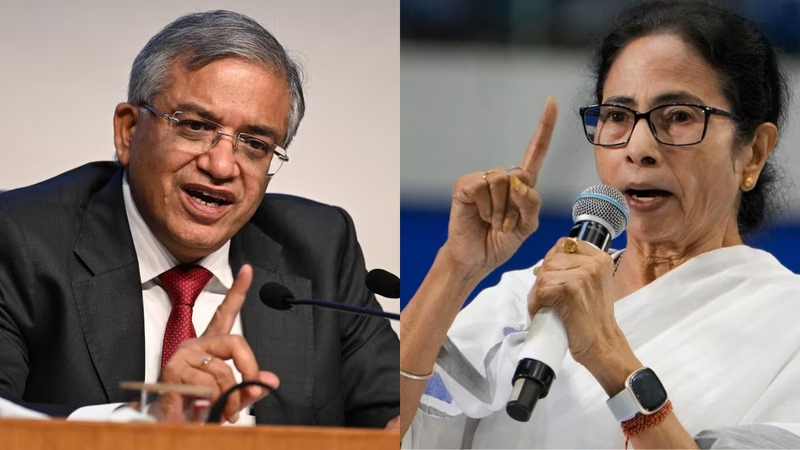
In a bold and uncompromising move, West Bengal Chief Minister Mamata Banerjee has sent a stern message to the Central Empowered Committee (CEC): fix the deep-rooted flaws in the Bengal SIR project—or scrap it entirely. In a strongly worded letter, Banerjee accused central authorities of pushing an “unplanned, top-down” industrial initiative that ignores ground realities, violates environmental norms, and disrespects the rights of local communities.
This escalating standoff over the Bengal SIR project isn’t just bureaucratic friction—it’s a high-stakes clash between state autonomy and central planning, with far-reaching implications for Bengal’s economy, ecology, and democratic process.
Table of Contents
- What Is the Bengal SIR Project?
- Mamata Banerjee’s Letter: Key Allegations
- Bengal SIR Project: Major Concerns Raised by CM
- Historical Context: Bengal’s Skepticism Toward Central Projects
- What Happens Next? The CEC’s Response
- Broader Implications for Industrial Policy in India
- Conclusion: A Test of Cooperative Federalism
- Sources
What Is the Bengal SIR Project?
The proposed Bengal SIR project—or Special Investment Region—is a mega-industrial corridor envisioned by the central government to attract large-scale private investments in manufacturing, logistics, and infrastructure. Modelled after similar zones in Gujarat and Tamil Nadu, the SIR aims to consolidate land parcels, fast-track clearances, and offer tax incentives to global investors.
However, unlike past models that involved extensive state-level buy-in, this iteration has been criticized for being imposed without adequate consultation with the West Bengal government or affected stakeholders.
Mamata Banerjee’s Letter: Key Allegations
In her official communication to the CEC, Banerjee outlined several critical issues:
- “Unplanned and arbitrary” zoning that overlaps with fertile agricultural land and ecologically sensitive zones.
- Lack of prior informed consent from local gram panchayats and landowners.
- Inadequate environmental impact assessments (EIAs) that fail to address groundwater depletion and air pollution risks.
- Contradiction with West Bengal’s own industrial policy, which prioritizes small and medium enterprises over mega-corporate land banks.
She concluded with a clear ultimatum: “Rectify the glitches, or the project must be stopped.”
Bengal SIR Project: Major Concerns Raised by CM
Banerjee’s objections go beyond procedural nitpicking—they strike at the heart of democratic governance and sustainable development.
Land Rights and Farmer Livelihoods
West Bengal has a painful history with forced land acquisition, most infamously during the Nandigram and Singur protests in the 2000s. Banerjee, who rose to power partly on the back of those agitations, is now determined to prevent a repeat. The proposed SIR reportedly targets over 10,000 acres across North and South 24 Parganas—areas rich in paddy fields and fisheries that sustain thousands of families.
Environmental Red Flags
Independent environmental experts warn that the SIR’s location near the Sundarbans buffer zone could accelerate salinity ingress and threaten fragile mangrove ecosystems. The project’s current EIA, critics say, is a “rubber-stamp exercise” lacking credible data .
Historical Context: Bengal’s Skepticism Toward Central Projects
This isn’t the first time West Bengal has pushed back against centrally driven industrial schemes. From the failed POSCO steel plant proposal to repeated clashes over the Teesta water-sharing agreement, the state has long championed a model of “development with dignity.”
Banerjee’s stance resonates with her political base and reflects a broader ideological stance: that states—not distant ministries—should decide their development trajectory. For more on this, see our analysis on [INTERNAL_LINK:west-bengal-industrial-policy-2025].
What Happens Next? The CEC’s Response
The CEC, a Supreme Court-mandated body that oversees environmental and forest-related clearances, now faces a political and legal dilemma. It can either:
- Revise the SIR proposal in consultation with the Bengal government;
- Defend the current plan and risk judicial and public backlash;
- Pause the project indefinitely pending further review.
Legal analysts suggest the CEC has limited authority to override state objections on land-use matters, especially when constitutional principles of federalism are invoked.
Broader Implications for Industrial Policy in India
The Bengal SIR project controversy is a microcosm of a national debate: how to balance rapid industrialization with democratic consent and ecological sustainability.
NITI Aayog’s push for “industrial corridors” must reckon with the fact that one-size-fits-all models rarely work in India’s diverse federal landscape . States like Kerala, Tamil Nadu, and Odisha have all asserted their right to tailor central initiatives to local needs—a trend that Banerjee’s letter reinforces.
Conclusion: A Test of Cooperative Federalism
Mamata Banerjee’s ultimatum on the Bengal SIR project is more than political posturing—it’s a principled stand for inclusive development. By demanding transparency, ecological caution, and community consent, she’s holding the center accountable to its own promises of sustainable and equitable growth.
If the CEC ignores her plea, it risks not just the failure of one project, but a deeper erosion of trust between New Delhi and India’s states. The ball is now in the CEC’s court: will it choose dialogue—or confrontation?
Sources
[12] Environmental concerns over proposed SIR near Sundarbans. Down To Earth.
[24] NITI Aayog’s Industrial Corridor Policy Framework. NITI Aayog Official Website
Times of India. (2026). ‘Rectify the glitches, or …’: CM Mamata writes to CEC; urges to stop ‘unplanned’ Bengal SIR. https://timesofindia.indiatimes.com/…
The Hindu. (2026). Mamata Banerjee opposes central SIR plan for Bengal. https://www.thehindu.com/…