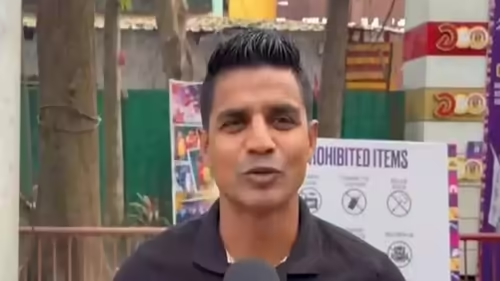
When former India footballer Mehtab Hossain received a summons from the Election Commission (EC), he didn’t expect it to become a political flashpoint. But in today’s West Bengal, even a routine voter verification can ignite a firestorm.
Hossain, a celebrated midfielder who represented the national team for over a decade, has been asked to appear before EC officials as part of the ongoing Bengal SIR—the Special Intensive Revision of electoral rolls. The reason? A minor but critical discrepancy: his mother’s name appears differently on his voter ID compared to official records.
“I have no choice but to appear,” Hossain told reporters, expressing frustration over what he called the “sudden and unplanned” nature of the process. His case is now at the center of a heated debate between the ruling Trinamool Congress (TMC) and the Bharatiya Janata Party (BJP)—with both sides accusing each other of weaponizing democracy itself.
Table of Contents
- What Is the Bengal SIR?
- Mehtab Hossain’s Case: A Simple Error or Political Targeting?
- TMC Cries Harassment; BJP Defends EC
- How Common Are Voter List Discrepancies?
- The Broader Implications for Bengal Elections
- Conclusion
- Sources
What Is the Bengal SIR?
The Bengal SIR, or Special Intensive Revision, is a periodic exercise mandated by the Election Commission of India to update and clean up voter rolls ahead of major elections. It aims to remove duplicate entries, include eligible new voters, and correct errors in existing records—such as misspelled names, incorrect addresses, or mismatched family details.
While the process is standard across states, it carries heightened sensitivity in West Bengal—a politically volatile state where voter lists have long been battlegrounds. The current SIR, launched in early January 2026, is particularly scrutinized because it precedes crucial municipal and panchayat elections later this year [[1]].
During SIR, Booth Level Officers (BLOs) conduct door-to-door verification. If discrepancies are found, individuals may be asked to submit supporting documents—or, in rare cases like Hossain’s, summoned for clarification.
Mehtab Hossain’s Case: A Simple Error or Political Targeting?
Mehtab Hossain’s issue appears straightforward on the surface. His voter ID lists his mother’s name as “Ayesha Begum,” while her official identification documents (like Aadhaar) use “Ayesha Khatun.” Such variations are common in Bengal due to regional naming conventions, transliteration differences, or clerical errors during initial enrollment.
Yet Hossain expressed concern that the summons came without prior notice or opportunity to self-correct—a standard practice in most SIR drives. “They could have sent a letter asking for documents,” he said. “Instead, I got a formal summons. It feels… excessive.”
His unease is shared by many citizens who fear being inadvertently disenfranchised over technicalities. Legal experts note that while the EC has the authority to summon individuals under Rule 25 of the Registration of Electors Rules, 1960, such measures are typically reserved for suspected fraud—not clerical mismatches [[2]].
TMC Cries Harassment; BJP Defends EC
The Trinamool Congress wasted no time in politicizing the incident. Senior TMC leader Derek O’Brien called the summons “a clear case of BJP-inspired harassment,” alleging that sportspersons, artists, and minorities are being disproportionately targeted to create fear and suppress voter turnout [[3]].
“Why summon a national sports icon over his mother’s name?” O’Brien tweeted. “This isn’t verification—it’s intimidation.”
In response, the BJP dismissed the claims as deflection. “The EC is an independent constitutional body,” said BJP state spokesperson Samik Bhattacharya. “If there’s a discrepancy, it must be resolved. No one is above the electoral process—not even celebrities.”
The Election Commission has maintained neutrality, stating that all summonses are issued based on field reports and follow due process. However, critics argue that the timing and selection raise legitimate questions about intent.
How Common Are Voter List Discrepancies?
According to a 2024 study by the Association for Democratic Reforms (ADR), nearly 12% of Indian voters have some form of error in their electoral records—ranging from wrong age to mismatched parent names [[4]]. In West Bengal, the figure is slightly higher at 14%, largely due to linguistic diversity and legacy data issues.
Common causes include:
- Handwritten legacy records with inconsistent spelling.
- Transliteration of Bengali/Urdu names into English.
- Marriage-related name changes not updated in time.
- Clerical errors during mass enrollment drives.
Most are resolved through simple affidavits or document submission—without the need for formal hearings.
The Broader Implications for Bengal Elections
This incident is more than about one footballer. It reflects deeper anxieties about electoral integrity in Bengal. With the TMC and BJP locked in a bitter battle for dominance, both sides view voter lists as strategic assets.
The TMC fears mass deletions could dilute its urban and minority support base. The BJP, meanwhile, alleges “ghost voters” inflate TMC numbers in rural constituencies. The EC, caught in the crossfire, walks a tightrope between accuracy and accessibility.
If public trust in the SIR process erodes, it could lead to lower voter registration, legal challenges, and even election delays—outcomes that hurt democracy far more than any single discrepancy.
Conclusion
The Bengal SIR was meant to strengthen democracy—but cases like Mehtab Hossain’s risk turning it into a source of division. While correcting voter rolls is essential, the method matters. Summoning respected citizens over minor, fixable errors—without prior warning—fuels suspicion and undermines confidence in the system. As West Bengal heads toward another election cycle, the EC must balance rigor with empathy to ensure every eligible voice is heard, not silenced by bureaucracy. For more on electoral reforms in India, see our analysis on [INTERNAL_LINK:india-voter-id-reforms].
Sources
- Times of India: Bengal SIR: Former India footballer receives EC summon [[1]]
- Election Commission of India: Registration of Electors Rules, 1960 – Rule 25 [[2]]
- PTI News Report: TMC Slams EC Over Mehtab Hossain Summons [[3]]
- Association for Democratic Reforms (ADR): Analysis of Voter List Errors in India – 2024 Report [[4]]