Table of Contents
- What is the Bengal SIR Chaos?
- Inside the EC Observer Car Attack
- What’s the SIR Process and Why Does it Matter?
- Political Tensions Fuel the Fire
- The EC’s Authority and Its Challenges
- What Happens Next for West Bengal?
- Summary
- Sources
What is the Bengal SIR Chaos?
The phrase Bengal SIR chaos isn’t just a headline; it’s a stark description of a democratic process under siege. In recent days, West Bengal has become the epicenter of a volatile political storm, with the crucial voter list revision exercise—known as the Special Intensive Revision (SIR)—being systematically disrupted. But this isn’t just bureaucratic gridlock. The chaos has turned physical, threatening the integrity of India’s electoral system in one of its most politically active states.
Inside the EC Observer Car Attack
The most alarming incident in this unfolding saga was the attack on the vehicle of C. Murugan, the Election Commission of India’s (ECI) Special Roll Observer for West Bengal. Murugan’s car was damaged after an agitating crowd gheraoed him during the SIR hearing phase . The protests were so intense that hearings at the Chinsurah-Mogra block office in Hooghly district were halted for a significant period .
Murugan, who is tasked with overseeing the SIR process to ensure its fairness, reported the incident directly to the Chief Electoral Officer of West Bengal . This brazen act of intimidation against a central election official is a direct challenge to the authority of the constitutional body responsible for India’s elections.
What’s the SIR Process and Why Does it Matter?
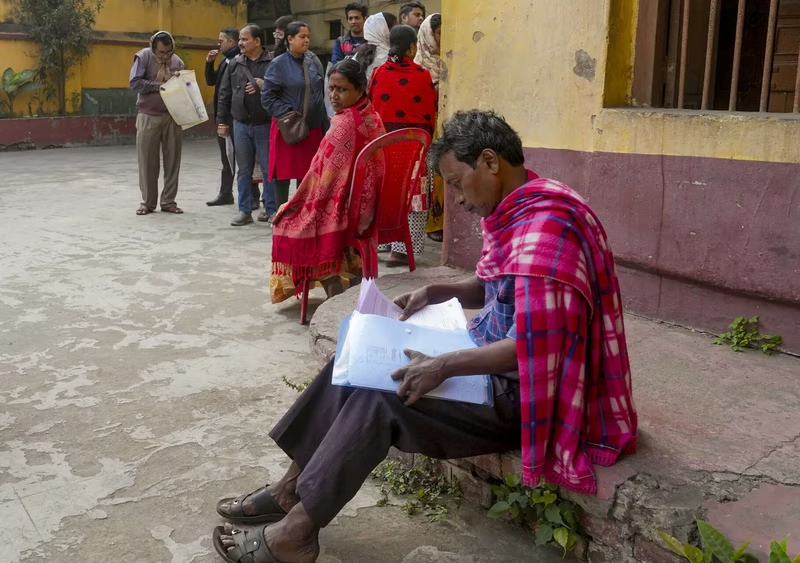
To understand the intensity of the conflict, you need to grasp the significance of the SIR process itself. The Special Intensive Revision is a critical exercise undertaken by the ECI to ensure that all eligible Indian citizens are included in the electoral rolls and that the rolls are free from errors and duplications . In West Bengal, this process began on November 4, 2025, and has been extended to February 14, 2026 .
The current phase involves personal hearings for electors who have been flagged for potential deletion from the rolls. This is a sensitive and vital step in maintaining an accurate and legitimate voter list, which is the very foundation of a free and fair election. Disrupting these hearings doesn’t just cause a delay; it actively undermines the credibility of the entire electoral process.
The Human Cost of the Chaos
The tension surrounding the SIR process has already claimed lives. Just weeks before these latest disruptions, Shantimoni Ekka, a Booth Level Officer (BLO) and anganwadi worker, died under distressing circumstances linked to the SIR exercise . This tragic event highlights the immense pressure and fear being generated at the grassroots level of this essential democratic work.
Political Tensions Fuel the Fire
The source of the Bengal SIR chaos is deeply political. The disruptions have been orchestrated by cadres and leaders of the ruling Trinamool Congress (TMC). Protests erupted at multiple centers, including Chinsurah and Midnapore, with TMC leaders arguing that the ECI’s decision to bar Booth-Level Agents (BLAs) from the hearings was an overreach [[1], [3]].
A TMC delegation, led by MP Partha Bhowmik and state Industry Minister Sashi Panja, even met with the state’s Chief Electoral Officer, Manoj Agarwal, to lodge their protest . Their core argument, as stated by a party leader, was that “West Bengal is not the zamindari of the Election Commission” . This rhetoric frames the ECI’s constitutional duty as an external imposition, a narrative that has clearly mobilized their base to take to the streets.
The EC’s Authority and Its Challenges
The Election Commission of India is no ordinary government department. It is a powerful, autonomous constitutional authority established under Article 324 of the Indian Constitution, entrusted with the superintendence, control, and direction of all elections in the country [[18], [27]].
Its role is to act as an impartial referee. The ECI appoints Special Roll Observers, like C. Murugan, specifically to oversee sensitive processes like the SIR in major states to guarantee a level playing field . However, the recent events in Bengal demonstrate a significant challenge: when a powerful state government openly defies and intimidates its officials, the EC’s ability to enforce its authority is severely tested. The attack on the observer’s car is a direct, physical manifestation of this political challenge.
What Happens Next for West Bengal?
The immediate consequence has been a temporary suspension of personal hearings for voters flagged for deletion in the affected areas . This is a necessary safety measure but a damaging one for the electoral process.
Looking ahead, the situation is precarious. The ECI now faces a critical decision: how to reassert its authority without escalating the conflict further. Options could include seeking central police support, issuing formal show-cause notices to the TMC, or even pursuing legal action. The party’s stance on the SIR has now become a major flashpoint in the state’s political landscape, and this West Bengal SIR hearings disrupted crisis is likely to be a central issue in the build-up to the next general elections. For voters, this chaos creates uncertainty about their own status on the electoral rolls and erodes trust in the system designed to protect their democratic right.
Summary
The Bengal SIR chaos represents a dangerous escalation in the political battle over electoral integrity in West Bengal. The attack on an EC observer’s vehicle and the widespread disruption of voter hearings are not just local disturbances; they are a direct assault on a core democratic institution. The ruling TMC’s justification for these actions has created a volatile standoff with the Election Commission, whose constitutional mandate is now in the crosshairs. The resolution of this crisis will be a defining moment for democracy not just in Bengal, but for the entire nation.
Sources
- Times of India: SIR hearings disrupted in WB, EC observer’s car attacked
- PTI News Report on SIR Hearing Disruptions
- Election Commission of India: Official Website on Electoral Rolls and SIR [[17], [25]]
- The Hindu: West Bengal Reels After Election Officer Deaths Amid SIR Chaos