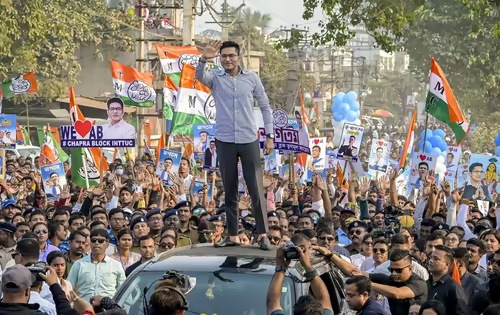
In a high-stakes political maneuver just before the West Bengal assembly elections, Trinamool Congress (TMC) national general secretary Abhishek Banerjee has launched a scathing attack on Prime Minister Narendra Modi. His central accusation? That the Prime Minister and his BJP-led central government are deliberately blocking Bengal funds, thereby inflicting severe economic and social miseries on the state’s populace .
This explosive claim has ignited a fierce war of words between the ruling party at the Centre and the dominant regional force in West Bengal, setting the stage for a contentious electoral battle. The allegation that the Bengal funds blocked by Modi is not just a political talking point but a serious charge that strikes at the heart of federal-state relations and public welfare.
Table of Contents
- The Core Allegation: A Starved State?
- Understanding the Context of the ‘Bengal Funds Blocked by Modi’ Claim
- The BJP’s Counter-Narrative: Who’s Really Blocking What?
- The Political Strategy Behind the Accusations
- What This Means for the People of West Bengal
- Summary: A Battle of Narratives with Real-World Consequences
- Sources
The Core Allegation: A Starved State?
Speaking at a rally in Kolkata, Abhishek Banerjee laid the blame for the state’s alleged financial distress squarely at the feet of the Prime Minister. He claimed that essential central funds, which are meant to support critical infrastructure, healthcare, and welfare schemes, have been systematically withheld from West Bengal .
“You blocked Bengal’s funds,” Banerjee directly accused PM Modi, framing the issue as a politically motivated act of punishment against a state governed by a rival party . This narrative is designed to resonate with voters who may be experiencing delays or gaps in public services, suggesting that their suffering is a direct result of Delhi’s vendetta against the TMC government.
Understanding the Context of the ‘Bengal Funds Blocked by Modi’ Claim
The claim that Bengal funds blocked by Modi is a complex one, often rooted in the intricate dynamics of India’s fiscal federalism. Central funds can be allocated through various channels, including centrally sponsored schemes (CSS), statutory transfers from the Finance Commission, and special assistance packages.
Disputes often arise over the implementation of these schemes. For instance, the central government might release funds for a scheme like Ayushman Bharat, but if the state government does not sign a Memorandum of Understanding (MoU) or fails to provide its share of the funding, the scheme cannot be rolled out. The TMC has previously cited concerns over federal autonomy and administrative control as reasons for not implementing certain central schemes in their entirety .
The BJP’s Counter-Narrative: Who’s Really Blocking What?
Unsurprisingly, the BJP has fired back with a counter-accusation of its own. Prime Minister Modi himself has repeatedly claimed that it is the Mamata Banerjee-led TMC government that is blocking central welfare schemes, thereby depriving the poor of West Bengal of their rightful benefits .
At a rally in Singur, PM Modi alleged that despite the Centre rolling out multiple welfare initiatives for the underprivileged, the people of Bengal were being kept in the dark because of the state government’s refusal to cooperate . The BJP points to schemes like Ayushman Bharat, where they claim the TMC has prevented its full implementation, thus shielding its own governance failures by blaming the Centre .
This creates a classic political standoff:
- TMC’s Stance: The Centre is withholding funds as a political tool to destabilize a non-BJP state.
- BJP’s Stance: The TMC is refusing to implement central schemes to maintain its own political control and avoid sharing credit with the Centre.
The Political Strategy Behind the Accusations
With the West Bengal assembly elections on the horizon, both parties are engaged in a fierce battle for the voter’s mind. Abhishek Banerjee’s accusation serves a clear strategic purpose: to position the TMC as the victim of an unfair and vindictive central government, thereby rallying its core support base and appealing to voters who feel neglected .
By framing the issue as “Delhi vs. Bengal,” the TMC aims to stoke regional pride and consolidate anti-BJP sentiment. This is a well-worn tactic in Indian politics, where state parties often leverage perceived slights from the Centre to galvanize local support. For more on this dynamic, see our analysis on [INTERNAL_LINK:state-vs-centre-politics-in-india].
What This Means for the People of West Bengal
Beyond the political rhetoric, the real question is the impact on ordinary citizens. When a political tug-of-war ensues over public funds, it is often the most vulnerable who suffer the most. Delays in the implementation of health, education, and rural development schemes can have tangible, negative consequences on people’s lives.
A transparent and accountable system for tracking fund flows is crucial. Independent bodies like the Comptroller and Auditor General of India (CAG) play a vital role in auditing these expenditures and providing clarity on where the bottlenecks truly lie. Until such independent verification is widely understood by the public, the competing narratives will continue to dominate the political discourse.
Summary: A Battle of Narratives with Real-World Consequences
The controversy over whether Bengal funds blocked by Modi is a prime example of how financial disputes between the Centre and states become potent political weapons during election season. While Abhishek Banerjee’s accusations are aimed at painting the BJP as an enemy of Bengal’s progress, the BJP counters by accusing the TMC of sacrificing its people’s welfare for political gain. For the voters of West Bengal, cutting through this noise to understand the factual ground reality will be key to making an informed choice at the ballot box.