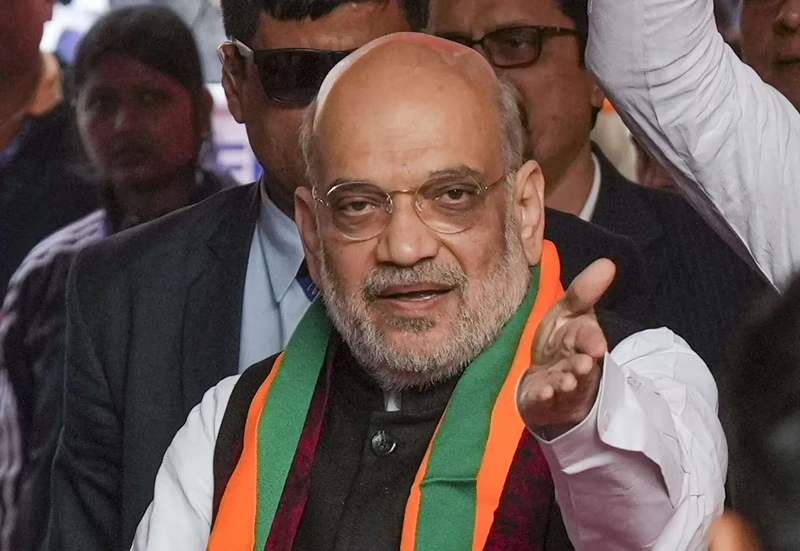
“We must win 22 out of 28 seats in and around Kolkata.”
That’s not a whisper—it’s a war cry. Union Home Minister Amit Shah, addressing BJP cadres in West Bengal, didn’t just announce an election target for the 2026 assembly polls. He laid out a battle plan that could reshape the state’s political landscape—or expose the party’s fragility in the face of entrenched opposition.
For years, the BJP has portrayed itself as Bengal’s rising alternative to Mamata Banerjee’s Trinamool Congress (TMC). But despite massive rallies, national backing, and a fierce 2021 campaign, it won only 77 seats—far short of a majority, and with minimal penetration in the capital region. Now, Shah is doubling down, focusing laser-sharp on Kolkata and its urban periphery, where the real battle for Bengal’s soul may be decided.
So what does this Bengal BJP 2026 strategy really entail? And can a party still seen by many as “outsiders” crack the cultural code of Kolkata’s complex electorate?
Table of Contents
- Amit Shah’s 22-of-28 Target: What It Really Means
- The 4-Pillar Strategy Behind Bengal BJP 2026
- The Controversial “Changing Demography” Narrative
- Can BJP Really Win in Kolkata? Voter Sentiment Analysis
- How TMC and Left Are Responding
- What This Means for the 2026 Bengal Assembly Elections
- Conclusion: High Stakes, Higher Risks
- Sources
Amit Shah’s 22-of-28 Target: What It Really Means
The 28 seats “in and around Kolkata” likely include the entire Kolkata Municipal Corporation area (16 seats) plus key urban and semi-urban constituencies in North and South 24 Parganas—such as Baranagar, Dum Dum, Ballygunge, Behala, and Diamond Harbour.
Winning 22 of these would be nothing short of a political earthquake. In 2021, the BJP won just three seats in this entire belt: Bhabanipur (which they later lost in a bypoll), Baranagar, and parts of North 24 Parganas. To jump from 3 to 22 in five years isn’t just ambitious—it demands a complete realignment of voter loyalty.
The 4-Pillar Strategy Behind Bengal BJP 2026
Shah’s confidence isn’t baseless. The BJP appears to be building its Bengal BJP 2026 campaign on four strategic pillars:
- Hyper-local leadership: Promoting Bengali-speaking, grassroots leaders like Sukanta Majumdar and Sayantan Basu over national firebrands.
- Welfare nationalism: Linking central schemes (PM Awas, Ujjwala) directly to BJP identity, bypassing TMC’s state-level delivery.
- Urban youth outreach: Leveraging social media, job anxieties, and anti-corruption sentiment among educated city voters.
- Community consolidation: Strengthening ties with Matua, Rajbanshi, and other SC/ST communities through targeted promises and symbolic gestures.
For more on BJP’s regional strategies, see [INTERNAL_LINK:bjp-state-election-playbooks].
The Controversial “Changing Demography” Narrative
Shah didn’t just talk about seats—he raised alarms about “infiltration” and a “changing demography” in the Kolkata region. This rhetoric, while familiar to BJP’s national base, is deeply polarizing in Bengal, where questions of identity, migration, and citizenship have long fueled tension.
Critics argue this narrative risks alienating moderate voters and reviving fears of divisive politics. Yet, for BJP’s core supporters, it reinforces a perceived threat to cultural and economic security—a potent mobilizing tool.
According to the Pew Research Center, identity-based appeals can significantly boost turnout among a party’s base, even if they don’t win over swing voters . Whether this pays off in Bengal’s diverse urban mosaic remains to be seen.
Can BJP Really Win in Kolkata? Voter Sentiment Analysis
Kolkata’s voters are notoriously independent-minded. They’ve rejected both Congress dominance and Left orthodoxy in the past. But they also value cultural rootedness—a space where Mamata Banerjee has long positioned herself as the authentic Bengali voice.
Recent surveys suggest a nuanced picture:
- BJP leads among urban youth (18–35) concerned about jobs and governance.
- TMC dominates among women and lower-income groups reliant on state welfare schemes.
- The Left-Congress alliance is nearly irrelevant in Kolkata, clearing the field for a direct BJP-TMC face-off.
The real battleground? Middle-class neighborhoods in South and Central Kolkata, where civic issues—water, transport, safety—could swing undecided voters.
How TMC and Left Are Responding
Mamata Banerjee hasn’t stayed quiet. Her party has launched “Didi’s Kitchen” and “Swasthya Sathi” expansions to shore up its pro-poor image. More crucially, she’s framing the BJP as “outsiders”—Delhi-based, Hindi-speaking, and culturally alien.
Meanwhile, the Left is trying to rebuild its student and trade union wings, hoping to claw back relevance. But without a credible third force, Bengal’s 2026 election is shaping up as a straight fight—and Shah knows it.
What This Means for the 2026 Bengal Assembly Elections
If BJP wins even 15 of the 28 Kolkata-area seats, it would signal a massive urban shift and put TMC on the defensive statewide. But failure to break double digits could demoralize cadres and fuel internal dissent.
Importantly, Kolkata’s outcome will influence national perception. A strong showing here validates BJP’s claim of being a pan-India force—even in “Mamata’s Bengal.” A flop could expose the limits of its Hindutva-plus-welfare model in culturally distinct regions.
Conclusion: High Stakes, Higher Risks
Amit Shah’s Bengal BJP 2026 target isn’t just about seats—it’s about symbolism. Capturing Kolkata would mean capturing the cultural capital of Eastern India, a prize far beyond electoral math. But in a city that prizes poetry over propaganda and nuance over noise, the BJP’s challenge is as much cultural as it is political. The 2026 election won’t just decide who rules Bengal—it will reveal whether a national party can truly become local.
Sources
[1] Pew Research Center: Identity and Political Behavior in Democracies (2025)
[2] Times of India: ‘Want 22 of 28 seats from Kolkata, nearby areas’: Amit Shah sets target for Bengal BJP
[3] Election Commission of India: West Bengal Assembly Election 2021 Results
[4] Centre for Studies in Developing Societies (CSDS): State of the States: Bengal Voter Survey 2025