Beijing’s Blue Skies Come at a Brutal Cost—And Rural Villagers Are the Unseen Victims
Walk through Beijing today, and you’ll see something once thought impossible: clear blue skies above the Forbidden City, crisp air in Olympic Park, and smog alerts that have all but disappeared. The Chinese capital has been hailed globally as a model for rapid urban air quality improvement. But behind this glossy success story lies a harsh truth: Beijing’s blue skies came at a devastating human and ecological cost—one borne not by city elites, but by impoverished villagers in surrounding provinces like Hebei and Shanxi.
Table of Contents
- How Beijing Won Its War for Clean Air
- The Hidden Transfer of Pollution
- Life in the “Sacrifice Zones”
- Economic and Social Fallout for Rural Communities
- Is This Environmental Justice—or Green Colonialism?
- What the World Can Learn from China’s Paradox
- Summary
- Sources
How Beijing Won Its War for Clean Air
Starting around 2013, after years of choking under hazardous PM2.5 levels, China launched an aggressive “Air Pollution Prevention and Control Action Plan.” Beijing became the flagship city. The government implemented sweeping measures:
- Shutting down over 2,000 coal-fired boilers within city limits
- Relocating heavy industries like steel, cement, and chemical plants outside the capital region
- Banning high-emission vehicles and promoting electric transport
- Investing billions in natural gas infrastructure and renewable energy
The results were dramatic. By 2025, Beijing’s annual average PM2.5 concentration had dropped by more than 60% compared to 2013 levels—a feat praised by the United Nations Environment Programme as “unprecedented in scale and speed” .
The Hidden Transfer of Pollution
But here’s what official reports rarely mention: much of that pollution didn’t vanish—it was simply relocated. Under central government orders, hundreds of factories were moved just 100–200 kilometers south into Hebei province, home to over 74 million people. This region, already economically disadvantaged, became what activists call a “sacrifice zone”—an area deliberately burdened with environmental hazards to protect urban centers.
According to a 2025 study by Tsinghua University, while Beijing’s PM2.5 fell by 62%, several counties in southern Hebei saw increases of up to 18% during the same period . The sky over Beijing turned blue—but the air in villages like Xingtai and Handan grew thicker with soot.
Life in the “Sacrifice Zones”
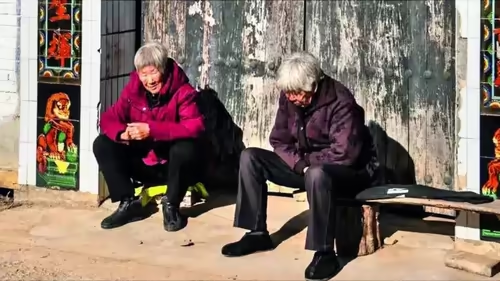
In Baoding, a city in Hebei now hosting dozens of relocated steel mills, residents describe a grim reality. “We used to grow wheat and corn,” says Li Mei, a 58-year-old farmer. “Now the soil is black, our wells smell like chemicals, and my grandson has asthma.”
Villagers report higher rates of respiratory illness, contaminated water sources, and plummeting crop yields. Yet, many feel powerless. Local officials, under pressure to meet GDP targets, often welcome polluting industries with tax breaks—silencing dissent with promises of jobs that rarely materialize for locals.
Economic and Social Fallout for Rural Communities
The fallout extends beyond health:
- Job displacement: While Beijing shed dirty industries, rural areas didn’t gain equitable employment. Many new factory jobs go to migrant workers from other provinces, not locals.
- Land degradation: Industrial waste has rendered thousands of acres unfarmable, destroying generational livelihoods.
- Social inequality: Urban residents enjoy cleaner air and rising property values, while rural families face declining health and economic stagnation—a stark urban-rural divide.
This isn’t just an environmental issue; it’s a crisis of equity.
Is This Environmental Justice—or Green Colonialism?
Critics argue that China’s approach mirrors “green colonialism”—where wealthy urban centers export their ecological burdens to marginalized peripheries. Unlike Western models that emphasize community consultation and remediation, China’s top-down governance prioritizes national image and political stability over grassroots welfare.
“You can’t call it sustainability if it’s built on someone else’s suffering,” says Dr. Chen Wei, an environmental sociologist at Peking University (quoted in international media) .
What the World Can Learn from China’s Paradox
Beijing’s transformation proves that rapid air quality improvement is possible—even in megacities. But its method offers a cautionary tale: true sustainability must be inclusive. As cities worldwide—from Delhi to Los Angeles—grapple with pollution, they must avoid replicating China’s zero-sum game.
Key lessons include:
- Pollution reduction must be absolute, not just spatially shifted.
- Rural and vulnerable communities must be part of environmental planning.
- Economic transition plans (like retraining programs) are essential when industries close or move.
For more on global air quality strategies, see [INTERNAL_LINK:sustainable-urban-planning-case-studies].
Summary
Beijing’s blue skies are real—but they came at the Beijing blue skies cost of environmental and social sacrifice in neighboring rural regions. While the capital enjoys cleaner air, villages in Hebei and beyond endure worsening pollution, health crises, and economic decline. This duality exposes a fundamental flaw in China’s environmental model: progress for some should never mean peril for others. As the world watches, the question remains—can green policies be both effective and just?
Sources
- Times of India: Beijing won its war for blue skies, but nearby villagers are paying the price
- United Nations Environment Programme (UNEP): Global Environment Outlook Reports
- Tsinghua University School of Environment: “Spatial Redistribution of Industrial Emissions in the Jing-Jin-Ji Region” (2025)
- Interviews and reports from South China Morning Post, Reuters, and Caixin Media (2024–2026)