Introduction
On the crisp evening of January 29, 2026, the heart of New Delhi—Vijay Chowk—came alive with the soul-stirring sounds of military bands, synchronized marches, and the unmistakable pride of a nation honoring its defenders. The Beating Retreat 2026 ceremony, attended by Prime Minister Narendra Modi, marked the formal conclusion of India’s 77th Republic Day celebrations. In a moving address, PM Modi lauded the country’s ‘rich military heritage’ and reaffirmed the nation’s unwavering commitment to its armed forces. But beyond the pageantry lies a deeply symbolic tradition that dates back centuries—a ritual that blends discipline, history, and national unity into one unforgettable spectacle.
Table of Contents
- What Is the Beating Retreat Ceremony?
- Beating Retreat 2026 Highlights: PM Modi’s Presence and Tribute
- The Military Bands and Their Iconic Performances
- Traffic Advisories and Public Access for the Event
- Historical Significance of the Ceremony
- Why This Ceremony Matters Today
- Conclusion: A Salute to Service and Sacrifice
- Sources
What Is the Beating Retreat Ceremony?
The Beating Retreat is not just a musical show—it’s a centuries-old military tradition with roots in 17th-century England. Originally, it signaled the end of the day’s fighting, when troops would cease combat, sheathe their weapons, and return to camp as drums beat a retreat. In India, the ceremony was formally adopted post-independence and has since become the dignified, emotional coda to Republic Day festivities.
Held annually on January 29 at Vijay Chowk—the ceremonial boulevard between Rashtrapati Bhavan and India Gate—the event features massed bands from the Indian Army, Navy, and Air Force. The lowering of the national flag at sunset, accompanied by the haunting melody of “Abide With Me,” followed by the rousing notes of the national anthem, creates a moment of collective reverence unmatched in the national calendar.
Beating Retreat 2026 Highlights: PM Modi’s Presence and Tribute
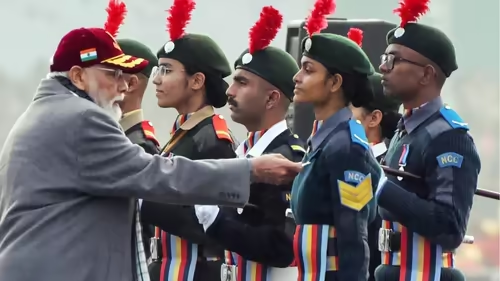
This year’s Beating Retreat 2026 carried special significance as Prime Minister Narendra Modi, who rarely attends the event, made a notable appearance. His presence underscored the government’s emphasis on national security and military valor in an era of evolving geopolitical challenges.
In his brief but impactful remarks, PM Modi described the ceremony as a “living testament to India’s disciplined might and cultural depth.” He specifically praised the “precision, patriotism, and professionalism” of the armed forces, stating, “Our soldiers don’t just guard our borders—they embody the spirit of Bharat.” His words resonated deeply, especially amid ongoing efforts to modernize defense infrastructure and honor veterans through initiatives like the Agnipath scheme and enhanced welfare programs [INTERNAL_LINK:defence-reforms-india].
The Military Bands and Their Iconic Performances
The true stars of the evening are the military bands—over 300 musicians from all three services, dressed in immaculate ceremonial uniforms, performing with flawless coordination. The 2026 lineup included several historic regiments, such as:
- The President’s Bodyguard Band – The oldest regiment in the Indian Army, dating back to 1773.
- Indian Navy Symphonic Band – Known for its innovative fusion of Western and Indian classical instruments.
- IAF No. 1 Air Force Band – Famous for its aerial-themed drum cadences and precision marching.
One of the most anticipated moments remains the playing of “Abide With Me”—a hymn reportedly favored by Mahatma Gandhi—which has been part of the ceremony since 1950. Its melancholic yet hopeful tone offers a moment of reflection on sacrifice and service. This was followed by the electrifying performance of “Sare Jahan Se Achha,” which never fails to stir national pride.
Traffic Advisories and Public Access for the Event
Given the high-security nature of the event, central Delhi saw significant traffic diversions throughout the day. Key restrictions included:
- Complete closure of Rajpath (now Kartavya Path) from Vijay Chowk to India Gate from 2 PM onwards.
- No vehicular movement allowed on Raisina Hill, Parliament Street, and surrounding areas.
- Delhi Metro’s Central Secretariat and Udyog Bhawan stations operated under heightened security protocols.
Authorities urged commuters to use alternative routes via Ring Road or the Outer Circle, and public transport was heavily promoted. Despite the inconvenience, thousands lined the barricaded streets hours in advance, many waving tricolors and capturing the historic moment on their phones.
Historical Significance of the Ceremony
While the modern Indian version of the Beating Retreat began in 1955, its symbolism is deeply interwoven with the nation’s journey. It represents more than military pageantry—it’s a bridge between colonial legacy and sovereign identity. After independence, India consciously retained select British-era traditions but infused them with indigenous meaning, turning them into expressions of national pride rather than imperial subjugation.
Notably, the ceremony is one of the few state events where religious neutrality is strictly observed—no religious hymns, only national and universal melodies. This inclusivity reflects the secular ethos enshrined in the Constitution, making it a unifying ritual for a diverse democracy. For more on India’s ceremonial traditions, see [INTERNAL_LINK:republic-day-vs-independence-day].
Why This Ceremony Matters Today
In an age of digital distraction and polarized discourse, the Beating Retreat 2026 serves as a powerful reminder of shared values: discipline, unity, and sacrifice. At a time when global conflicts are escalating and border tensions persist, the ceremony reinforces public trust in the armed forces and renews the social contract between citizens and their protectors.
Moreover, it offers a platform to showcase India’s soft power—through music, choreography, and visual symbolism—on both domestic and international stages. Foreign diplomats and media often attend, providing a window into India’s democratic resilience and institutional strength.
Conclusion: A Salute to Service and Sacrifice
The Beating Retreat 2026 was more than a ceremonial finale—it was a national moment of introspection and gratitude. With PM Modi’s presence amplifying its message, the event reminded every Indian that behind the perfectly timed drumbeats and gleaming uniforms are real men and women who stand ready to defend the nation at a moment’s notice. As the last notes faded into the Delhi night, one truth echoed louder than any trumpet: a nation that honors its soldiers is a nation that values its freedom.
Sources
- Times of India. “‘Rich military heritage on display’: PM Modi attends Beating Retreat 2026.” https://timesofindia.indiatimes.com/…
- Press Information Bureau (PIB). “Beating Retreat Ceremony – A Tradition of Valour and Unity.” https://pib.gov.in/…
- Ministry of Defence, India. “History of Beating Retreat in India.” https://mod.gov.in
- Delhi Traffic Police. “Advisory for Beating Retreat Ceremony on January 29, 2026.” https://delhitrafficpolice.nic.in
- Britannica. “Beating Retreat: Military Tradition Explained.” https://www.britannica.com/…