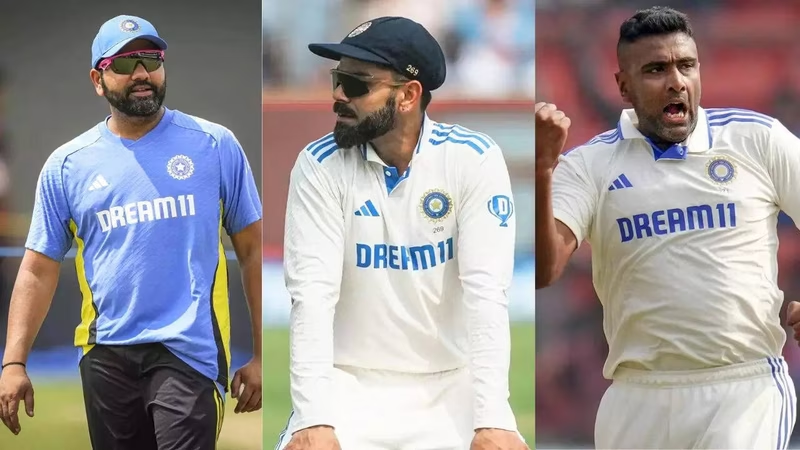
Imagine this: packed stadiums, emotional tributes, a nation holding its breath as its greatest warriors walk out to bat or bowl for the very last time in whites. For fans of James Anderson and Stuart Broad, this was a reality—a carefully orchestrated, deeply moving farewell that honored decades of service to English cricket.
Now, picture the silence surrounding three of India’s all-time greats: Virat Kohli, Rohit Sharma, and Ravichandran Ashwin. No official announcement. No designated farewell series. Just murmurs, speculation, and a lingering sense that something’s missing. That’s the heart of the controversy ignited by former England spinner Monty Panesar, who recently slammed the BCCI for its apparent indifference toward organizing proper BCCI farewell Tests for these legends .
With their international careers clearly in the twilight, the question isn’t just about cricket—it’s about respect, legacy, and how a cricket-crazy nation chooses to honor its heroes.
Table of Contents
- Monty Panesar’s Stinging Critique
- Why BCCI Farewell Tests Matter
- The English Blueprint: A Masterclass in Respect
- What Fans and Experts Are Saying
- The Case for Each Legend’s Farewell
- Conclusion: It’s Not Too Late
- Sources
Monty Panesar’s Stinging Critique
In a candid and widely shared statement, Monty Panesar didn’t hold back. “Virat Kohli, Rohit Sharma, and R Ashwin have given so much to Indian cricket—they absolutely deserved that respect,” he declared . He went on to contrast India’s quiet exit strategy with England’s approach, where Broad and Anderson were given meticulously planned final Test matches that became national events.
Panesar’s point is simple yet powerful: these players aren’t just athletes; they’re cultural icons who have defined an era of Indian cricket. To let their Test careers fizzle out without a formal, celebratory send-off feels like a missed opportunity—not just for them, but for the millions of fans who’ve cheered them on for over a decade.
Why BCCI Farewell Tests Matter
Afarewell Test is more than just a game. It’s a ceremonial bridge between generations. It allows fans to say a proper goodbye, to show their gratitude in person, and to create a collective memory that cements a player’s legacy. For the players themselves, it offers closure—a chance to walk off the field to a standing ovation, knowing their contribution has been formally acknowledged by the very board they served.
From a commercial standpoint, these matches are also massive. A farewell series for Kohli or Ashwin would sell out stadiums across India and generate significant broadcast revenue. It’s a win-win that the BCCI, as a savvy sporting organization, should be eager to capitalize on.
The English Blueprint: A Masterclass in Respect
England’s handling of their legendary pace duo was textbook perfect. Stuart Broad’s final Test at The Oval in 2023 was a theatrical masterpiece—he took a wicket with his very last ball. James Anderson’s farewell, though slightly less dramatic, was equally dignified, with tributes from across the cricketing world .
Both events were officially designated as farewells, giving fans time to prepare, travel, and participate in the celebration. The ECB understood that honoring its legends wasn’t just a nice gesture—it was a core part of its duty as a custodian of the sport’s history.
What Fans and Experts Are Saying
Panesar’s comments have struck a massive chord on social media. Fans are flooding platforms with #FarewellForTheFab3, sharing memories and calling on the BCCI to act. Many are pointing out that even Sachin Tendulkar was given a grand farewell in 2013—a three-Test series that culminated in a tearful speech at the Wankhede.
Former Indian players have also weighed in. While some understand the BCCI’s desire to avoid sentimentality in team selection, others agree that a designated farewell match, perhaps even outside the World Test Championship cycle, would be a fitting tribute.
The Case for Each Legend’s Farewell
Let’s be clear: each of these three legends has a compelling, unique case for a farewell.
- Virat Kohli: Over 8,800 Test runs, 29 centuries, and one of the most intense competitors the game has ever seen. His leadership transformed India’s overseas record.
- Rohit Sharma: The “Hitman” has seamlessly transitioned from a T20 specialist to a rock-solid Test opener, with four double-centuries to his name—the most by any Indian.
- Ravichandran Ashwin: With over 500 Test wickets and 32 five-wicket hauls, he’s not just India’s premier spinner but one of the greatest all-rounders in Test history.
To deny any of them a final, formal goodbye on home soil would be a genuine disservice.
Conclusion: It’s Not Too Late
The criticism over the lack of BCCI farewell Tests isn’t just about nostalgia—it’s about institutional respect. The BCCI still has time to get this right. Whether it’s a one-off Test at Eden Gardens for Ashwin, a final Wankhede appearance for Kohli, or a Chepauk curtain call for Rohit, the opportunity exists. Indian cricket owes it to its legends and its fans to ensure their final walks are as memorable as their greatest innings. For more on the legacy of Indian Test cricket, read our deep dive on [INTERNAL_LINK:indian_test_cricket_history].
Sources
- Monty Panesar’s comments on BCCI and Indian legends:
- Details on England’s farewell matches for Broad and Anderson:
- ICC’s official player statistics for Kohli, Sharma, and Ashwin: https://www.icc-cricket.com/rankings/mens/player-rankings/test