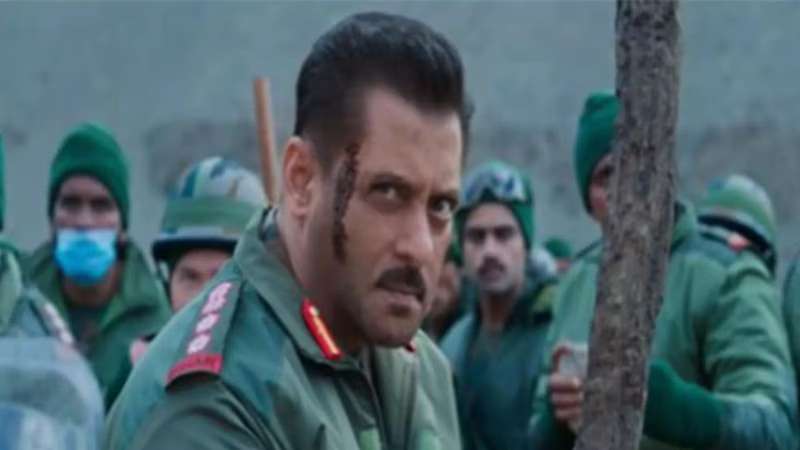
A new Bollywood film has ignited more than just box office buzz—it’s sparked a diplomatic flashpoint. Salman Khan’s upcoming war drama, Battle of Galwan, has drawn fierce criticism from Chinese state media, with Beijing accusing the movie of “distorting facts” about the deadly June 2020 Galwan Valley confrontation between Indian and Chinese troops.
The Global Times, a nationalist mouthpiece under China’s state-run media, called the film “over-the-top” and “politically provocative,” claiming it misrepresents the People’s Liberation Army (PLA) and glorifies India’s military narrative. The controversy comes at a time when India-China border talks remain tense, making this cinematic portrayal far more than just entertainment—it’s become a lens through which national pride, memory, and geopolitics collide.
So, what’s in the film? Why is China so upset? And how does this reflect the broader state of India-China relations? Let’s unpack the real story behind the Battle of Galwan storm.
Table of Contents
- What Is ‘Battle of Galwan’ About?
- China’s Fury Over ‘Battle of Galwan’
- The Real Galwan Valley Clash: What Happened in 2020?
- Bollywood and Patriotic War Films: A Growing Trend
- Geopolitical Implications of the Film
- Summary
- Sources
What Is ‘Battle of Galwan’ About?
Directed by debutant director Laxman Utekar (not to be confused with the Luka Chuppi director of the same name—this is a different filmmaker), Battle of Galwan is a dramatized retelling of the June 15, 2020, clash in eastern Ladakh’s Galwan Valley. The film stars Salman Khan as an Indian Army officer leading his troops in a fierce, hand-to-hand combat scenario against Chinese soldiers.
Early trailers depict intense combat sequences, emotional tributes to fallen soldiers, and a strong nationalist tone—hallmarks of India’s recent wave of patriotic cinema like Uri: The Surgical Strike and Shershaah. The movie reportedly draws from eyewitness accounts and media reports, though it is not officially endorsed by the Indian Ministry of Defence.
China’s Fury Over ‘Battle of Galwan’
On December 29, 2025, China’s Global Times published a scathing piece titled “Indian film distorts truth about Galwan clash, provokes anti-China sentiment.” The article accused the film of fabricating events to depict the PLA as “aggressors” and India as “defenders of sovereignty.”
“This over-the-top movie not only distorts historical facts but also seeks to inflame public opinion against China,” the outlet stated. “The PLA resolutely safeguards China’s territorial integrity and will not be intimidated by cinematic propaganda.”
Notably, China has never officially acknowledged any casualties on its side during the Galwan clash—a point of contention that the film appears to challenge by showing Chinese soldiers engaging in combat.
Key Chinese Objections:
- “Factual Distortion”: Claims the film misrepresents who initiated the violence.
- “Nationalist Propaganda”: Alleges the movie is designed to stoke anti-China sentiment in India.
- “Military Mischaracterization”: Objects to the portrayal of PLA soldiers as undisciplined or aggressive.
The Real Galwan Valley Clash: What Happened in 2020?
On the night of June 15, 2020, a violent face-off occurred along the Line of Actual Control (LAC) in Galwan Valley—marking the deadliest military clash between India and China in over 45 years. Indian sources confirmed 20 fatalities
The clash erupted during a de-escalation meeting, when Indian troops discovered Chinese forces had erected structures in a contested area. What followed was a brutal melee involving stones, iron rods, and wooden clubs—no firearms were used, per a 1996 agreement. Independent analysts, including from the International Crisis Group, confirm that both sides bear responsibility for the escalation, though India maintains it was responding to Chinese transgressions. Battle of Galwan is part of a larger cinematic shift in India, where real-life military operations are being turned into high-octane dramas. This genre resonates deeply with audiences, blending entertainment with national pride. However, these films often walk a fine line between tribute and sensationalism. While Uri had partial military collaboration, Battle of Galwan appears to be a private production—raising questions about historical accuracy versus dramatic license. In the current climate—where India and China have held 20+ rounds of military talks with limited progress—the release of Battle of Galwan couldn’t be more sensitive. The film may galvanize domestic support in India, but it risks further straining bilateral relations already damaged by trade restrictions, visa bans, and border standoffs. Experts warn that cinematic narratives can shape public perception, especially among younger audiences who may not recall the 2020 events firsthand. As one Delhi-based foreign policy analyst noted, “When films become historical records for the masses, accuracy matters—not just patriotism.” Salman Khan’s Battle of Galwan has become a lightning rod for India-China tensions, with Beijing accusing the film of distorting facts about the 2020 border clash. While the movie aims to honor fallen Indian soldiers, its dramatized portrayal has drawn sharp criticism from Chinese state media, which sees it as anti-China propaganda. As the film’s release approaches, it stands as a potent symbol of how cinema, memory, and geopolitics are increasingly intertwined in South Asia. Whether it will be seen as a tribute or a provocation may depend on which side of the Himalayas you’re watching from.Bollywood and Patriotic War Films: A Growing Trend
Geopolitical Implications of the Film
Summary
Sources