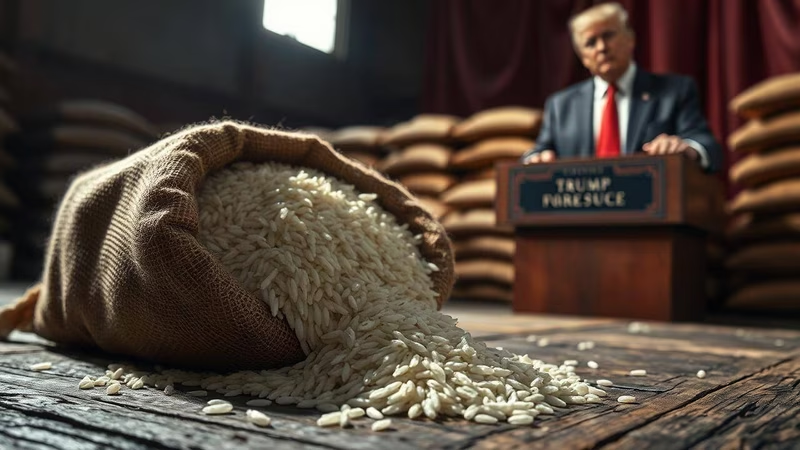
For generations, India’s aromatic Basmati rice has been a symbol of culinary excellence and a vital source of income for millions of farmers. But today, this golden grain is caught in a geopolitical vise. On one side, violent unrest in Iran—the destination for nearly a quarter of India’s Basmati rice exports—has brought trade to a standstill, causing a sharp drop in domestic prices . On the other, the specter of a 25% tariff from a potential second Trump administration in the US threatens to slam shut another crucial market . This isn’t just a trade hiccup; it’s a full-blown crisis for one of India’s most important agricultural sectors.
Table of Contents
- The Iran Crisis: A Key Market Paralyzed
- Trump’s Tariff Threat: The US Market at Risk
- Double Whammy: Impact on Farmers and Exporters
- India’s Basmati Rice Export Landscape: A Deep Dive
- What Can Be Done? Strategies for Resilience
- Conclusion: Navigating an Uncertain Future
- Sources
The Iran Crisis: A Key Market Paralyzed
Iran has long been the single largest importer of Indian Basmati rice, accounting for roughly 22-24% of total exports . The relationship is built on decades of trade and cultural affinity for the long-grain variety. However, the recent surge in civil unrest and political instability has created an immediate and severe logistical nightmare.
Exporters report that banks in Iran have halted transactions, making it impossible to receive payments. Shipping lines are refusing to dock at Iranian ports due to security concerns. The result? A wave of order cancellations and indefinite delays. With a major chunk of their market suddenly inaccessible, Indian exporters have been forced to offload their surplus stock in the domestic market, leading to a dramatic price crash of up to 15% in some regions . For farmers who had already harvested their crop based on expected export demand, this is a direct hit to their livelihoods.
Trump’s Tariff Threat: The US Market at Risk
Just as the industry grapples with the Iran fallout, a new and potentially more damaging threat has emerged from across the Atlantic. During his 2024 presidential campaign, Donald Trump floated the idea of imposing a blanket 25% tariff on all imports from countries he deems to have unfair trade practices, which could include India .
The United States is the second-largest market for Indian Basmati rice exports, valued at over $300 million annually . A 25% tariff would make Indian Basmati significantly more expensive than its competitors, primarily from Pakistan, which already enjoys a competitive price advantage. This could lead to a massive loss of market share in the US, a blow from which the industry might struggle to recover.
[INTERNAL_LINK:india-us-trade-relations-history] While the proposal is still just that—a proposal—it has created immense uncertainty among exporters who are now hesitant to sign long-term contracts.
Double Whammy: Impact on Farmers and Exporters
The combined effect of these two external shocks is creating a perfect storm:
- Price Collapse:** The domestic price of premium Basmati (1121 variety) has reportedly fallen from around ₹5,800 per quintal to below ₹5,000, eroding farmer profits .
- Cash Flow Crunch:** Exporters are stuck with unsold inventory and mounting storage costs, straining their working capital.
- Future Planting Decisions:** Faced with such volatility, farmers may be discouraged from planting Basmati next season, opting for less risky but lower-value crops, which could impact India’s global supply chain dominance in the long run.
India’s Basmati Rice Exports Landscape: A Deep Dive
To understand the gravity of the situation, it’s important to grasp the scale of the industry. India commands over 65% of the global Basmati market, with annual exports worth approximately $4.3 billion . The primary growing regions are in the states of Punjab, Haryana, and Western Uttar Pradesh. This sector supports not just millions of farmers, but also a vast network of millers, traders, logistics providers, and packaging units.
The industry’s success has been built on a delicate balance of quality, price, and reliable supply chains. The current disruptions in Iran and the potential policy shift in the US directly attack this balance, threatening the entire ecosystem.
What Can Be Done? Strategies for Resilience
In the face of such external pressures, a multi-pronged strategy is essential:
- Diversify Markets:** The government and industry bodies must aggressively explore new markets in Africa, Southeast Asia, and Latin America to reduce dependence on any single region.
- Strengthen Geographical Indication (GI):** Leverage India’s GI tag for Basmati to build a premium brand that can command higher prices and differentiate itself from Pakistani rice.
- Policy Support:** The government could consider temporary buffer stock purchases or export subsidies to stabilize domestic prices in the short term.
- Diplomatic Engagement:** Proactive diplomatic channels should be used to address trade concerns with both the US and Iran to find stable solutions.
Conclusion: Navigating an Uncertain Future
The current crisis facing India’s Basmati rice exports is a stark reminder of how vulnerable global agricultural trade is to geopolitical events and protectionist policies. While the immediate pain is being felt by farmers in Punjab and Haryana, the long-term implications could reshape India’s position in the global food market. The path forward requires not just reactive measures, but a strategic, long-term vision to build a more resilient and diversified export model for this iconic Indian product.