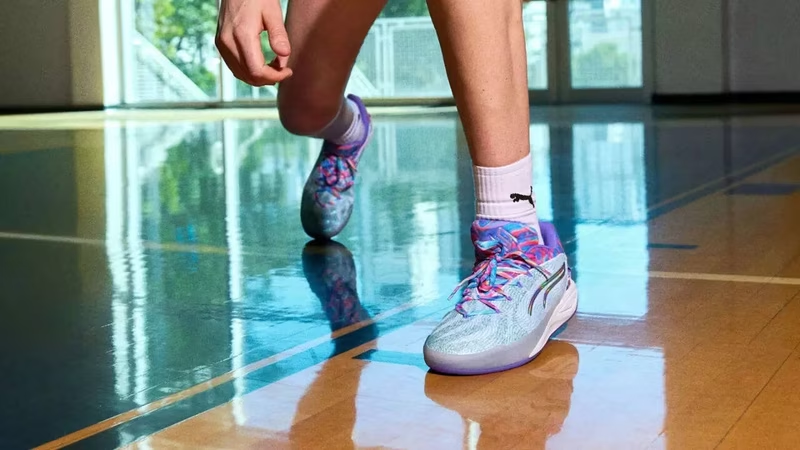
Imagine walking into your office—barefoot. No socks, no slippers, just your feet on the floor. Sounds unconventional? In a growing number of U.S. tech startups, it’s not just allowed—it’s encouraged. Companies like Cursor and Replo are telling employees: “Leave your shoes behind.”
This isn’t a hygiene experiment or a wellness gimmick. It’s a visible symbol of a deeper shift in how work is being reimagined in the post-pandemic, AI-driven era. Dubbed part of the “pajama economy,” this barefoot at work trend reflects a culture that prioritizes comfort, focus, and flow over traditional corporate formalities. But while it’s thriving in niche tech circles, mainstream adoption faces cultural, generational, and even biological hurdles.
Table of Contents
- The Rise of the Barefoot Office
- Why Startups Are Going Shoeless
- The Pajama Economy and China’s 996 Influence
- Challenges to Mainstream Adoption
- What This Says About the Future of Work
- Summary: Comfort or Chaos?
- Sources
The Rise of the Barefoot Office
The movement started quietly. At Cursor, an AI-powered code editor startup, founders noticed engineers were already working barefoot during late-night coding sessions. Instead of enforcing a dress code, they leaned in—installing soft rugs, temperature-controlled floors, and even foot-washing stations in some co-working spaces .
Replo, a no-code design platform, took it further: their San Francisco office now has a “shoe check” at the entrance—voluntary, but widely adopted. According to CEO Charlie Smith, “When you’re barefoot, you’re physically grounded. It reduces stress and improves focus during deep work” .
This isn’t about being quirky. It’s about optimizing the environment for what these companies value most: uninterrupted, high-output cognitive labor.
Why Startups Are Going Shoeless
Three key drivers are fueling the barefoot at work trend:
- Deep Work Optimization: Neuroscience suggests that sensory comfort—like the feeling of bare feet on a soft surface—can lower cortisol levels and enhance concentration . For coders in flow state, every distraction matters.
- Blurring Home and Office Boundaries: In hybrid or co-living workspaces (like those operated by startups such as Sandbox or Outsite), home-like norms naturally extend to the office.
- Cultural Signaling: Ditching shoes becomes a badge of belonging—a shared ritual that reinforces team identity in flat, mission-driven organizations.
As one Cursor engineer put it: “If I’m debugging for 12 hours straight, the last thing I need is tight shoes. My brain works better when my body isn’t fighting discomfort.”
The Pajama Economy and China’s 996 Influence
While the “pajama economy” term originally described remote work in loungewear, it’s evolving. Now, it encompasses a broader philosophy: work should adapt to the human body, not the other way around.
Interestingly, this trend has subtle roots in China’s infamous “996” work culture (9 a.m. to 9 p.m., 6 days a week). Chinese tech workers, exhausted by long hours, began prioritizing micro-comforts—slippers, eye masks, foot massagers—to endure grueling schedules . U.S. startups, facing similar pressure to ship AI features at breakneck speed, are importing these coping mechanisms—but framing them as productivity hacks, not survival tactics.
For a global perspective on evolving work cultures, the World Economic Forum’s Future of Jobs Report highlights how comfort-centric work environments are rising in knowledge economies .
Challenges to Mainstream Adoption
Despite its appeal in tech bubbles, the barefoot at work movement faces real-world friction:
- Social Taboos: In many Western cultures, feet are considered private or unhygienic. A 2024 YouGov survey found 68% of Americans over 45 find bare feet in shared spaces “unprofessional” .
- Age Divide: Younger Gen Z and millennial workers embrace it; older professionals often see it as infantilizing or sloppy.
- Health & Safety Concerns: Offices must maintain OSHA-compliant flooring, and bare feet can pose risks in labs or hardware startups.
- Cultural Misalignment: What works in a 20-person AI startup in Austin may not fly in a Fortune 500 legal or finance department.
As a result, the trend remains largely confined to agile, digitally native companies where culture is built from the ground up—not inherited from legacy norms.
What This Says About the Future of Work
Bare feet are just the surface. The real story is about who controls the work environment. In traditional offices, employees conform to space. In these new models, space conforms to employees.
This reflects a larger shift: as AI handles more routine tasks, human value is increasingly tied to creativity, focus, and emotional resilience. Companies that remove friction—even something as simple as shoes—are betting that comfort equals cognitive advantage.
That said, this isn’t a one-size-fits-all future. For more on how workplace norms are fragmenting, see our deep dive on [INTERNAL_LINK:evolving-hybrid-workplace-etiquette].
Summary: Comfort or Chaos?
The barefoot at work movement is more than a quirky trend—it’s a window into the extreme optimization of knowledge work. While it may never grace corporate boardrooms, it signals a powerful truth: in the race for talent and focus, even the smallest comforts are becoming strategic assets. Whether you love it or find it odd, one thing’s clear—the future of work won’t be wearing dress shoes.
Sources
- Times of India: ‘Leave your shoes behind’: US tech startups’ message to employees
- TechCrunch: How Cursor is Redefining Developer Workspaces
- Harvard Business Review: The Neuroscience of Comfort and Focus
- South China Morning Post: China’s 996 Culture and the Rise of Micro-Comforts
- World Economic Forum: The Future of Jobs Report 2025
- YouGov Survey (Jan 2026): Attitudes Toward Bare Feet in U.S. Workplaces