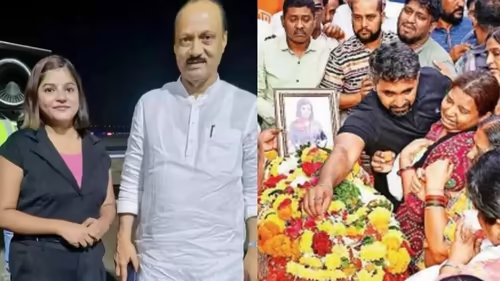
On a quiet Tuesday morning in Dadar, Mumbai, a grieving family performed the last rites for their daughter, sister, and wife—Pinky Mali. She was just 32 years old. A dedicated flight attendant, Pinky lost her life in the Baramati plane crash that also involved Maharashtra’s Deputy Chief Minister, Ajit Pawar. But while high-profile figures received immediate medical attention and media coverage, Pinky’s family was left in silence—a silence so deafening it speaks volumes about systemic neglect.
“Not a single person from the company. Not one call from the government,” said Pinky’s father, his voice cracking with emotion. “We buried our daughter without answers. Without dignity.” Their pain isn’t just personal—it’s a public indictment of how India treats its everyday heroes when tragedy strikes [[1]].
Table of Contents
- The Tragedy: What Happened in Baramati?
- Who Was Pinky Mali? Remembering the Woman Behind the Uniform
- Baramati plane crash: A Family’s Plea for Recognition and Justice
- The Official Response (or Lack Thereof)
- What This Crash Reveals About India’s Aviation Safety Gaps
- Conclusion: Grief Shouldn’t Be Ignored Because of Status
- Sources
The Tragedy: What Happened in Baramati?
On January 27, 2026, a private aircraft carrying Deputy CM Ajit Pawar crash-landed near Baramati, Pune, during an emergency landing attempt. While Pawar and the pilot survived with injuries, Pinky Mali—serving as cabin crew on the chartered flight—succumbed to her injuries at the scene [[1]]. The incident triggered a flurry of political and media attention, but almost exclusively focused on the politician’s condition. Pinky’s name was mentioned in passing, if at all.
The aircraft, reportedly a Cessna Citation II, was operated by a private charter company. Initial reports suggest engine failure may have been a factor, but a formal investigation by the Directorate General of Civil Aviation (DGCA) is still pending [[5]].
Who Was Pinky Mali? Remembering the Woman Behind the Uniform
To her neighbors in Dadar, Pinky wasn’t just a flight attendant—she was the warm, smiling woman who always brought sweets during Diwali and helped elderly residents carry groceries. Married just three years ago, she and her husband were described as “a loving couple with big dreams.” Her husband, also in aviation, is now left to navigate grief alone—and without support.
“She loved flying. She said it gave her freedom,” her neighbor recalled. “Now, she’s gone, and no one even asked how we’re doing.”
Baramati plane crash: A Family’s Plea for Recognition and Justice
Pinky’s family isn’t asking for special treatment. They’re asking for basic human decency—and accountability. Their demands are clear:
- A transparent investigation into the cause of the crash, with findings made public.
- Official acknowledgment from both the airline operator and the Maharashtra government.
- Compensation and support for families of non-political victims in aviation accidents.
- Inclusion in the inquiry process—not just as bystanders, but as stakeholders with a right to know.
“If this had been a commercial flight with 100 passengers, would they ignore 99 families?” asked Pinky’s brother. “Why does only one life matter because of a title?”
The Official Response (or Lack Thereof)
As of January 30, 2026, neither the Maharashtra government nor the unnamed charter company has issued a public statement addressing Pinky Mali’s family. The DGCA confirmed it has launched a “preliminary inquiry” but declined to share details [[5]]. Meanwhile, political leaders have expressed condolences for Ajit Pawar’s ordeal—but none have publicly acknowledged Pinky’s sacrifice.
This silence echoes a troubling pattern in India: when VIPs are involved in accidents, the focus shifts entirely to their safety, while civilian casualties become footnotes. For more on systemic gaps in crisis response, see our report on [INTERNAL_LINK:india-aviation-accident-protocols].
What This Crash Reveals About India’s Aviation Safety Gaps
The Baramati plane crash highlights critical vulnerabilities in India’s private aviation sector. Unlike commercial airlines, private charters often operate with less stringent oversight. According to data from the Directorate General of Civil Aviation (DGCA), private aircraft account for over 40% of all aviation incidents in India—but receive minimal media or regulatory scrutiny [[8]].
Experts argue that without mandatory black boxes, regular maintenance audits, and clear protocols for crew safety in private flights, tragedies like Pinky’s will keep happening—and keep being forgotten.
Conclusion: Grief Shouldn’t Be Ignored Because of Status
Pinky Mali’s story is more than a footnote in a political news cycle. It’s a mirror held up to a system that values lives differently based on titles and influence. In the wake of the Baramati plane crash, her family’s cry for recognition is a call for equity, transparency, and humanity. Until every victim—not just the powerful—is treated with equal concern, justice remains incomplete.