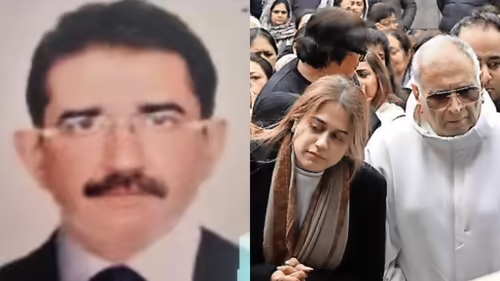
The skies lost one of their finest on January 28, 2026, when veteran pilot **Capt. Sumit Kapur**—universally known by his nickname “Bunny”—perished in the **Baramati crash**, a tragic charter aircraft accident in Maharashtra’s Pune district. The news sent shockwaves through India’s aviation fraternity, not just because of the loss of a skilled aviator, but because it took someone whose warmth, humility, and professionalism touched everyone he met.
At just 48 years old, Kapur had already logged over **20,000 flight hours**, served as a **Boeing 737 Type Rating Examiner**, and trained generations of commercial pilots. Yet to those who knew him, his greatest legacy wasn’t measured in airtime—it was in the kindness he showed on the ground, the patience he extended to trainees, and the joy he brought to his family. As tributes pour in, a portrait emerges of a man who soared professionally while staying deeply rooted in humanity.
Table of Contents
- Who Was Capt. Sumit Kapur? The Man Behind ‘Bunny’
- The Baramati Crash: What We Know So Far
- A Legacy in Indian Aviation: Examiner, Mentor, Leader
- Tributes from the Aviation Community
- Aviation Safety Concerns After the Baramati Crash
- Conclusion: Remembering a Life Well Flown
- Sources
Who Was Capt. Sumit Kapur? The Man Behind ‘Bunny’
Born and raised in Delhi, Sumit Kapur earned his wings early, joining flying school straight after college. His peers quickly nicknamed him “Bunny” for his gentle demeanor and ever-present smile—a moniker that stuck throughout his career, even among senior airline executives.
Colleagues describe him as the rare blend of technical brilliance and emotional intelligence. “He could spot a micro-error in your landing flare from the jump seat,” recalled a former cadet, “but he’d correct you with a joke, not a reprimand.”
Off-duty, Kapur was a devoted husband and father of two. He loved photography, often capturing sunsets from 35,000 feet, and was an avid reader of historical biographies. Friends say he believed flying wasn’t just a job—it was a responsibility to thousands of passengers who trusted their lives to his hands every day.
The Baramati Crash: What We Know So Far
The **Baramati crash** occurred during a private charter flight from Delhi to Pune. The aircraft—a Cessna Citation II—was carrying four people, including Kapur, who was reportedly traveling for a family event. Shortly after initiating its descent into Pune, the plane crashed near Baramati, killing all on board instantly.
Preliminary reports from the Directorate General of Civil Aviation (DGCA) suggest possible spatial disorientation due to poor visibility in hazy conditions, though a full investigation is underway. The aircraft was registered to a private operator and had passed its last maintenance check in December 2025.
This incident has reignited debates about oversight of non-scheduled operators (NSOPs) in India—a sector that has grown rapidly but faces scrutiny over training standards and operational protocols.
A Legacy in Indian Aviation: Examiner, Mentor, Leader
Capt. Kapur’s impact extended far beyond his own logbook. As a **Boeing 737 Type Rating Examiner**, he was authorized by the DGCA to certify other pilots’ competency on one of the world’s most widely used commercial jets. In this role, he shaped safety culture across multiple airlines.
Key contributions include:
- Training over 500 first officers and captains since 2010
- Developing simulator scenarios for emergency handling at major Indian carriers
- Volunteering with the Federation of Indian Airlines (FIA) on fatigue management guidelines
His approach emphasized “human factors”—the psychological and physiological elements that affect performance. “Flying is 20% skill, 80% mindset,” he often told students. That philosophy saved countless lives indirectly through the pilots he certified.
For authoritative insights into pilot training standards, the International Civil Aviation Organization (ICAO) provides global frameworks that inform national regulations like India’s.
Tributes from the Aviation Community
Within hours of the news breaking, social media flooded with condolences. Airline CEOs, junior pilots, and even cabin crew shared stories of Kapur’s generosity.
“He once stayed back three hours after a check ride to help a nervous cadet understand crosswind landings,” wrote a fellow examiner. “That’s the kind of man he was.”
IndiGo Airlines, where Kapur served as a senior trainer, called him “the gold standard of professionalism.” The Airline Operators Association of India (AOAI) announced it would establish a memorial scholarship in his name for aspiring pilots from underprivileged backgrounds.
Aviation Safety Concerns After the Baramati Crash
While the investigation continues, the **Baramati crash** has spotlighted systemic issues:
- Oversight gaps: NSOPs operate with less regulatory scrutiny than scheduled airlines.
- Weather decision-making: Haze and low visibility remain persistent challenges in North India.
- Aging fleet: Some private jets in India are over 30 years old, raising maintenance concerns.
Experts urge the DGCA to mandate enhanced terrain awareness systems and stricter recency requirements for private charter pilots. For deeper analysis, see our [INTERNAL_LINK:india-aviation-safety-reforms] report.
Conclusion: Remembering a Life Well Flown
Capt. Sumit “Bunny” Kapur’s death is a profound loss—not just for his family, but for an entire ecosystem that relied on his expertise and humanity. In an industry often defined by technology and procedure, he reminded everyone that at its heart, aviation is about people. As the investigation into the **Baramati crash** unfolds, his legacy must inspire not just grief, but action—to make the skies safer for every soul who dares to fly.
Sources
- Times of India: From Boeing 737 examiner to ‘Bunny’: The life of Baramati crash victim Capt. Sumit Kapur
- The Hindu: Baramati plane crash: Pilot Sumit Kapur remembered as mentor and friend
- DGCA India: Directorate General of Civil Aviation – Official Updates
- ICAO: International Civil Aviation Organization – Safety Standards