Bengaluru stands at a crossroads—and this Friday could decide its green fate.
A Supreme Court-appointed expert committee is visiting Bannerghatta National Park to assess the fallout of a highly contentious government order: the drastic reduction of its **eco-sensitive zone (ESZ)** from 268.9 square kilometers to just 168.8 square kilometers . That’s a loss of nearly 37%—an area larger than 14,000 football fields—sliced away from critical wildlife buffer in one stroke.
Environmentalists are calling it “Bengaluru’s Aravalli moment,” drawing parallels to the ecological battle over the Aravalli Range in Haryana and Rajasthan, where unchecked construction and mining have devastated ancient ecosystems . The fear? That Karnataka’s move isn’t about conservation—it’s about clearing the path for real estate and granite mining interests, with little regard for the city’s already gasping green cover.
Table of Contents
- What Happened: The Controversial ESZ Reduction
- Why Bannerghatta Matters: Bengaluru’s Green Lifeline
- The Aravalli Parallel: Lessons from a Destroyed Range
- Who Benefits? The Real Estate and Mining Angles
- The SC Panel’s Role and What to Expect Friday
- Public Outcry and Legal Battle
- Conclusion: Can Bengaluru Avoid an Ecological Point of No Return?
- Sources
What Happened: The Controversial ESZ Reduction
In late 2025, the Karnataka state government, acting on a proposal from the Ministry of Environment, Forest and Climate Change (MoEFCC), officially notified a shrunken **Bannerghatta eco-sensitive zone**. The revised boundary excludes dozens of villages and tracts that were previously protected from industrial activity, large-scale construction, and mining .
The justification? Streamlining development and resolving “land use conflicts.” But critics say the real motive is far more commercial. The excised areas include lands adjacent to major highways and near proposed infrastructure corridors—prime real estate in a city where land prices are soaring.
Why Bannerghatta Matters: Bengaluru’s Green Lifeline
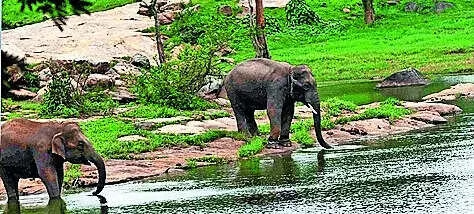
Bannerghatta isn’t just a park—it’s a lifeline. Spanning over 25,000 hectares, it’s home to tigers, leopards, elephants, and over 100 bird species. More crucially, it acts as a critical ecological buffer for Bengaluru, helping regulate microclimate, recharge groundwater, and absorb air pollution from India’s tech capital .
Consider these facts:
- Bengaluru has lost **over 70% of its tree cover** since 2000 due to urban sprawl .
- The city’s groundwater levels are depleting at an alarming rate—protected forests like Bannerghatta are vital recharge zones.
- Human-wildlife conflict has increased as urban boundaries creep closer to the park; a smaller ESZ will only worsen this.
Shrinking the ESZ doesn’t just hurt wildlife—it directly threatens the city’s livability.
The Aravalli Parallel: Lessons from a Destroyed Range
The comparison to the Aravalli Range isn’t hyperbole. Once a 670-million-year-old shield against desertification, large parts of the Aravallis have been flattened for luxury housing, golf courses, and illegal mining—all enabled by repeated dilutions of its protected status .
Now, activists warn Bengaluru could follow the same path. “When you reduce an ESZ, you don’t just move a line on a map—you invite concrete,” says Dr. Meena Venkataraghavan, an urban ecologist and founder of the Bengaluru Environment Trust. “The Aravallis taught us that once the green barrier falls, there’s no going back.”
Who Benefits? The Real Estate and Mining Angles
Documents accessed by environmental groups show that several of the excluded zones overlap with land parcels identified by the Karnataka Industrial Areas Development Board (KIADB) for “strategic development” . Additionally, the region is rich in granite, and mining leases are pending in areas now outside the new ESZ boundary.
While the government denies any corporate influence, the timing is suspicious. Major real estate lobbies had previously petitioned for “rationalization” of green norms around Bengaluru, citing “urban growth needs” .
This raises a fundamental question: Is Bengaluru prioritizing short-term profits over long-term sustainability?
The SC Panel’s Role and What to Expect Friday
The panel—comprising experts from the Indian Institute of Science (IISc) and the Wildlife Institute of India (WII)—was formed after a public interest litigation (PIL) challenged the ESZ reduction. Their mandate is to:
- Physically inspect the excluded areas.
- Assess ecological sensitivity using satellite and ground data.
- Evaluate potential impacts on wildlife corridors and groundwater.
- Submit a confidential report to the Supreme Court within 15 days .
Their findings could lead to an interim stay on development in the contested zones—or, conversely, validate the state’s decision. All eyes are on their on-ground assessment this Friday.
Public Outcry and Legal Battle
Citizen groups, including #SaveBannerghatta and the Karnataka Wildlife Conservation Society, have mobilized thousands in protests. Online petitions have gathered over 150,000 signatures. Meanwhile, the legal fight intensifies, with petitioners arguing the reduction violates the Wildlife (Protection) Act, 1972, and the Supreme Court’s own 2022 judgment mandating a **minimum 1-km ESZ around all protected areas** .
For deeper context on environmental jurisprudence in India, see our analysis on [INTERNAL_LINK:india-environmental-laws-sc-rulings].
Conclusion: Can Bengaluru Avoid an Ecological Point of No Return?
The fate of the **Bannerghatta eco-sensitive zone** is more than a local issue—it’s a test of India’s commitment to balancing development with ecological integrity. Bengaluru, once known as the “Garden City,” is now a cautionary tale of unplanned urbanization. If the Supreme Court panel finds merit in the activists’ claims, it could not only restore the ESZ but also set a national precedent against the dilution of environmental safeguards for commercial gain. The city’s green future hangs in the balance.
Sources
- Times of India. (2026, January 2). Aravalli-like row in Bengaluru: SC panel to visit on Friday. Retrieved from https://timesofindia.indiatimes.com/india/aravalli-like-row-in-bengaluru-sc-panel-visit-today/articleshow/126295956.cms
- Down To Earth. (2023). The Fall of the Aravallis: A Timeline of Destruction. Retrieved from https://www.downtoearth.org.in
- Ministry of Environment, Forest and Climate Change (MoEFCC). (2025). Notification: Eco-Sensitive Zone around Bannerghatta National Park.
- Indian Institute of Science (IISc). (2021). Urban Growth and Tree Cover Loss in Bengaluru.
- Supreme Court of India. (2022). Order in Writ Petition (Civil) No. 838 of 2021.
- Karnataka Wildlife Conservation Society. (2025). Impact Assessment of ESZ Reduction Proposal.