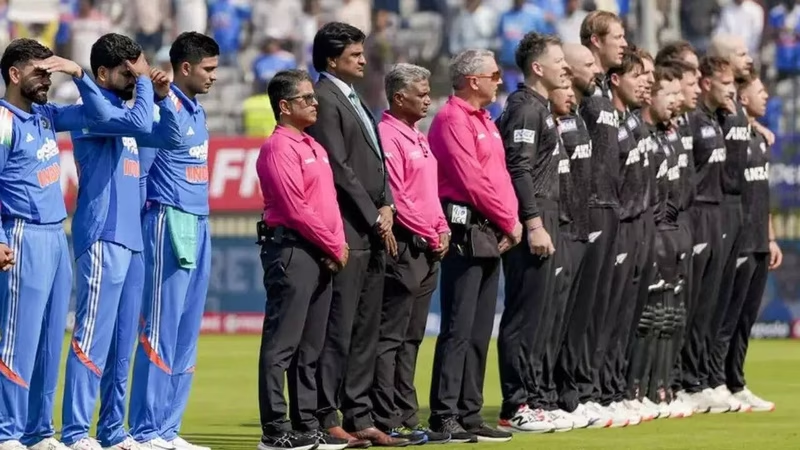
Who Is the Bangladeshi Umpire in the India vs New Zealand ODI?
The first ODI between India and New Zealand in January 2026 wasn’t just a contest on the field—it also put a spotlight on the match officials, particularly the Bangladeshi umpire in the third umpire’s chair. His name is Sharfuddoula Ibne Shahid Saikat, and his appointment has sparked curiosity among fans wondering about his background and the rules that led to his selection. This isn’t just a trivia question; it’s a window into the structured, neutral world of international cricket officiating.
Table of Contents
- The Man Behind the Mic: Who is Sharfuddoula Saikat?
- Why a Bangladeshi Umpire for an IND vs NZ Game?
- Decoding the ICC Rules: Clause 2.1.4 and 2.1.5 Explained
- A Historic Career for Bangladesh Cricket
- Conclusion: More Than Just a Name
- Sources
The Man Behind the Mic: Who is Sharfuddoula Saikat?
Sharfuddoula Ibne Shahid Saikat, often known simply as Sharfuddoula, is a trailblazer for Bangladesh in the world of international cricket officiating. Born in Dhaka, he has steadily climbed the ranks to become one of the most respected officials from his nation . His journey is a testament to dedication, having officiated in a remarkable 32 Test matches and 118 ODIs at the international level .
In a historic move for Bangladesh cricket, Sharfuddoula became the first official from his country to be named to the prestigious Emirates ICC Elite Panel of Umpires in March 2024 . This elite panel is the highest tier of international umpires, reserved for those who consistently demonstrate exceptional skill and judgment. His assignment as the TV umpire (or third umpire) for the high-profile India vs New Zealand ODI in Vadodara is a direct result of this elite status .
Bangladeshi umpire: Why Him for an IND vs NZ Clash?
For fans new to the intricacies of international cricket, seeing a Bangladeshi umpire officiate a match between India and New Zealand might seem unusual. However, it’s not just normal—it’s mandated by the sport’s governing body. The International Cricket Council (ICC) has strict neutrality protocols to ensure fair play and impartiality in all its sanctioned matches.
The core principle is simple: no umpire should have a national allegiance to either of the two competing teams. This eliminates any potential for perceived or real bias, which is crucial in a sport as passionate and closely followed as cricket. Since the match was between India and New Zealand, officials from both these nations are excluded from being the ICC-appointed neutral umpire. This opens the door for qualified officials from other Full Member nations like Bangladesh, England, South Africa, and others.
Decoding the ICC Rules: Clause 2.1.4 and 2.1.5 Explained
The specific framework for appointing umpires in One Day Internationals is laid out in the ICC’s official playing conditions. Two key clauses govern the process:
- Clause 2.1.4: “The ICC shall appoint one umpire to stand in each ODI match. Such umpire shall not be from the same country as the participating teams” . This is the rule that mandates a neutral, third-country official. In the IND vs NZ game, this role was filled by England’s Richard Illingworth as one of the on-field umpires, while Sharfuddoula, as a member of the ICC’s international panel, served as the neutral TV umpire .
- Clause 2.1.5: “The Home Board shall appoint one umpire to stand in each ODI” . This allows the host nation—in this case, the BCCI (India)—to select one of its own qualified officials. For this match, the BCCI appointed K.N. Ananthapadmanabhan as the second on-field umpire .
This two-pronged system ensures a balance between global standards of neutrality and local expertise. It’s a system designed to build trust in the integrity of the game at the highest level [INTERNAL_LINK:icc-playing-conditions-explained].
A Historic Career for Bangladesh Cricket
Sharfuddoula’s presence in Vadodara is more than just a personal achievement; it’s a significant milestone for Bangladesh cricket. For a nation that gained Test status only in 2000, having an umpire on the ICC Elite Panel is a powerful symbol of its growing stature and contribution to the global game. He is set to become the first Bangladeshi umpire to officiate in a Cricket World Cup, further cementing his legacy . His journey from local matches in Dhaka to the international stage serves as an inspiration for aspiring officials across the subcontinent.
Conclusion: More Than Just a Name
So, the next time you see a Bangladeshi umpire like Sharfuddoula Saikat in the third umpire’s box during a major series, remember it’s not a random choice. It’s the result of years of hard work by the official, combined with a robust ICC framework designed to protect the spirit of the game. His role is a quiet but essential part of ensuring that contests like India vs New Zealand are decided solely by the skill of the players on the field, not by any external influence. Understanding these rules and the people who enforce them adds a whole new layer of appreciation for the beautiful game of cricket.
Sources
- Times of India: Bangladeshi umpire officiates India vs New Zealand first ODI amid Mustafizur Rahman row — who is he?
- ESPNcricinfo Match Scorecard: IND vs NZ, 1st ODI at Vadodara, January 2026 [[1], [8]]
- ICC Official Playing Conditions for Men’s ODI Matches [[12], [18]]
- ICC Announcement on Elite Panel of Umpires (March 2024)