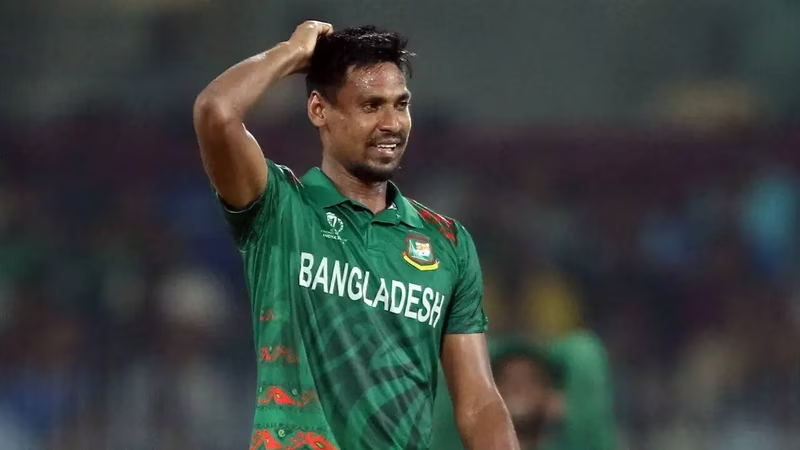
In a development that underscores the complex intersection of diplomacy, security, and sport, the Board of Control for Cricket in India (BCCI) has finally broken its silence on Bangladesh’s T20 World Cup venue request. During a high-level meeting in Mumbai, BCCI officials clarified they have no authority to unilaterally relocate matches—emphasizing that the International Cricket Council (ICC) holds sole jurisdiction over scheduling and venue decisions for the upcoming 2026 tournament .
This statement arrives amid heightened scrutiny following reports that Bangladesh sought to move its group-stage fixtures out of certain Indian cities, allegedly due to concerns over player safety and visa delays—particularly surrounding star pacer Mustafizur Rahman. While the BCCI maintained a neutral stance, its clarification shifts the spotlight squarely onto the ICC, which now faces mounting pressure to ensure a smooth, secure, and politically neutral tournament.
Table of Contents
- The Mustafizur Controversy Sparks Diplomatic Tensions
- BCCI Officially Responds to “Bangladesh T20 World Cup Venue Request”
- Why the ICC Holds All the Power in T20WC Logistics
- What This Means for the India vs. Bangladesh Match
- BCCI Focuses on Domestic Development Amidst Controversy
- Fan Reactions and Regional Politics
- Conclusion
- Sources
The Mustafizur Controversy Sparks Diplomatic Tensions
The roots of this diplomatic unease trace back to early January 2026, when reports emerged that Mustafizur Rahman—a key figure in Bangladesh’s bowling attack—faced unexpected delays in securing his Indian visa . Given his past participation in the IPL and clean immigration record, the holdup raised eyebrows across the cricketing world.
While neither the Indian Ministry of External Affairs nor Bangladeshi authorities confirmed the specifics, speculation swirled that the delay was linked to broader geopolitical sensitivities. The situation escalated when Bangladesh Cricket Board (BCB) officials reportedly approached the ICC and BCCI to explore relocating their matches to “more neutral” venues—possibly outside India or in cities perceived as lower-risk .
BCCI Officially Responds to “Bangladesh T20 World Cup Venue Request”
During its Mumbai conclave, the BCCI addressed these rumors head-on. A senior board official stated, “The BCCI is not the appropriate body to decide on match venues for an ICC event. That responsibility lies entirely with the ICC.” The message was clear: India, as a co-host, will provide infrastructure and security as planned, but logistical changes are beyond its purview .
This response aligns with standard protocol. As per the ICC’s Event Regulations, host nations commit to facilities and local coordination, but the global governing body retains final control over the tournament schedule, including last-minute venue adjustments for “force majeure” events like civil unrest, natural disasters, or security threats .
Why the ICC Holds All the Power in T20WC Logistics
To understand why the BCCI can’t simply “approve” a venue shift, it’s essential to grasp the ICC’s operational framework:
- Centralized Authority: The ICC manages all commercial, broadcast, and logistical contracts for World Cups.
- Security Protocols: Any venue change requires ICC-led threat assessments in consultation with local governments and independent security firms.
- Financial Implications: Moving matches impacts broadcasting rights, ticketing, and sponsor obligations—costs borne by the ICC, not host boards.
For authoritative context, the ICC’s official media portal regularly publishes governance guidelines that reinforce this structure .
What This Means for the India vs. Bangladesh Match
Crucially, the marquee India vs. Bangladesh clash—scheduled for a major metropolitan venue—is unlikely to be moved. High-profile fixtures draw massive crowds and global viewership, making them logistically and commercially sacrosanct unless an extreme emergency arises.
That said, if Bangladesh’s other group matches (against lower-ranked teams) were under consideration for relocation, the ICC would likely weigh factors like crowd size, local sentiment, and police deployment capacity. So far, no such announcement has been made.
BCCI Focuses on Domestic Development Amidst Controversy
Notably, the same Mumbai meeting also prioritized long-term cricket development. Officials discussed accelerating recruitment for vacant technical roles at the National Cricket Academy (now rebranded as the Centre of Excellence) and planning future India A and U-19 tours .
This dual focus—addressing international friction while investing in grassroots talent—reflects the BCCI’s strategy to project stability. For more on India’s youth pipeline, see our coverage on [INTERNAL_LINK:India U-19 Cricket Team].
Fan Reactions and Regional Politics
On social media, Indian fans have largely dismissed Bangladesh’s request as “unnecessary drama,” while Bangladeshi supporters express anxiety over player welfare. Political commentators warn that cricket is increasingly becoming a proxy for bilateral tensions—a trend seen in India-Pakistan relations and now potentially extending to the eastern subcontinent.
Yet, both boards have historically worked to insulate sport from politics. Whether they can do so again remains to be seen.
Conclusion
The Bangladesh T20 World Cup venue request has exposed the fragile balance between sporting camaraderie and real-world geopolitics. While the BCCI has rightly deferred to the ICC’s authority, the underlying concerns—rooted in the Mustafizur visa issue—highlight the need for transparent communication between cricket boards and governments. As the June 2026 kickoff approaches, all parties must prioritize the spirit of the game over suspicion. After all, millions of fans just want to see great cricket—not bureaucratic standoffs.
Sources
- The Times of India. “Mustafizur Rahman controversy: BCCI breaks silence on Bangladesh’s request to shift T20 World Cup matches.” January 10, 2026.
- Hindustan Times. “Visa delay for Mustafizur Rahman sparks tension ahead of T20 World Cup.”
- ESPNcricinfo. “BCB seeks venue review for T20 World Cup matches in India.”
- International Cricket Council (ICC). “ICC Men’s T20 World Cup 2026 – Event Regulations.”