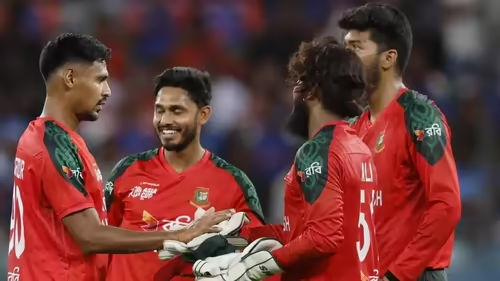
The countdown is on—and the stakes couldn’t be higher. As of Tuesday, January 20, 2026, the cricketing world is holding its breath. The International Cricket Council (ICC) has issued a hard deadline of **January 21** for the Bangladesh Cricket Board (BCB) to confirm its participation in the upcoming T20 World Cup. If Bangladesh fails to commit, their coveted spot in the tournament could be handed to **Scotland**, throwing the entire competition into flux just months before the first ball is bowled.
Table of Contents
- Why Is Bangladesh Hesitating?
- The ICC Deadline and Potential Consequences
- Scotland: The Next in Line
- Possible Group Swap Scenarios
- Broader Implications for Global Cricket
- Conclusion: A Tournament on the Brink
- Sources
Why Is Bangladesh Hesitating?
The BCB’s reluctance stems from legitimate **security concerns** surrounding the tournament’s host nations. While the ICC has not publicly detailed specific threats, reports suggest that internal assessments by Bangladeshi authorities have raised red flags about player safety in certain venues .
In response, the BCB has formally requested that all of Bangladesh’s matches be relocated to **Sri Lanka**, a neutral and logistically feasible alternative. This move follows heightened regional tensions and a general climate of uncertainty that has made overseas travel for national teams increasingly complex.
Compounding the issue is the recent **Mustafizur Rahman row**, where the star pacer voiced strong reservations about touring high-risk locations without adequate security guarantees. His stance has amplified pressure on the board to prioritize player welfare over sporting commitments—a dilemma many boards now face in an era of geopolitical volatility.
The ICC Deadline and Potential Consequences
The ICC’s January 21 deadline isn’t arbitrary. With team logistics, broadcast schedules, ticket sales, and training camps already locked in, any last-minute change would trigger a logistical nightmare. Yet, the governing body has made it clear: **no confirmation means no participation**.
If Bangladesh officially withdraws, it won’t just be a blow to their players and fans—it will disrupt the carefully balanced structure of the tournament. Bangladesh was placed in a competitive group alongside established sides, and their absence would leave a void that needs immediate filling. The ICC’s contingency plan? Promote the next highest-ranked non-qualified team: **Scotland**.
What Happens to Bangladesh’s Group?
The ICC is reportedly considering two options:
- Direct Replacement: Scotland steps into Bangladesh’s exact position in the group, inheriting their fixtures and opponents.
- Group Reshuffle: All teams are re-seeded to maintain competitive balance, potentially moving stronger sides between groups to offset the loss of a Full Member nation.
While the first option is simpler, the second is fairer—especially since Scotland, despite recent improvements, operates with far fewer resources than a Full Member like Bangladesh.
Scotland: The Next in Line
For Scottish cricket, this is both an opportunity and a challenge. Having narrowly missed qualification through the official pathway, the team—led by Richie Berrington—has been keeping itself match-ready, just in case. Their inclusion would mark only their third appearance in a T20 World Cup, following stints in 2009 and 2021.
Scotland’s rise in recent years has been impressive. They’ve beaten England in ODIs and consistently troubled top-tier teams in qualifiers. However, stepping into a World Cup at the eleventh hour presents unique hurdles: limited preparation time, unfamiliar conditions, and the psychological weight of replacing a team that didn’t choose to leave.
Still, for Associate nations, such a call-up is a dream come true—a chance to showcase their talent on the biggest stage and push for greater recognition and funding from the ICC.
Broader Implications for Global Cricket
This crisis highlights a growing tension in international cricket: the clash between **sporting integrity** and **real-world security realities**. As global instability increases, more boards may follow Bangladesh’s lead, demanding venue changes or even withdrawing altogether.
It also raises questions about the ICC’s hosting model. Should future tournaments be held in a single, secure country (like the IPL or BBL), rather than across multiple nations with varying risk profiles? The current multi-country format boosts local engagement but introduces significant operational and safety risks.
Moreover, the potential inclusion of Scotland underscores the importance of maintaining a robust **Associate pathway**. Teams like Scotland, Netherlands, and Namibia are no longer easy beats—they’re competitive, professional, and deserve a seat at the table. For more on the rise of Associate cricket, see our [INTERNAL_LINK:associate-nations-cricket-rise] feature.
Conclusion: A Tournament on the Brink
As the clock ticks toward the ICC’s January 21 deadline, the fate of the Bangladesh T20 World Cup campaign remains uncertain. What began as a routine security request has escalated into a potential tournament-altering decision. Whether Bangladesh commits, withdraws, or negotiates a compromise, the outcome will send ripples through the cricketing world. One thing is certain: the 2026 T20 World Cup may look very different from what fans expected—and Scotland might just be the unexpected story of the summer.
Sources
- Times of India: ICC deadline puts Bangladesh T20 WC spot under threat; this team next in line
- ICC Official Website: T20 World Cup 2026 Participation Guidelines
- ESPNcricinfo: Bangladesh raises security concerns over T20 World Cup 2026 [[5], [12]]
- Cricket Scotland: Scotland Ready for Any Opportunity in T20 World Cup
- Reuters: ICC sets deadline for Bangladesh T20 World Cup decision