Table of Contents
- The Controversial Decision to Withdraw
- Ex-BCB Secretary Slams the ‘Overplayed Hand’
- ICC Security and the Flawed IPL Link
- The Consequences for Bangladesh Cricket
- Scotland Steps into the Spotlight
- Conclusion: A Self-Inflicted Crisis
- Sources
The Controversial Decision to Withdraw
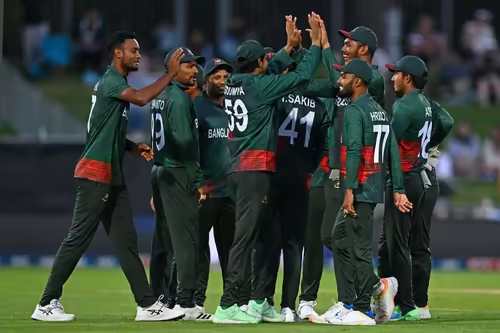
In a move that sent shockwaves through the cricketing world, the Bangladesh Cricket Board (BCB), backed by its government, announced its withdrawal from the upcoming ICC Men’s T20 World Cup. The official reason cited was security concerns over playing in India. However, many insiders believe the decision was deeply intertwined with a separate political dispute involving the Indian Premier League (IPL) and the exclusion of a prominent Bangladeshi player. This unprecedented step has left fans and experts alike questioning the true motives and the long-term fallout for a nation that has worked hard to establish itself on the global stage.
Ex-BCB Secretary Slams the ‘Overplayed Hand’
Former BCB general secretary Suyed Ashraful Haque has emerged as one of the most vocal critics of this decision. In a series of strong statements, Haque has labeled the T20 World Cup pullout as not just a mistake, but a catastrophic strategic blunder. He argues that the BCB has “overplayed its hand” by using the world’s premier cricket tournament as a bargaining chip in a separate, unrelated conflict .
“It was not right for Bangladesh to withdraw from the T20 World Cup just because a Bangladeshi player was not allowed to play in the IPL,” Haque stated, directly challenging the narrative put forward by the current board administration . His comments cut to the heart of the controversy, suggesting that the security concerns were a convenient smokescreen for a political power play that has now backfired spectacularly.
ICC Security and the Flawed IPL Link
Haque’s criticism is grounded in a fundamental understanding of how international cricket operates. He points out a critical flaw in the BCB’s logic: the conflation of a private T20 league with an official ICC event. The International Cricket Council (ICC) is renowned for its stringent and comprehensive security protocols for its tournaments, which are often far more robust than those for domestic leagues like the IPL .
The ICC itself has publicly stated that there is “no specific threat to the Bangladesh team in India” and that its decisions are based on objective security assessments and host guarantees [[24], [28]]. By linking their participation in an ICC-sanctioned event to their grievances over a franchise-based league, the BCB has not only undermined its own credibility but also shown a concerning disregard for the established safety mechanisms of the global game.
Why the IPL Comparison Doesn’t Hold Water
- Different Governing Bodies: The IPL is run by the BCCI, while the T20 World Cup is under the direct authority of the ICC, which has a global mandate for player safety.
- Security Scale: ICC events involve multi-layered federal, state, and local security arrangements that are escalated specifically for the tournament .
- Global Stakes: The reputation of the host nation and the ICC is on the line, creating a powerful incentive to ensure absolute security for all participating teams.
The Consequences for Bangladesh Cricket
The ramifications of this T20 World Cup pullout extend far beyond the missed opportunity to compete. Haque warns that this move paints Bangladesh as a “potential troublemaker” in the eyes of the international cricketing community . This perception is incredibly damaging. It risks:
- Isolation: Future hosting rights for major tournaments could be jeopardized.
- Loss of Revenue: Missing out on crucial ICC funding and exposure that comes with World Cup participation.
- Player Morale: Denying a generation of talented players a rare chance to showcase their skills on the biggest stage, a point Haque has emphasized as a grave injustice .
Furthermore, this episode highlights the dangerous level of political influence in the BCB’s decision-making, a trend that Haque has consistently warned against [[6], [7]]. When cricket administration becomes a tool for political agendas, the sport and its players are the ultimate losers.
Scotland Steps into the Spotlight
While Bangladesh grapples with the fallout of its decision, another nation has been handed a golden opportunity. The ICC has officially confirmed that Scotland will replace Bangladesh in the 2026 T20 World Cup [[27], [30]]. For the Scottish team, who had initially failed to qualify, this is a dream come true. They will now join Group C, facing off against cricketing giants like England and the West Indies, as well as Nepal .
This development serves as a stark reminder of the competitive nature of international cricket. Vacancies are filled swiftly, and opportunities lost by one team are eagerly seized by another. [INTERNAL_LINK:scotland-cricket-rise] Scotland’s late entry is a direct consequence of Bangladesh’s self-imposed exile from the tournament.
Conclusion: A Self-Inflicted Crisis
The withdrawal of the Bangladesh cricket team from the T20 World Cup stands as a cautionary tale of how politics and sport should never mix. The sharp criticism from a respected former insider like Suyed Ashraful Haque underscores the depth of the misjudgment. By prioritizing a political grievance over the interests of its players and the long-term health of its cricket, the BCB has made a decision that appears to be a significant strategic error. The immediate consequence is a spot on the world stage given to Scotland, but the long-term cost to Bangladesh’s reputation and progress in the sport may be far more severe. As the cricketing world watches, the hope is that this episode will serve as a lesson in the importance of keeping the game’s integrity and its players’ dreams at the forefront of all decisions.
Sources
- Times of India: ‘Bangladesh overplayed its hand’: Former BCB secretary slams T20 World Cup pullout
- ICC Official Statement on Security: ICC confirms no credible threat to Bangladesh team in India
- ICC Announcement on Scotland’s Replacement: Scotland to replace Bangladesh in ICC Men’s T20 World Cup 2026