Table of Contents
- A Crisis at the Crossroads of Cricket and Politics
- The Mustafizur Rahman Spark That Lit the Fuse
- The BCB’s Unwavering Stance: Security and National Pride
- The ICC’s Ultimatum and the Looming Replacement
- A History of Tension: Bangladesh’s Cricketing Visits to India
- What Happens Next? The Future of the Bangladesh T20 World Cup Dream
- Conclusion: A Sporting Dispute with Far-Reaching Consequences
- Sources
A Crisis at the Crossroads of Cricket and Politics
The world of cricket is facing one of its most significant political flashpoints in recent memory. In a stunning and defiant move, the Bangladesh Cricket Board (BCB) has confirmed it will not send its national team to India for the upcoming ICC Men’s T20 World Cup 2026. This isn’t just a scheduling dispute; it’s a high-stakes standoff that pits national pride against the global game’s governing body, with the participation of an entire nation hanging in the balance.
This dramatic turn of events has sent shockwaves through the sporting community, leaving fans and analysts scrambling to understand the complex web of politics, player welfare, and international diplomacy that has led to this impasse. At the heart of this crisis lies a single, explosive incident involving one of Bangladesh’s most celebrated athletes.
The Mustafizur Rahman Spark That Lit the Fuse
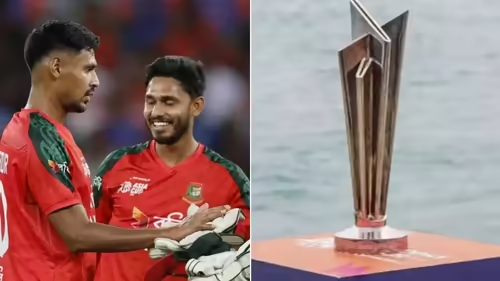
The immediate catalyst for this unprecedented boycott is the controversial release of star left-arm pacer Mustafizur Rahman from his Indian Premier League (IPL) franchise, the Kolkata Knight Riders (KKR). Reports indicate that the Board of Control for Cricket in India (BCCI) instructed KKR to release Mustafizur from their squad . This directive, widely believed to be influenced by external political pressure, was the final straw for the BCB .
For Bangladesh, Mustafizur Rahman is more than just a cricketer; he’s a national icon. His abrupt and unexplained removal from the IPL—a league where he had been a key performer—was perceived in Dhaka as a direct slight against the nation and its players. The BCB saw this not as an isolated personnel decision but as a symptom of a deeper, more concerning environment for their athletes in India .
The BCB’s Unwavering Stance: Security and National Pride
In the wake of the Mustafizur incident, the BCB formally requested the International Cricket Council (ICC) to relocate all of Bangladesh’s group-stage matches away from India, citing serious safety and security concerns for its players . The board argued that the political climate and the treatment of their star player created an unsafe and hostile atmosphere that could not be ignored .
Despite the ICC sharing a security assessment that reportedly indicated “no specific or heightened threat” to the Bangladesh team , the BCB has remained resolute. Their position is now firmly entrenched in a matter of principle and national dignity. They have stated they will not compromise on the safety of their players and will continue to fight for what they believe is right, even if it means sacrificing their place in the prestigious tournament .
The ICC’s Ultimatum and the Looming Replacement
The ICC, tasked with ensuring the smooth running of its flagship event, has shown little flexibility in response to the BCB’s demands. The council has officially rejected the request to change venues for Bangladesh’s matches, which are scheduled to be played in Kolkata .
Faced with the BCB’s defiance, the ICC has issued a clear and uncompromising ultimatum: participate in India as scheduled or forfeit your spot in the tournament. According to multiple reports, Scotland is on standby to replace Bangladesh in Group C should they fail to comply . This hardline stance from the ICC underscores the immense logistical and financial pressures of organizing a global event and its unwillingness to set a precedent that could encourage future political interference in the sport.
A History of Tension: Bangladesh’s Cricketing Visits to India
While this current crisis is acute, it doesn’t exist in a vacuum. The relationship between Indian and Bangladeshi cricket has often been strained by the broader geopolitical tensions between the two neighboring nations. Past tours have sometimes been marred by crowd behavior and security scares, creating a backdrop of underlying anxiety for Bangladeshi players and officials .
The Mustafizur Rahman episode has amplified these pre-existing concerns to a breaking point. The BCB’s emergency meetings and the interim government’s expressed reluctance to send the team highlight how deeply this issue has penetrated beyond the confines of the cricket pitch . It’s a stark reminder that in South Asia, sport and state are often inextricably linked.
What Happens Next? The Future of the Bangladesh T20 World Cup Dream
As of today, Thursday, January 22, 2026, the situation remains at a tense stalemate. The BCB’s defiance is a powerful statement, but the consequences are severe. Missing the T20 World Cup would be a massive blow to the players’ careers, the development of cricket in Bangladesh, and the commercial interests of all parties involved.
Several potential outcomes are on the table:
- Last-Minute Diplomacy: A behind-the-scenes negotiation between the ICC, BCCI, and BCB could lead to a face-saving compromise, perhaps involving enhanced security guarantees.
- Full Boycott: The BCB stands firm, and Bangladesh is officially replaced by Scotland, casting a long shadow over the tournament’s legitimacy in the eyes of many.
- Partial Participation: A fractured team, perhaps without key players like Mustafizur, travels to India under protest, creating an awkward and potentially volatile situation.
No matter the path forward, the spirit of the game has already taken a significant hit.
Conclusion: A Sporting Dispute with Far-Reaching Consequences
The Bangladesh T20 World Cup boycott is far more than a simple case of a team refusing to travel. It is a complex saga where sport has become a proxy for national sentiment, player welfare, and international power dynamics. The BCB’s principled stand, while costly, has forced a global conversation about the responsibilities of host nations and the limits of a governing body’s authority. For fans of the game, the hope remains that a solution can be found before the first ball is bowled, preserving both the integrity of the competition and the safety of those who play it. Until then, the cricketing world watches and waits, caught in the crossfire of a dispute that threatens to overshadow the sport itself.
Sources
[INTERNAL_LINK:icc-t20-world-cup-2026-schedule]
[INTERNAL_LINK:mustafizur-rahman-career-stats]
The official ICC website provides the authoritative schedule and regulations for all its events: https://www.icc-cricket.com/.