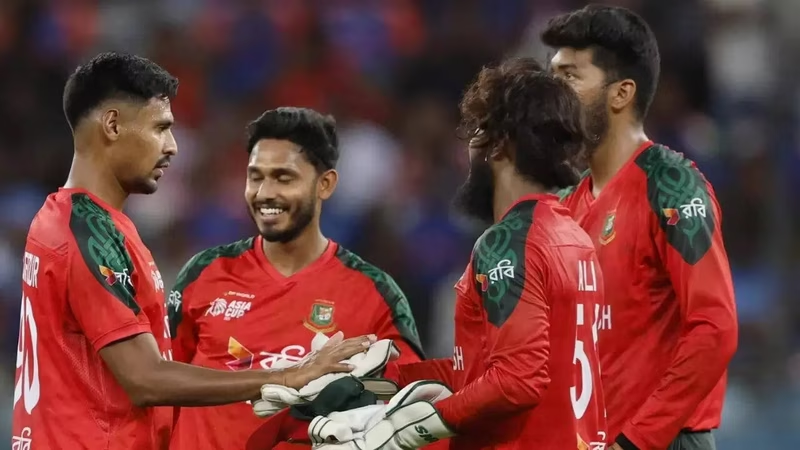
In a move that has ignited fierce debate across the cricketing world, the **Bangladesh Cricket Board (BCB)** has declared that it would face no financial loss if the national team pulls out of the upcoming **T20 World Cup**—but the players themselves would bear the brunt through lost match fees and performance bonuses.
The statement, made by BCB’s finance chief during a recent internal meeting, comes amid growing tensions between star pacer Mustafizur Rahman and board officials over central contracts, travel conditions, and player welfare . While the board insists its institutional finances are secure until 2027 thanks to long-term ICC funding and sponsorship deals, critics argue this stance exposes a troubling disconnect between administrators and the athletes who represent the nation on the global stage.
Table of Contents
- The Controversy Behind Bangladesh’s T20 World Cup Participation
- Bangladesh T20 World Cup: BCB Claims Financial Immunity
- What Players Stand to Lose: Match Fees and Bonuses
- How ICC Funding Protects Boards—but Not Athletes
- Global Comparisons: Do Other Boards Treat Players This Way?
- Mustafizur Rahman Row: The Tipping Point
- Conclusion: A Question of Priorities
- Sources
The Controversy Behind Bangladesh’s T20 World Cup Participation
Rumors of a potential withdrawal began circulating after several senior players, including Mustafizur Rahman, expressed dissatisfaction with BCB’s handling of overseas tours, inadequate rest protocols, and lack of transparency in contract renewals. The tension peaked when Mustafizur opted out of a bilateral series, citing mental fatigue—a decision that drew both public support and administrative backlash.
While full-scale withdrawal remains unlikely, the mere suggestion has forced the BCB to clarify its financial position. In doing so, it inadvertently revealed a system where institutional stability is prioritized over individual athlete compensation—a model increasingly at odds with modern sports ethics.
Bangladesh T20 World Cup: BCB Claims Financial Immunity
According to BCB’s finance committee head, the board receives guaranteed annual distributions from the **International Cricket Council (ICC)** as part of its Full Member status. These funds—reportedly locked in until 2027—cover operational costs, infrastructure projects, and domestic tournaments, regardless of whether the national team participates in ICC events like the **T20 World Cup** .
“The board’s revenue stream is not contingent on tournament participation,” the official stated. “If we don’t go, we don’t pay match fees or win bonuses. That’s where the saving—or rather, the non-loss—occurs.”
This logic, while fiscally sound from an accounting perspective, has drawn sharp criticism from player unions and former cricketers who argue that it reduces athletes to disposable assets rather than valued stakeholders.
What Players Stand to Lose: Match Fees and Bonuses
For Bangladesh’s cricketers, participation in the T20 World Cup represents a significant income opportunity:
- Match Fee**: Approximately $5,000–$7,000 per T20I (as per BCB’s 2025 central contract structure)
- Win Bonus**: Additional $3,000–$5,000 per victory
- Tournament Progression Bonus**: Up to $20,000 for reaching semifinals or finals
- Sponsorship Uplift**: Performance in global events often triggers private endorsement clauses
For many players—especially those outside the top-tier earners—these figures constitute a major portion of their annual income. Missing the tournament could mean a 20–30% drop in yearly earnings, with no alternative compensation from the board.
How ICC Funding Protects Boards—but Not Athletes
The ICC distributes over **$400 million annually** to its 12 Full Members, with larger shares going to boards based on historical contribution and market size . Bangladesh, as a Full Member since 2000, receives an estimated $12–15 million per year—enough to sustain operations even without tournament success.
However, **none of this funding is earmarked for direct player compensation**. Unlike leagues such as the IPL or The Hundred, where player salaries are built into the event economics, ICC tournaments rely on national boards to pay their own squads. This creates a structural imbalance: boards gain financial security, while players assume all performance-related risk.
For context, see the ICC’s official [revenue distribution framework](https://www.icc-cricket.com/about/governance/finance) .
Global Comparisons: Do Other Boards Treat Players This Way?
Most leading cricket nations have moved toward more player-centric models:
- England & Wales Cricket Board (ECB): Guarantees minimum tournament appearance fees even if a player is benched.
- Cricket Australia (CA): Includes “event participation” as a contractual obligation with fixed payouts.
- Board of Control for Cricket in India (BCCI): Offers separate World Cup retainers beyond regular match fees.
In contrast, the BCB’s approach reflects an older, administrator-first mindset—one that may soon face legal and reputational challenges as player associations grow stronger across Asia.
Mustafizur Rahman Row: The Tipping Point
Star bowler Mustafizur Rahman has become the face of this discontent. After years of relentless international duty without adequate rest, his public stance on workload management resonated with fans and fellow athletes alike. His absence from recent tours wasn’t just personal—it was symbolic of a systemic issue.
By framing the **Bangladesh T20 World Cup** participation as optional from a financial standpoint, the BCB has inadvertently validated player concerns: if the board doesn’t stand to lose, why should athletes sacrifice their health and income for a cause the institution treats as expendable?
For deeper analysis, read our feature on [INTERNAL_LINK:player-welfare-in-south-asian-cricket].
Conclusion: A Question of Priorities
The BCB’s assertion that only players—not the board—will suffer financially if Bangladesh skips the **T20 World Cup** reveals a fundamental misalignment in values. While fiscal prudence is important, sustainable cricket ecosystems depend on mutual trust between administrators and athletes. Ignoring player welfare today may save a few lakhs tomorrow—but it risks the very future of the game in Bangladesh.