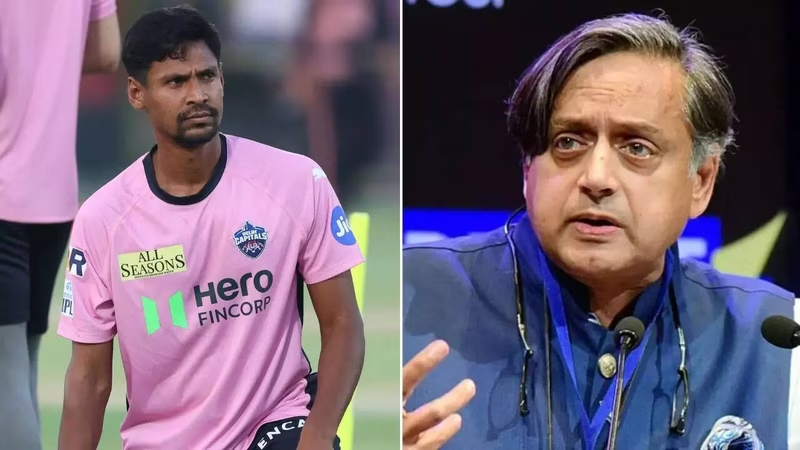
Cricket was once hailed as a bridge between nations. But right now, that bridge looks like it’s on fire. In a stunning development that blends diplomacy, sport, and national pride, Bangladesh refuses to play T20 World Cup in India—citing serious concerns over player safety. The spark? The BCCI’s controversial advice to Kolkata Knight Riders (KKR) to release star fast bowler Mustafizur Rahman from the IPL 2026.
This move has not only thrown the ICC’s tournament planning into disarray but has also ignited a fierce political backlash in India. Congress MP and former Union Minister Shashi Tharoor didn’t mince words: he called the entire episode a “self-inflicted embarrassment”—a phrase that’s now echoing across newsrooms and social media alike.
Table of Contents
- How It All Started: Mustafizur’s IPL Release
- Bangladesh Refuses to Play T20 World Cup in India: The Official Response
- Tharoor’s Blunt Assessment: A ‘Self-Inflicted Embarrassment’
- What Does This Mean for the T20 World Cup 2026?
- The Broader Geopolitical Context
- Possible Solutions and the ICC Dilemma
- Conclusion: When Cricket Becomes Casualty of Politics
- Sources
How It All Started: Mustafizur’s IPL Release
The trouble began when the Board of Control for Cricket in India (BCCI) reportedly advised KKR to terminate Mustafizur Rahman’s contract for the upcoming IPL season. While the BCCI hasn’t issued an official statement, multiple credible sources—including Times of India and ESPNcricinfo—confirm the advice stemmed from “security concerns” related to ongoing communal tensions in Bangladesh affecting India’s diplomatic stance.
Mustafizur, a key asset for KKR and one of Bangladesh’s most celebrated cricketers, was left stranded without a team just weeks before the auction. For the Bangladesh Cricket Board (BCB), this wasn’t just a sporting snub—it was perceived as a political signal.
Bangladesh Refuses to Play T20 World Cup in India: The Official Response
In a swift and firm rebuke, the BCB has formally requested the International Cricket Council (ICC) to relocate all of Bangladesh’s group-stage matches from India to a neutral venue. Citing “grave concerns for the safety and well-being of our players,” the board stated that the atmosphere is no longer conducive for their team to tour.
Originally, Bangladesh was scheduled to play high-profile matches in Kolkata, Mumbai, and Bengaluru—venues expected to draw massive crowds. The BCB’s refusal now forces the ICC into emergency mode, with Sri Lanka and the UAE emerging as potential alternative hosts.
Tharoor’s Blunt Assessment: A ‘Self-Inflicted Embarrassment’
Shashi Tharoor, a known cricket enthusiast and vocal critic of mixing politics with sport, expressed deep dismay over the episode. “We have brought this embarrassment upon ourselves,” he said in a social media post, widely quoted across media platforms .
Tharoor argued that by allowing geopolitical friction to dictate sporting decisions, India has undermined its credibility as a global cricket host. “The BCCI is supposed to be a sports body, not a foreign policy wing,” he remarked, highlighting the dangerous precedent being set.
What Does This Mean for the T20 World Cup 2026?
The fallout could be severe:
- Logistical chaos: Rescheduling matches requires venue availability, travel coordination, and broadcasting adjustments.
- Financial losses: The BCCI stands to lose millions in ticket sales, hospitality, and sponsorship revenue from Bangladesh fixtures.
- Reputational damage: Future ICC events may bypass India if it’s seen as a politically volatile host.
Moreover, fans are left disappointed—especially in Bengal and Maharashtra, where India-Bangladesh matches are always electric.
The Broader Geopolitical Context
This isn’t happening in a vacuum. India-Bangladesh relations have been strained in recent months over issues like border management, water sharing, and minority rights. Cricket, often a soft-power tool, has now become a casualty of this friction.
Historically, cricket diplomacy has helped ease tensions—think India-Pakistan matches in the 2000s. But this reversal shows how fragile that goodwill can be. For a deeper dive, check out our piece on [INTERNAL_LINK:history-of-india-bangladesh-cricket-diplomacy].
Possible Solutions and the ICC Dilemma
The ICC now faces a tough choice. It can:
- Accept Bangladesh’s request and shift matches—a move that may set a precedent for future boycotts.
- Mediate between BCCI and BCB to restore trust, possibly with security guarantees.
- Insist on the original schedule, risking a full Bangladesh withdrawal from the tournament.
According to ICC regulations, teams cannot unilaterally refuse to play without forfeiting points—but safety exceptions exist. The situation remains fluid.
Conclusion: When Cricket Becomes Casualty of Politics
The phrase “Bangladesh refuses to play T20 World Cup in India” may seem like a sports headline, but it’s really about broken trust, miscommunication, and the dangerous blending of sport with statecraft. Shashi Tharoor’s “self-inflicted embarrassment” isn’t just a soundbite—it’s a warning. If cricket bodies start acting like extensions of foreign ministries, the spirit of the game—and India’s standing in it—will suffer long after the last ball is bowled.
Sources
[1] Tharoor, S. (2026, January 4). “We have brought this embarrassment upon ourselves.” Times of India. https://timesofindia.indiatimes.com/…
ESPNcricinfo. (2026). BCB seeks ICC intervention over India tour. https://www.espncricinfo.com/
The Hindu. (2026). Mustafizur’s IPL release triggers diplomatic row. https://www.thehindu.com/…
ICC Official Governance Guidelines