Bangladesh Press Under Siege: Journalists Demand Protection After Newspaper Attacks
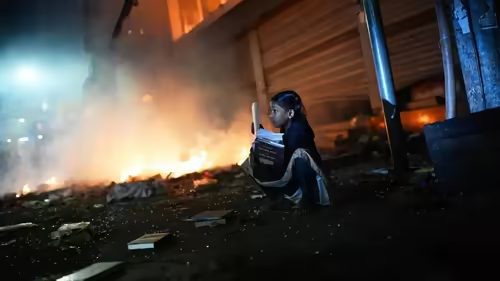
In a chilling escalation of anti-press violence, mob attacks on prominent newspaper offices in Bangladesh have left journalists fearing for their lives and livelihoods. Staff were trapped inside burning buildings as offices were torched, vandalized, and looted—acts that media unions call “a direct assault on democracy itself.” Now, journalists and media owners are demanding immediate state protection, accusing the interim Yunus-led government of dangerous inaction. This unfolding Bangladesh press freedom crisis has drawn sharp condemnation from international watchdogs and raised urgent questions about the country’s commitment to free speech ahead of crucial elections.
Table of Contents
- The Attacks: What Happened at the Newspaper Offices?
- Journalists’ Response: A Unified Cry for Safety
- Government Inaction: Criticism of the Yunus-Led Interim Administration
- A Broader Pattern of Harassment and Surveillance
- International Reaction and Press Freedom Rankings
- Conclusion: Can Bangladesh’s Fourth Estate Survive?
- Sources
The Attacks: What Happened at the Newspaper Offices?
Over the past week, coordinated mob violence targeted several leading national dailies in Dhaka and other urban centers. According to eyewitness accounts and video evidence, masked assailants stormed newspaper premises, smashed printing presses, set fire to editorial rooms, and stole computers and archives .
In one harrowing incident, reporters and editors were locked inside their own office as flames engulfed the building. They escaped only after breaking windows and climbing down with makeshift ropes. No injuries were fatal, but the psychological trauma and material losses are immense .
While no group has officially claimed responsibility, sources suggest the mobs were politically motivated, possibly linked to factions angered by recent investigative reports on corruption and electoral manipulation .
Journalists’ Response: A Unified Cry for Safety
The Bangladesh Federal Union of Journalists (BFUJ) and the Dhaka Union of Journalists (DUJ) have issued a joint statement condemning the attacks as “state-sanctioned terror by omission.” They are demanding:
- Immediate deployment of security forces to protect all media houses;
- A special judicial inquiry into the attacks;
- Compensation for damaged infrastructure and lost income;
- Repeal of repressive laws like the Digital Security Act, used to jail reporters.
“We are not just reporters—we are citizens under siege,” said veteran editor Rezaul Karim in a press conference. “If the government won’t protect us, who will?”
Government Inaction: Criticism of the Yunus-Led Interim Administration
The interim government, headed by economist Dr. Muhammad Yunus following political turmoil, has faced fierce backlash for its delayed and muted response. Despite repeated pleas from media leaders, no high-level official visited the damaged offices or addressed the nation in the first 72 hours .
Critics argue this silence signals tacit approval or, at best, institutional weakness. “An interim government must be neutral—but neutrality in the face of violence is complicity,” said human rights lawyer Sara Hossain .
Opposition parties have seized on the issue, accusing the administration of prioritizing political stability over constitutional rights—a dangerous precedent ahead of the upcoming general elections .
A Broader Pattern of Harassment and Surveillance
These attacks are not isolated. Over the past two years, Bangladeshi journalists have faced escalating threats:
- Legal harassment: Over 200 cases filed under the Digital Security Act since 2024;
- Physical assaults: 47 reported attacks on reporters in 2025 alone;
- Surveillance: Evidence of state-sponsored phone tapping and online monitoring;
- Economic pressure: Government advertising withdrawn from critical outlets.
This ecosystem of intimidation has pushed Bangladesh to 165th out of 180 countries in Reporters Without Borders’ 2025 World Press Freedom Index—a steep decline from its 2010 ranking of 121st .
International Reaction and Press Freedom Rankings
Global organizations have sounded the alarm. UNESCO called the attacks “a grave violation of fundamental freedoms,” while the Committee to Protect Journalists (CPJ) urged the UN Human Rights Council to intervene .
The U.S. State Department expressed “deep concern” and hinted at potential aid reviews if democratic norms continue to erode. Meanwhile, regional bodies like SAARC have remained conspicuously silent—a reflection of broader geopolitical hesitancy to criticize Bangladesh’s internal affairs .
Conclusion: Can Bangladesh’s Fourth Estate Survive?
The Bangladesh press freedom crisis is more than a media issue—it’s a litmus test for the nation’s democratic soul. When newspapers burn and reporters hide, it’s not just journalism that’s under attack; it’s the public’s right to know, to question, and to hold power accountable. The Yunus-led interim government now faces a defining choice: act decisively to protect its press, or become complicit in its silencing. For millions of Bangladeshis who rely on independent news to navigate an uncertain future, the stakes couldn’t be higher. Stay informed on global press freedom trends at [INTERNAL_LINK:global_press_freedom_index].
Sources
- Times of India: Bangladesh: Journalists demand protection after attacks on national dailies
- Reporters Without Borders: 2025 World Press Freedom Index
- Committee to Protect Journalists (CPJ): Bangladesh Emergency Alerts