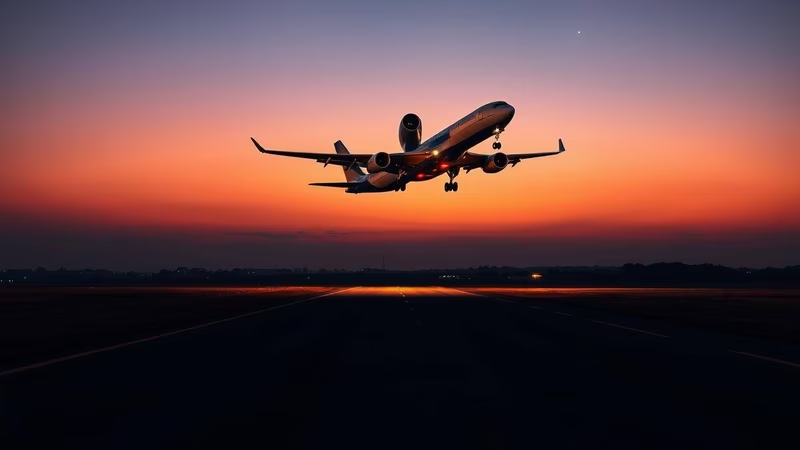
After a decade-long pause, a historic air link is set to roar back to life. On January 29, Biman Bangladesh Airlines will officially restart its direct flights between Dhaka and Karachi, reconnecting two nations with a complex and often fraught past. The move signals a warming of diplomatic ties between Bangladesh and Pakistan, promising to boost business, tourism, and people-to-people contact. But looming over this positive development is a single, pivotal question that could determine the route’s long-term viability: Has India given clearance for the flights to use its airspace? Without this overflight permission, the journey becomes significantly longer, more expensive, and far less practical—a reality that places New Delhi at the center of a delicate regional equation .
Table of Contents
- The End of a Decade-Long Hiatus
- Bangladesh Pakistan Flights: The New Route Details
- The India Overflight Question: The Elephant in the Room
- Why Did the Flights Stop in the First Place?
- A Broader Diplomatic Thaw Between Dhaka and Islamabad
- Economic and Strategic Implications
- Conclusion: A Test for Regional Cooperation
- Sources
The End of a Decade-Long Hiatus
The suspension of direct air services between Bangladesh and Pakistan dates back to 2016, following a deadly terrorist attack on an Indian airbase in Pathankot. In the aftermath, India revoked Pakistan’s overflight rights for flights to and from Bangladesh as part of a broader security stance. This effectively severed the most efficient air corridor between Dhaka and Karachi, as the direct route traverses Indian airspace . For the past ten years, travelers have been forced to take lengthy and costly detours via the Middle East, turning a 3-hour flight into a 10-hour ordeal.
Bangladesh Pakistan Flights: The New Route Details
According to official announcements from Biman Bangladesh, the service will relaunch on January 29, 2026, with an initial schedule of twice-weekly flights using modern aircraft . The airline has framed the decision as a response to growing demand from the business community, students, and families with cross-border ties. The resumption is seen as a major step in normalizing relations and fostering economic cooperation between the two South Asian neighbors. However, the airline has been notably silent on the critical logistics of the flight path, leaving the overflight issue shrouded in uncertainty.
The India Overflight Question: The Elephant in the Room
The geographic reality is simple: the shortest and most fuel-efficient route between Dhaka and Karachi flies directly over Indian territory. Without India’s permission, the flight must take a massive detour south over the Indian Ocean or north over China and Afghanistan, adding significant time, cost, and operational complexity.
As of now, there is no official confirmation from Indian authorities that overflight clearance has been granted. The Ministry of External Affairs in New Delhi has not issued a statement, and aviation experts are divided on whether such a permission would be politically feasible given the current state of India-Pakistan relations, which remain tense . This silence from New Delhi is the single biggest factor casting doubt on the sustainability of the new service. For the route to be a true success, a green light from India is not just beneficial—it’s essential.
Why Did the Flights Stop in the First Place?
The original halt in 2016 wasn’t just a bilateral Bangladesh-Pakistan decision; it was a direct consequence of India’s reaction to cross-border terrorism. Following the Pathankot attack, India implemented a series of measures to isolate Pakistan diplomatically and economically. Revoking third-party overflight rights was a key part of this strategy, effectively using its geographic position as leverage. The suspension of the Dhaka-Karachi route was a tangible, everyday consequence of that high-level geopolitical rift .
A Broader Diplomatic Thaw Between Dhaka and Islamabad
The decision to restart flights is part of a larger, quiet effort by Bangladesh and Pakistan to mend ties. Over the past two years, there have been several high-level visits and agreements on trade, education, and cultural exchange. Both nations see mutual benefit in moving past historical grievances, particularly as Bangladesh emerges as a significant economic power in the region. The air link is a symbolic and practical manifestation of this new chapter in their relationship .
Economic and Strategic Implications
The stakes are high for all parties involved:
- For Bangladesh and Pakistan: A direct, efficient air link can boost bilateral trade, facilitate student exchanges, and strengthen diaspora connections.
- For India: Granting overflight clearance would be seen as a conciliatory gesture, but could be politically risky domestically. Denying it maintains pressure on Pakistan but may strain its relationship with Dhaka, a key partner.
- For Regional Stability: This situation is a microcosm of the larger challenge of fostering cooperation in South Asia, where historical animosities often override shared economic interests .
Conclusion: A Test for Regional Cooperation
The resumption of Bangladesh Pakistan flights is a hopeful sign of normalization between two nations. Yet, its ultimate success hinges on a decision from a third party: India. The overflight clearance question is more than just an aviation logistics issue; it’s a litmus test for the possibility of pragmatic cooperation in a region often paralyzed by distrust. If India grants permission, it could pave the way for a new era of connectivity. If not, the route may become a costly symbol of a dream deferred. All eyes are now on New Delhi. To understand the deeper history of these complex ties, read our analysis on [INTERNAL_LINK:south-asia-diplomatic-relations].
Sources
- Times of India: B’desh to resume flights to Pak after 10-yr gap; has India given clearance?
- Dawn: Why Dhaka-Karachi Flights Were Suspended in 2016
- Ministry of External Affairs, India: Official Statements (Archives)
- Biman Bangladesh Airlines: Official Website & Route Announcements
- Carnegie Endowment for International Peace: The Geopolitics of South Asian Air Corridors