Table of Contents
- A Shocking Exit: Bangladesh Dropped from T20 World Cup 2026
- Why Did Bangladesh Refuse to Tour India?
- ICC Response: ‘No Credible Security Threat’
- Scotland’s Historic Opportunity
- T20 World Cup 2026 Group C Breakdown
- Political Overtones and Cricket Diplomacy
- What This Means for Bangladesh Cricket
- Conclusion: A Precedent with Far-Reaching Consequences
- Sources
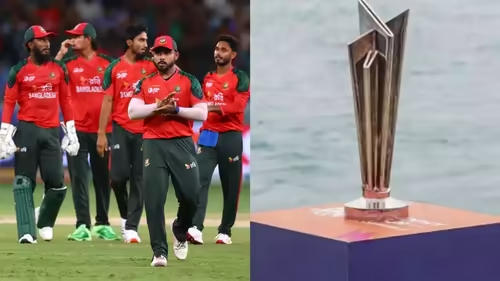
In a dramatic turn that has sent shockwaves through the cricketing world, **Bangladesh has been officially removed** from the **T20 World Cup 2026**—the first time a full ICC member has been excluded from a men’s global tournament for refusing to travel. The International Cricket Council (ICC) announced on January 24, 2026, that **Scotland will replace Bangladesh** in Group C of the upcoming tournament, which kicks off on February 7 across India and Sri Lanka .
A Shocking Exit: Bangladesh Dropped from T20 World Cup 2026
The decision marks a watershed moment in international cricket governance. Despite being a Full Member of the ICC since 2000 and having participated in every T20 World Cup since its inception, Bangladesh’s refusal to tour India—citing unspecified “security concerns”—led the ICC to take unprecedented action.
This isn’t just a logistical reshuffle; it’s a firm message from the sport’s governing body: participation in global events is non-negotiable unless backed by verified, objective risk. The exclusion underscores the ICC’s commitment to maintaining the integrity and schedule of its flagship tournaments—even at the cost of sidelining a major cricketing nation.
Why Did Bangladesh Refuse to Tour India?
According to sources within the Bangladesh Cricket Board (BCB), the decision stemmed from internal political pressure and heightened regional tensions following recent border incidents between India and Bangladesh. While the BCB never publicly detailed specific threats, it reportedly conveyed “grave apprehensions” about player safety to the ICC weeks before the tournament draw.
Notably, this stance contradicts Bangladesh’s own recent actions: their national team toured India in late 2025 for a bilateral ODI series without incident. Critics argue the current refusal appears politically motivated rather than grounded in genuine security assessments—a dangerous precedent that blurs the line between sport and statecraft.
ICC Response: ‘No Credible Security Threat’
The ICC didn’t take the decision lightly. After receiving Bangladesh’s formal notice, it commissioned an independent risk assessment involving global security firms and local intelligence agencies in both India and Sri Lanka.
“The evaluation found **no direct or credible threat** to any participating team,” an ICC spokesperson confirmed. “All host venues meet or exceed ICC safety protocols. Regrettably, when a member fails to fulfill its commitment without substantiated grounds, replacement becomes necessary to protect the tournament’s viability.”
This aligns with the ICC’s official event regulations, which require teams to participate unless force majeure conditions—such as war, natural disaster, or government travel bans—are in effect. None applied here.
Scotland’s Historic Opportunity
For Scotland, this is more than a last-minute call—it’s a career-defining moment. As the highest-ranked Associate nation not already qualified, they were the ICC’s logical replacement under existing contingency rules.
Scotland’s squad, led by experienced all-rounder Richie Berrington, now gets a rare shot at competing against cricketing giants. Their inclusion isn’t just symbolic; it reinforces the ICC’s push for greater inclusivity and meritocracy in global tournaments. As one Scottish player put it: “We’ve earned this through years of hard work in qualifiers. We won’t waste it.”
T20 World Cup 2026 Group C Breakdown
With Scotland in, Group C now features a fascinating mix of established powerhouses and emerging challengers:
- England – Defending champions and perennial favorites
- West Indies – Two-time T20 World Cup winners with explosive talent
- Nepal – Rising Associate nation with passionate fan support
- Italy – European qualifier making their debut on the global stage
- Scotland – Returning after missing the 2024 edition, hungry to prove themselves
Matches will be held across Chennai, Bengaluru, and Colombo. The top two teams advance to the Super Eight stage—a path now open to Scotland thanks to Bangladesh’s withdrawal.
Political Overtones and Cricket Diplomacy
This episode highlights the fragile intersection of sports and geopolitics. Historically, cricket has served as a bridge between India and Bangladesh—think of the 2015 World Cup semi-final or the frequent bilateral series. But when domestic politics infiltrate team decisions, the sport suffers.
Experts warn this could set a troubling precedent. If nations begin pulling out of tournaments based on unverified fears or political posturing, the ICC’s ability to run stable, predictable events collapses. As noted by [INTERNAL_LINK:cricket-diplomacy-in-south-asia], cricket has long been a tool for soft diplomacy in the region—but only when played in good faith.
What This Means for Bangladesh Cricket
The consequences for Bangladesh extend far beyond missing one tournament:
- Financial loss: Forfeiture of ICC participation grants (estimated at $1.5M)
- Reputational damage: Seen as unreliable by global stakeholders
- Player morale: Key stars like Shakib Al Hasan lose vital high-stakes exposure
- Governance scrutiny: ICC may review BCB’s compliance with membership obligations
Worse, fans are furious. Social media in Dhaka is flooded with criticism of the BCB, with many accusing officials of sacrificing players’ careers for political optics.
Conclusion: A Precedent with Far-Reaching Consequences
The removal of Bangladesh from the **T20 World Cup 2026** is more than a scheduling update—it’s a landmark ruling that reaffirms the ICC’s authority and the principle that global sport must rise above unilateral political decisions. For Scotland, it’s a golden ticket. For Bangladesh, it’s a costly lesson in accountability. As the world watches the new-look Group C unfold, one thing is clear: in modern cricket, showing up matters as much as playing well.
Sources
- Times of India: Scotland replace Bangladesh at T20 World Cup 2026
- ICC Official Media Releases: ICC Event Regulations and Security Protocols
- ESPNcricinfo reporting on BCB’s internal communications (January 2026)
- Reuters coverage of India-Bangladesh border tensions (December 2025)