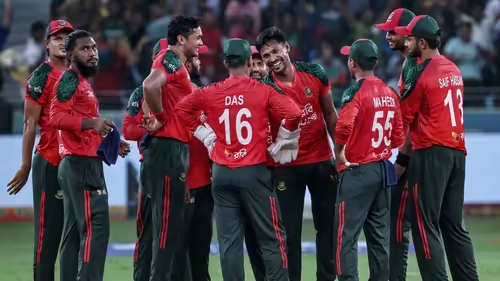
The cricketing world is holding its breath. What was supposed to be a celebration of the sport’s most explosive format has turned into a geopolitical flashpoint. At the heart of it all is Bangladesh’s defiant stance against the International Cricket Council (ICC) over its participation in the T20 World Cup 2026 in India. This isn’t just about cricket; it’s about national pride, security, and a perceived slight that has sent shockwaves through the game.
Table of Contents
- The Heart of the Dispute: Mustafizur Rahman and Beyond
- Bangladesh’s Uncompromising Stance
- ICC’s Firm Position and the January 21 Deadline
- Confirmed T20 World Cup 2026 Venues in India
- Possible Scenarios: What Happens Next?
- Conclusion: A Defining Moment for Cricket
- Sources
The Heart of the Dispute: Mustafizur Rahman and Beyond
While the official reason cited by the Bangladesh Cricket Board (BCB) revolves around “unreasonable conditions” and security concerns for playing in India, the catalyst for this crisis is widely understood to be the sudden and controversial release of their star pacer, Mustafizur Rahman, from his Indian Premier League (IPL) franchise .
Mustafizur, a fan favorite and a key asset for any T20 team, was let go by the Kolkata Knight Riders reportedly at the behest of the Board of Control for Cricket in India (BCCI). This move was seen in Dhaka not just as a sporting decision, but as a politically charged act that has poisoned the well for bilateral relations . The BCB has since retaliated by banning the broadcast of the IPL in Bangladesh, escalating the tension to a point where a simple cricket tournament feels impossible .
Bangladesh’s Uncompromising Stance on the T20 World Cup 2026
Bangladesh has drawn a clear line in the sand. Their position is firm: they will not travel to India for the T20 World Cup 2026. They have formally requested the ICC to relocate their matches to a neutral venue, a demand they believe is justified given the current climate .
The BCB has dismissed the ICC’s assurances of top-tier security as insufficient. For them, the issue transcends logistics; it’s about the principle of competing in a country where their star player was publicly sidelined under murky circumstances. As one BCB official stated, they “will not accept” what they perceive as unfair treatment . This is a matter of national dignity for Bangladesh, and they are willing to sacrifice their place in the global tournament to make that point.
ICC’s Firm Position and the Looming January 21 Deadline
The ICC, for its part, is standing its ground. The governing body has made it unequivocally clear that the tournament schedule and venues are final. They have rejected Bangladesh’s request to move their matches outside of India . The ICC’s message is simple: the event is in India, and all participating teams are expected to compete there under the agreed-upon framework.
To force a resolution, the ICC has reportedly set a hard deadline of January 21, 2026—tomorrow—for the BCB to confirm its participation . If Bangladesh refuses, the ICC is prepared to move forward without them. Reports suggest that Scotland, the next team in line from the qualifying pathway, is the most likely replacement, though the ICC has not yet initiated formal talks with them [[9], [15]].
Confirmed T20 World Cup 2026 Venues in India
The ICC has already locked in the host cities for the Indian leg of the tournament. The matches are scheduled to be played across five iconic stadiums:
- Narendra Modi Stadium, Ahmedabad
- Arun Jaitley Stadium, Delhi
- Eden Gardens, Kolkata
- Wankhede Stadium, Mumbai
- MA Chidambaram Stadium, Chennai [[19], [21]]
These venues were chosen for their capacity, infrastructure, and historical significance in the sport. The ICC’s refusal to budge on these locations underscores their commitment to the original plan and their unwillingness to set a precedent that could complicate future global events.
Possible Scenarios: What Happens Next?
As we approach the critical January 21 deadline, three main scenarios could unfold:
- Bangladesh Backs Down: In a surprise move, the BCB could accept the ICC’s terms, citing the best interests of their players and fans. This would de-escalate the crisis but might be seen as a loss of face domestically.
- Bangladesh Stands Firm, ICC Finds a Replacement: The most likely outcome. Bangladesh officially withdraws, and the ICC swiftly confirms Scotland or another qualified team as their replacement, ensuring the tournament proceeds as scheduled.
- A Last-Minute Compromise: A less probable but not impossible scenario involves intense, behind-the-scenes diplomacy leading to a face-saving compromise, perhaps involving guarantees for future engagements or a symbolic gesture from the BCCI regarding Mustafizur Rahman.
For fans of the game, the prospect of missing out on a talented and passionate Bangladeshi side is a bitter pill to swallow. Their absence would not only diminish the competitive quality of the T20 World Cup 2026 but also cast a long shadow over the spirit of international cricket.
Conclusion: A Defining Moment for Cricket
This standoff between Bangladesh and the ICC is more than a scheduling conflict. It’s a stark reminder of how deeply intertwined sports can be with politics and national sentiment. The decision that comes out of Dhaka in the next 24 hours will have far-reaching consequences, not just for the teams involved, but for the very principles that govern international sport. Will the game’s administrators find a way to keep the focus on the field, or will external forces dictate the outcome? The entire cricketing world is waiting to find out.
Sources
- Times of India: ‘We will not accept’ – Bangladesh rejects ICC’s ‘unreasonable’ conditions
- Various news reports on the Mustafizur Rahman IPL controversy and BCB’s response [[1], [6], [7]]
- Reports on the ICC’s January 21 deadline and stance on venue changes [[9], [13], [14], [17]]
- Official and reported lists of T20 World Cup 2026 venues in India [[19], [21], [22]]