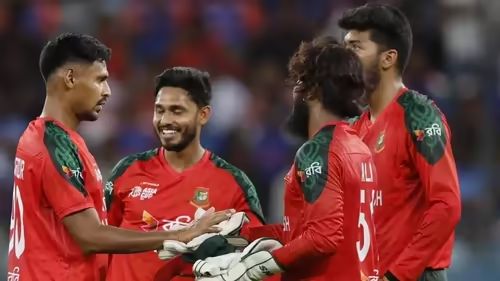
When Fair Play Meets Favoritism: Bangladesh’s Fiery Stand Against the ICC
In a dramatic escalation that’s shaking the cricketing world, the Bangladesh Cricket Board (BCB) has publicly accused the International Cricket Council (ICC) of hypocrisy and double standards over the hosting of the upcoming T20 World Cup. The controversy erupted after the ICC rejected Bangladesh’s formal request to relocate its scheduled matches from India due to serious security and logistical concerns. What makes this rebuke especially potent? The BCB pointed directly to a recent precedent: the ICC’s own decision to allow India to play the 2025 ICC Champions Trophy at a neutral venue—despite being a co-host .
This isn’t just about travel plans or hotel bookings. It’s about perceived inequity at the highest level of global cricket governance—a system many smaller nations feel is tilted in favor of the sport’s financial powerhouses. And with the T20 World Cup just around the corner, tensions are running high.
Table of Contents
- What Sparked the Controversy?
- The Champions Trophy Precedent: India’s ‘Privilege’
- Why Bangladesh Wanted to Move Its Matches
- ICC’s Response and Global Reactions
- Broader Implications for Cricket Governance
- Conclusion: Is Cricket Truly Inclusive?
- Sources
What Sparked the Controversy?
The BCB submitted a formal request to the ICC asking that Bangladesh’s group-stage matches in the T20 World Cup be moved out of India. Citing “prevailing security concerns” and potential diplomatic sensitivities, the board argued that playing in India could pose risks to its players and staff .
However, the ICC swiftly denied the request, stating that all host arrangements were final and that India was fully capable of ensuring safety and smooth operations. This rigid stance stood in stark contrast to the flexibility shown just months earlier regarding the 2025 Champions Trophy—a tournament originally set to be co-hosted by India, Pakistan, and possibly others.
The Champions Trophy Precedent: India’s ‘Privilege’
Here’s where the BCB’s frustration boils over. In late 2024, the ICC confirmed that the 2025 Champions Trophy would be held in Pakistan—but with a major caveat: India’s matches would be played at a neutral venue, likely in the UAE or Sri Lanka, due to political tensions between New Delhi and Islamabad .
While this decision was framed as a pragmatic solution to ensure India’s participation, the BCB sees it as preferential treatment. “If India can be granted a neutral venue for security and political reasons,” a senior BCB official told reporters, “why can’t Bangladesh be given the same consideration?”
The implication is clear: when it comes to the ‘Big Three’—India, England, and Australia—the ICC bends the rules. But for associate or mid-tier nations like Bangladesh, the door remains firmly shut.
Why Bangladesh Wanted to Move Its Matches
Bangladesh’s concerns aren’t baseless. Relations between Dhaka and New Delhi have seen strain in recent months over issues ranging from water-sharing disputes to trade imbalances. While full-blown hostility is absent, the BCB fears that even minor incidents—like fan protests, visa delays, or media sensationalism—could escalate and affect team morale or safety.
Moreover, logistical challenges loom large. Unlike India, which has vast infrastructure and multiple international airports, Bangladesh relies heavily on seamless cross-border coordination. Any disruption could jeopardize training schedules, recovery protocols, and overall performance.
Crucially, the BCB isn’t asking to withdraw—it’s asking for fairness. As one insider put it: “We’re not seeking special treatment. We’re asking for the same courtesy extended to others.”
ICC’s Response and Global Reactions
The ICC has so far offered no public rebuttal to the BCB’s allegations. Privately, however, sources suggest the council views the Champions Trophy arrangement as a unique geopolitical compromise, not a template for future tournaments .
Still, the cricketing community is divided. Former players from Sri Lanka and the West Indies have voiced support for Bangladesh, calling the ICC’s stance “inconsistent.” Meanwhile, Indian officials have dismissed the controversy as “unnecessary politicization” of sport.
Notably, the ICC’s own governance charter emphasizes “equity, inclusivity, and fair treatment for all members” . Critics argue that this episode exposes a gap between principle and practice.
Broader Implications for Cricket Governance
This dispute is symptomatic of a deeper crisis in global cricket administration. For years, smaller nations have complained that the ICC’s decision-making is dominated by the financial clout of the BCCI (India), ECB (England), and CA (Australia). The 2014 restructuring that gave these three boards disproportionate voting power still casts a long shadow.
If the ICC fails to address these perceptions of bias, it risks eroding trust among its full and associate members. In an era where T20 leagues are booming and alternative tournaments are emerging, the ICC can no longer afford to appear tone-deaf to the concerns of half its membership.
For more on how power dynamics shape international cricket, see our deep dive on [INTERNAL_LINK:icc-governance-reform-cricket-democracy].
Conclusion: Is Cricket Truly Inclusive?
The T20 World Cup is meant to be a celebration of global talent—a stage where underdogs can shine and giants can be humbled. But when governance appears skewed, that spirit is compromised. Bangladesh’s protest isn’t just about one tournament; it’s a call for consistent, transparent, and equitable treatment across all member nations.
The ICC now faces a choice: double down on its current stance and risk further alienation, or acknowledge the legitimacy of Bangladesh’s concerns and open a dialogue on fairer protocols. In the end, the credibility of the T20 World Cup—and world cricket itself—depends on whether the game’s guardians truly believe in a level playing field.
Sources
- Times of India: T20 WC row: Bangladesh cite India’s ‘privilege’; accuse ICC of double standards
- ESPNcricinfo: Champions Trophy 2025: India to play at neutral venue
- Cricbuzz: BCB slams ICC over T20 World Cup ‘double standards’
- International Cricket Council: ICC Governance Framework