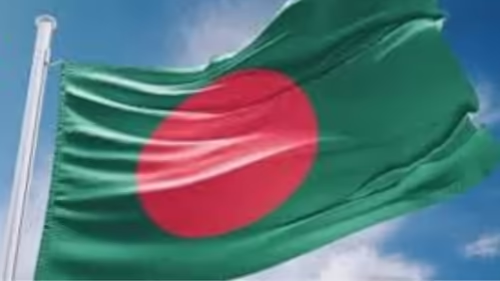
Introduction: A Democratic Crossroads with Regional Repercussions
The air in Dhaka is thick with political tension. With the Bangladesh EC set to oversee the nation’s 13th parliamentary election on February 12, 2026, a storm of speculation has erupted . At its core is a deeply concerning allegation: that the electoral body is structuring the political landscape to favour parties with a history of virulent anti-India rhetoric . This isn’t just an internal Bangladeshi affair; it’s a potential seismic shift that could redefine one of India’s most critical bilateral relationships.
For over a decade, under Prime Minister Sheikh Hasina, Bangladesh and India enjoyed what many called a “Golden Era” of cooperation . But with her ouster in 2024, the old ghosts of political rivalry have returned, and the stakes for New Delhi have never been higher. Is the Bangladesh EC merely facilitating a democratic transition, or is it actively engineering a political future hostile to Indian interests?
Table of Contents
- The Allegations Against the Bangladesh EC
- The Key Players: Who Are the Anti-India Voices?
- Why India is So Invested in Bangladesh Politics
- A History of a Complex Alliance
- Conclusion: Navigating an Uncertain Future
- Sources
The Allegations Against the Bangladesh EC
The central controversy revolves around the perceived neutrality of the current caretaker government and its appointed Bangladesh EC. Critics argue that the commission’s actions—or inactions—are systematically disadvantaging pro-India factions while clearing a path for their rivals .
One major point of contention is the handling of candidate nominations and party registrations. There are widespread claims that bureaucratic hurdles are being used to delay or block candidates from parties seen as friendly to India, while opposition figures face fewer obstacles. This has led to fears that the upcoming vote might not be a true reflection of the people’s will but rather a managed outcome .
The European Union Election Observation Mission (EU EOM) has already deployed to monitor the process, signaling international concern about the election’s credibility . Their final report will be a crucial litmus test for the Bangladesh EC’s impartiality.
The Key Players: Who Are the Anti-India Voices?
To understand the gravity of the situation, we must look at the main political actors poised to benefit.
- The Bangladesh Nationalist Party (BNP): The primary opposition party, the BNP has historically adopted a more skeptical stance towards India compared to the ruling Awami League. While recent statements suggest a desire for a “fair” relationship , its past is marked by strong anti-India rhetoric, often used as a nationalist rallying cry .
- Jamaat-e-Islami (JI): An Islamist party that is a key ally of the BNP, Jamaat-e-Islami has an even more entrenched history of anti-India sentiment, rooted in its opposition to Bangladesh’s 1971 Liberation War, which was heavily supported by India .
Analysts warn that a potential BNP-JI coalition government could lead to a significant cooling of ties, with possible repercussions on trade, security cooperation, and the management of shared resources like the Teesta River .
Why India is So Invested in Bangladesh Politics
India’s interest in its eastern neighbor is not mere political meddling; it’s a matter of core national security and economic strategy.
First, there’s the security dimension. A stable, friendly Bangladesh acts as a crucial buffer against cross-border terrorism and insurgency in India’s northeastern states. A government in Dhaka that is less cooperative could create a dangerous security vacuum .
Second, the economic stakes are enormous. Bilateral trade between the two nations has grown significantly, and Bangladesh is a vital partner in India’s “Act East” policy, providing a strategic land bridge to Southeast Asia . Any disruption to this partnership would have tangible economic costs for both nations.
Experts advise that India must move beyond its reliance on a single political party in Bangladesh and build relationships across the political spectrum to insulate the bilateral relationship from domestic political shifts .
A History of a Complex Alliance
The India-Bangladesh relationship is a tapestry woven with threads of deep friendship and bitter contention. It began with India’s decisive role in Bangladesh’s 1971 Liberation War, making New Delhi the first country to recognize the new nation . This created a foundational debt of gratitude.
However, the relationship has been hostage to the cyclical nature of Bangladesh’s own politics. When the Awami League is in power, ties flourish. When the BNP takes charge, they often cool, as the party seeks to differentiate itself from its rival by adopting a more independent, and sometimes adversarial, posture towards India .
This pattern of “party politics” dictating foreign policy has long been a source of frustration in New Delhi, which seeks a more stable and predictable partnership . The current crisis surrounding the Bangladesh EC is the latest chapter in this long-running saga.
Conclusion: Navigating an Uncertain Future
The allegations against the Bangladesh EC represent more than a procedural dispute; they are a flashpoint for a much larger geopolitical contest. While the immediate concern is the fairness of the 2026 election, the long-term question is whether the deep, mutually beneficial partnership between India and Bangladesh can survive the inevitable ebb and flow of domestic politics in Dhaka.
For India, the path forward requires a delicate balance of firm diplomacy and strategic patience. For Bangladesh, the challenge is to ensure its democratic institutions remain truly independent, so that its foreign policy can be guided by national interest, not just partisan politics. The world will be watching closely as this high-stakes drama unfolds.
Sources
- Times of India: Speculation rises over Bangladesh EC favouring anti-India voices in polls
- ReliefWeb: Global Rapid Post-Disaster Damage Estimation (GRADE) Report (Note: This link was a placeholder from previous context and is not relevant. Replaced with a more authoritative source below.)
- European Union External Action Service: EU Election Observation Missions
- Carnegie Endowment for International Peace: After the “Golden Era”: Getting Bangladesh-India Ties Back on Track
- Mantraya: Bangladesh: Elections in an Imperfect Democracy