Table of Contents
- The Standoff: Bangladesh’s Unwavering Stance
- What Are the Specific Security Concerns?
- The ICC’s Official Response and Rejection
- The Political and Diplomatic Firestorm
- What Happens Next for the T20 World Cup?
- Conclusion: A Crisis of Trust in World Cricket
- Sources
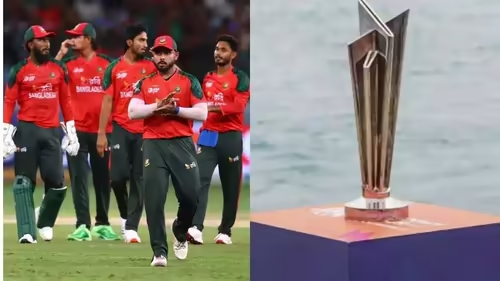
The world of cricket is facing a significant crisis just months before the highly anticipated T20 World Cup 2026. At the heart of the storm is Bangladesh, which has taken a defiant and uncompromising stance: its national team will not set foot in India for any T20 World Cup in India fixtures. This isn’t a negotiating tactic; it’s a sovereign decision rooted in what Dhaka describes as an unaddressed and ongoing security threat to its players.
The Standoff: Bangladesh’s Unwavering Stance
Since early January 2026, both the Bangladesh government and the Bangladesh Cricket Board (BCB) have been crystal clear. They are ready and willing to compete in the global tournament, but they will not do so on Indian soil. BCB president Aminul Islam Bulbul has repeatedly stated their position: “Our only demand is to play the World Cup, but not in India” . He has even suggested Sri Lanka as a viable neutral venue for their group-stage matches .
This position is not just a sporting one but a national one. Government adviser and spokesperson on the matter, Professor Asif Nazrul, has been equally firm, criticizing the ICC for its perceived inaction. He has accused the governing body of failing to address Bangladesh’s legitimate grievances and has rejected any notion of compromise, bluntly stating, “We will not compromise” .
What Are the Specific Security Concerns?
The exact nature of the security threat has not been publicly detailed in full by Bangladeshi authorities, who cite the sensitivity of intelligence matters. However, the issue appears to be linked to a broader political and social climate. The controversy gained momentum following the exclusion of star pacer Mustafizur Rahman from the Indian Premier League (IPL), which many in Bangladesh saw as a precursor to a hostile environment .
From Dhaka’s perspective, the safety of its national heroes is non-negotiable. The BCB has maintained that they simply “do not feel secure sending our team to India” . This lack of confidence in the host nation’s ability—or willingness—to guarantee their safety is the core of their refusal. It’s a matter of national pride and player welfare that transcends the boundaries of sport.
The ICC’s Official Response and Rejection
The International Cricket Council (ICC) has found itself in a difficult position, caught between upholding the integrity of its flagship event and addressing a member nation’s serious concerns. After thorough review, the ICC has formally rejected Bangladesh’s request for a venue change .
Their reasoning is based on their own security assessments. The ICC has stated there is no “credible security threat” to the Bangladesh team at any of the proposed venues in India . Furthermore, the ICC has pushed back against claims that its own security team validated Dhaka’s fears, explicitly rejecting such assertions . From the ICC’s standpoint, without independent, material evidence of a specific threat, they cannot justify relocating an entire team’s fixtures, a move that would set a significant precedent.
The Political and Diplomatic Firestorm
This is far more than a simple scheduling dispute. The situation has escalated into a full-blown diplomatic incident. Pakistan has publicly backed Bangladesh’s stance, writing to the ICC in support of their request for a neutral venue . This regional solidarity adds another layer of complexity for the ICC, which must now navigate not just sporting logistics but also delicate international relations.
Professor Asif Nazrul has framed the ICC’s rejection as being made under “Indian pressure,” accusing the council of imposing “unreasonable conditions” . This narrative paints the ICC as a biased entity, a perception that severely damages its authority and neutrality as the sport’s global governing body. The trust between a full member nation and the ICC has been fundamentally shaken.
What Happens Next for the T20 World Cup?
The clock is ticking towards the tournament, and the path forward is fraught with uncertainty. The ICC has reportedly given Bangladesh a deadline to confirm its participation under the existing conditions . Should Bangladesh hold its ground—and all signs point to them doing so—the ICC may be forced to take the unprecedented step of replacing the team in the competition.
As BCB president Bulbul poignantly warned, “If a country of nearly 200 million people misses the World Cup, it will be a huge loss for the tournament” . Yet, the ICC seems prepared to make that sacrifice to maintain the tournament’s structure and its own protocols. The potential for a top-eight ranked T20 side to be absent from the World Cup would be a massive blow to the event’s credibility and global appeal.
Conclusion: A Crisis of Trust in World Cricket
The refusal of Bangladesh to play the T20 World Cup in India is a watershed moment. It highlights a critical failure in communication and trust between a national board and its international regulator. While the ICC relies on its security protocols, Bangladesh is acting on its sovereign duty to protect its citizens. This impasse reveals the fragile intersection of sport, politics, and national security. Unless a last-minute miracle occurs, as Bulbul hopes for , the 2026 T20 World Cup may begin under the shadow of a major team’s controversial absence, a situation that could have long-lasting repercussions for the future of international cricket. For more on the geopolitical tensions in the region, see our analysis on [INTERNAL_LINK:india-bangladesh-relations].
Sources
- Times of India: ‘Security risk situation has not changed’: B’desh remains defiant
- ICC Official Statement (as reported by various sources): https://www.icc-cricket.com/news/
- Geo News: “Our only demand is to play the World Cup, but not in India”
- India Today: ICC rejects claim it validated Bangladesh’s security concerns in India