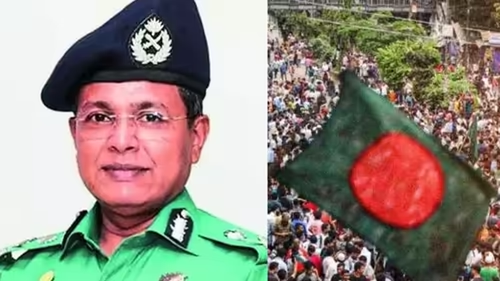
The gavel has fallen in Dhaka, and its echoes are being felt across the globe. In a historic and chilling verdict, Bangladesh’s International Crimes Tribunal (ICT) has sentenced three former top-ranking police officials to death for crimes against humanity. At the center of this seismic legal event is the fugitive former Dhaka Metropolitan Police (DMP) commissioner, Habibur Rahman, along with his deputies, Sudip Kumar Chakraborty and another senior officer [[18]].
This isn’t just another court ruling; it’s a direct reckoning with the violent summer of 2024 that saw the dramatic ouster of Prime Minister Sheikh Hasina and left a trail of blood on the streets of the capital. If you’ve been following the political tremors in South Asia, this is the moment that crystallizes the chaos.
Table of Contents
- The Verdict: Who Was Sentenced and Why
- What Constitutes “Crimes Against Humanity” in This Case?
- The 2024 Protests: The Spark That Lit the Fire
- How the Crackdown Led to the Fall of Sheikh Hasina
- Global Implications and the Path Forward
The Verdict: Who Was Sentenced and Why
On January 27, 2026, the restructured International Crimes Tribunal delivered its second major verdict, finding the three former police officials guilty in absentia [[15]]. The court concluded that they were the masterminds behind a systematic and brutal campaign of violence against civilians during the anti-government protests of July and August 2024.
The convicted individuals are:
- Habibur Rahman: Former Commissioner of the Dhaka Metropolitan Police (DMP).
- Sudip Kumar Chakraborty: Former Joint Commissioner of the DMP.
- A third senior DMP official whose name has been consistently reported alongside the other two [[18]].
All three are currently fugitives, believed to be outside Bangladesh, which adds a layer of international complexity to the enforcement of these Bangladesh death sentences.
What Constitutes “Crimes Against Humanity” in This Case?
The tribunal’s charge of “crimes against humanity” is not used lightly. It refers to widespread or systematic attacks directed against any civilian population. In this specific context, the court found that the actions of the convicted officers went far beyond maintaining order.
Evidence presented during the trial pointed to a coordinated strategy involving:
- Indiscriminate live-fire on unarmed protesters.
- Targeted killings of protest leaders and organizers.
- Widespread torture and enforced disappearances.
This systematic brutality, ordered from the highest levels of the capital’s police force, is what elevated their actions from mere human rights violations to the level of an international crime.
The 2024 Protests: The Spark That Lit the Fire
To understand the gravity of this verdict, one must look back at the tumultuous events of mid-2024. What began as student-led demonstrations against a controversial job quota system quickly snowballed into a nationwide movement demanding the resignation of Prime Minister Sheikh Hasina [[10]].
The government’s response, orchestrated by the Dhaka police leadership, was swift and savage. Reports from the United Nations and independent human rights groups later confirmed that the crackdown resulted in a staggering death toll. A UN investigation revealed that as many as 1,400 people may have been killed between July and August 2024 alone [[9]].
This period of intense state violence, now known as the “Chankharpul Killings” among other names, became the catalyst for the government’s ultimate collapse [[12]].
How the Crackdown Led to the Fall of Sheikh Hasina
Paradoxically, the very crackdown designed to crush the dissent is what ultimately sealed the fate of the Hasina administration. The sheer scale of the violence, broadcast globally, turned public opinion decisively against the government. It also fractured the military and civil service, key pillars of her long-standing rule.
Faced with an ungovernable situation and a complete loss of legitimacy, Sheikh Hasina was forced to resign on August 5, 2024 [[10]]. Her departure marked the end of an era and plunged the country into a period of political transition. The current verdict is a direct consequence of that power vacuum and the new authorities’ attempt to deliver justice for the atrocities committed under the previous regime.
This case is a stark reminder of how state violence can often be its own undoing. For more on the mechanics of political uprisings, see our deep dive on [INTERNAL_LINK:how-civil-disobedience-leads-to-regime-change].
Global Implications and the Path Forward
The international community is watching closely. The use of the “crimes against humanity” framework by a domestic tribunal like the ICT is a significant development in international law. It signals Bangladesh’s intent to hold its own powerful figures accountable, even if they are in exile.
However, the practical challenge remains: how will these Bangladesh death sentences be enforced? This will likely depend on international cooperation and extradition treaties. The verdict also sets a precedent for future cases related to the 2024 uprising, including potential charges against other high-ranking officials from the Hasina government.
For further reading on international legal standards regarding such crimes, the Office of the United Nations High Commissioner for Human Rights (OHCHR) provides a comprehensive overview.
Conclusion: A Nation Seeking Justice
The sentencing of the former Dhaka police chief and his deputies is more than a legal conclusion; it’s a symbolic act of national healing for Bangladesh. It represents a formal acknowledgment of the immense suffering inflicted on its citizens during the summer of 2024. While the fugitive status of the convicts presents a hurdle, the verdict itself is a powerful statement that such egregious abuses of power will not be forgotten or forgiven. The world now waits to see if this pursuit of justice can be fully realized.
Sources
- India Today. “Bangladesh sentences ex-Dhaka police chief, 2 others to death for protest crackdown.” January 27, 2026. [[18]]
- NDTV. “Former Dhaka Police Chief, 2 Cops Sentenced to Death By Bangladesh Tribunal.” January 27, 2026. [[15]]
- United Nations News. “Bangladesh protests probe reveals top leaders led brutal crackdown that left 1,400 dead.” February 12, 2025. [[9]]
- Wikipedia. “Bangladesh post-resignation violence (2024–present).” [[10]]