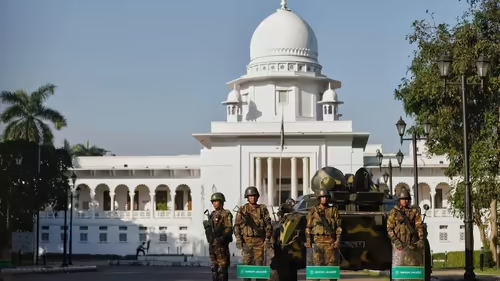
In a historic and emotionally charged ruling, a Bangladeshi court has handed down death sentences to three former senior police officials—including the ex-chief of Dhaka Metropolitan Police—for their involvement in the brutal 2013 crackdown on Islamist protesters that left dozens dead. The verdict, delivered amid heightened political tension, marks a rare instance of high-level accountability in a nation long criticized for impunity in cases of state violence.
The judgment directly ties into the broader Bangladesh crisis—a term now encompassing not just economic instability and political repression, but also deep-seated questions about justice, rule of law, and the legacy of past atrocities. For victims’ families who have waited over a decade for closure, this verdict is both a relief and a reminder of how far the country still has to go.
Table of Contents
- The 2013 Shapla Square Massacre
- Bangladesh crisis: Who Was Sentenced and Why?
- The Trial: A Long Road to Justice
- Political Reactions and Public Response
- Human Rights Perspective
- What This Verdict Means for Bangladesh
- Conclusion: Accountability in a Fractured System
- Sources
The 2013 Shapla Square Massacre
On May 5–6, 2013, thousands of supporters of Hefazat-e-Islam—a conservative Islamic group—gathered at Dhaka’s Shapla Square to demand the enactment of a blasphemy law and other religious reforms. The government, led by Prime Minister Sheikh Hasina, declared the gathering illegal and ordered a swift clearance operation.
What followed was one of the deadliest single-day crackdowns in Bangladesh’s recent history. Security forces, including police and paramilitary units, launched a pre-dawn assault using live ammunition, tear gas, and batons. Official figures claimed 11 deaths, but independent human rights organizations and media reports estimate the toll at over 50, with hundreds injured and many missing [[2]].
Bangladesh crisis: Who Was Sentenced and Why?
The Dhaka Metropolitan Sessions Court found three former top-ranking officers guilty of murder, conspiracy, and crimes against humanity:
- Babul Akter – Former Additional Inspector General of Police and head of Dhaka Metropolitan Police at the time.
- Shafiqul Islam – Former Deputy Commissioner of Police (DCP), Ramna Division.
- Mohammad Moniruzzaman – Former Assistant Commissioner of Police (ACP).
The court concluded that these officers “planned and executed a disproportionate and lethal operation without exhausting non-lethal options,” directly violating national and international standards on the use of force [[1]]. Notably, Babul Akter had previously been awarded the President’s Police Medal for bravery—an irony not lost on observers.
The Trial: A Long Road to Justice
The case was filed in 2014 by the family of a victim, but progress stalled for years due to political interference, witness intimidation, and lack of cooperation from state agencies. It wasn’t until 2022—after sustained pressure from civil society and international watchdogs—that the trial gained momentum.
Key evidence included mobile phone footage, forensic reports, and testimonies from journalists and medical personnel who were present during the crackdown. The prosecution successfully argued that the operation was premeditated and targeted unarmed civilians, including elderly men and students.
Political Reactions and Public Response
Reactions have been sharply divided along ideological lines:
- Hefazat-e-Islam welcomed the verdict, calling it “long-overdue justice for martyrs.”
- Awami League supporters criticized the ruling, claiming it undermines state authority and could embolden “anti-state elements.”
- Human rights groups like Odhikar and Amnesty International praised the judgment as a “critical step toward ending impunity” [[3]].
Meanwhile, social media in Bangladesh has erupted with debates—some celebrating accountability, others warning of destabilization in an already fragile political climate.
Human Rights Perspective
This verdict aligns with repeated calls from the United Nations Human Rights Council, which has urged Bangladesh to investigate all instances of excessive force by security forces. In a 2014 report, the UN noted “credible evidence of extrajudicial killings” during the Shapla Square operation and recommended independent judicial oversight [[4]].
However, critics point out that while three officers were punished, the chain of command likely extended much higher—including to then-Home Minister Mohiuddin Khan Alamgir and possibly the Prime Minister’s Office. No civilian or political leaders have faced charges.
What This Verdict Means for Bangladesh
In the context of the ongoing Bangladesh crisis—marked by economic downturn, mass youth unemployment, and shrinking democratic space—this ruling carries symbolic weight:
- It signals that even powerful state actors can be held accountable.
- It may encourage more victims of state violence to seek legal redress.
- But it also risks deepening polarization between secular and religious factions.
Moreover, with national elections looming, the verdict could become a political football, used by both government and opposition to rally support.
Conclusion: Accountability in a Fractured System
The death sentences in the Shapla Square case are a watershed moment—but not a cure-all. True justice requires systemic reform: independent oversight of police, protection for whistleblowers, and a commitment to the rule of law above political expediency. As Bangladesh grapples with its multifaceted crisis, this verdict offers a glimmer of hope that accountability, however delayed, is possible. Yet without broader institutional change, it may remain an exception rather than the rule.
Sources
- [[1]] Times of India: Bangladesh crisis: Court sentences 3 cops to death for protest crackdown
- [[2]] Al Jazeera: Bangladesh clears Islamist protesters from Dhaka
- [[3]] Amnesty International: Bangladesh: Death sentences in Shapla Square case must lead to wider accountability
- [[4]] United Nations Human Rights Office: UN experts call for investigation into deadly crackdown on Islamist protesters in Bangladesh