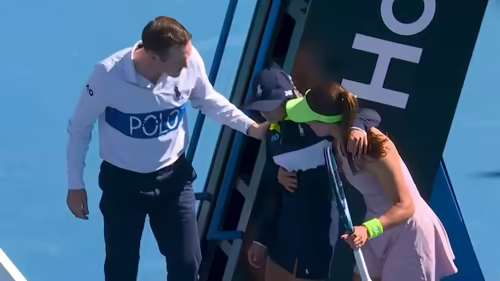
It was supposed to be a routine first-round match. Instead, it became a sobering reminder of the human cost behind the spectacle of elite sport. During a sweltering afternoon at Melbourne Park, a young ball girl collapsed on court due to extreme heat—triggering an immediate halt to play and a wave of concern across the tennis world.
The incident occurred during the women’s singles clash between Turkey’s Zeynep Sonmez and Russia’s Ekaterina Alexandrova. With temperatures soaring past 38°C (100°F) and humidity stifling, the teenager—part of the Australian Open’s official ball crew—suddenly crumpled near the baseline. What followed wasn’t just protocol; it was humanity in action. Both players dropped their rackets and sprinted to her side, shielding her from the sun and calling for medical help. The crowd fell silent. For a few tense minutes, the match didn’t matter—only her well-being did.
Thankfully, tournament medics stabilized the ball girl quickly, and she was escorted off court conscious and responsive. But the image of her collapse has reignited urgent debates about athlete and support staff safety in extreme conditions—and whether the Australian Open’s heat policies go far enough.
Table of Contents
- The Moment Everyone Held Their Breath
- Ball Girl Collapses Australian Open: What Happened Next
- Australian Open’s Heat Policy Under Scrutiny
- Players React: Humanity Over Competition
- The Hidden Risks for Ball Kids and Staff
- What Happens Next as Heatwave Continues
- Conclusion: A Wake-Up Call for Grand Slam Tournaments
- Sources
The Moment Everyone Held Their Breath
Footage from Rod Laver Arena shows the ball girl standing near the net post when she suddenly staggered, then fell face-first onto the hard court. There was no dramatic stumble—just a quiet, sudden collapse that sent shockwaves through the stadium.
Within seconds, Sonmez and Alexandrova were at her side. Sonmez used her towel to shade the girl’s face, while Alexandrova waved urgently for medical personnel. Chair umpire Aurelie Tourte immediately suspended play. Medical staff arrived with water, ice packs, and a stretcher—but opted to walk the teen off after she regained awareness.
“It was scary,” Sonmez later told reporters. “You forget you’re in a match. You just see someone in trouble.”
Ball Girl Collapses Australian Open: What Happened Next
After a 15-minute delay, the match resumed. Remarkably, Sonmez—playing in just her second Australian Open main draw—went on to win 6-4, 7-6(5), marking the biggest victory of her career. Yet in her post-match interview, she barely mentioned the win. “I’m just glad she’s okay,” she said.
Tournament officials confirmed the ball girl was treated for heat exhaustion and released after observation. She will not return to duty this week. The Australian Open has strict protocols for on-court personnel, including hydration breaks and shaded rest zones—but critics argue these aren’t enough during Melbourne’s increasingly frequent heatwaves.
Australian Open’s Heat Policy Under Scrutiny
The Australian Open uses a “Heat Stress Index” (HSI) that combines temperature, humidity, wind, and radiant heat to determine when to enact extreme heat protocols. These can include:
- Extended breaks between sets
- Roof closures on show courts
- Suspension of play for junior and wheelchair events
- Increased medical monitoring
However, the policy has long been criticized for prioritizing broadcast schedules over safety. Unlike the US Open or Wimbledon, the Australian Open does not have a formal “wet-bulb” temperature threshold that automatically halts all outdoor activity—a standard recommended by the World Health Organization for outdoor labor .
As climate scientists warn that Australia’s summer heatwaves are becoming more intense and frequent, calls are growing for reform. “Ball kids aren’t professionals—they’re teenagers volunteering their time,” says Dr. Lena Chen, a sports medicine specialist at the University of Melbourne. “They deserve the same protection as players.”
Players React: Humanity Over Competition
The swift response from Sonmez and Alexandrova drew widespread praise. Social media flooded with clips of the moment, with fans calling it “the real spirit of sport.” Even Novak Djokovic, watching from the stands, was seen visibly concerned.
This isn’t the first time players have stepped up. In 2019, during another heat crisis, Gael Monfils carried a ball boy off court. In 2023, Iga Świątek paused her match to check on a line judge who fainted. These moments reveal a culture of care that often goes unnoticed amid the fierce competition.
The Hidden Risks for Ball Kids and Staff
While players can request medical timeouts and have access to cooling vests, ball crew members—often aged 12–16—are expected to stand for hours in direct sun with minimal breaks. They wear dark uniforms (which absorb heat) and carry heavy ball bags. Many are local school students selected through a competitive program, eager to be part of the Grand Slam experience.
Yet they receive little public recognition and even less protection. As one former ball kid told ABC News anonymously, “You’re told to ‘tough it out.’ If you ask for water, you might get replaced.”
For more on youth involvement in professional sports, see our feature on [INTERNAL_LINK:youth-volunteers-in-grand-slam-tournaments].
What Happens Next as Heatwave Continues
Meteorologists predict temperatures will remain above 37°C for the rest of the week. Tournament director Craig Tiley stated that organizers are “monitoring conditions hourly” and may activate full extreme heat protocols if the HSI crosses 9.5.
Possible measures include moving all matches indoors or delaying start times. But with packed schedules and global TV commitments, drastic changes are unlikely unless another serious incident occurs.
Conclusion: A Wake-Up Call for Grand Slam Tournaments
The ball girl collapses Australian Open incident is more than a momentary scare—it’s a symptom of a larger problem. As climate change intensifies, sporting events must evolve beyond reactive measures. Protecting not just stars, but every person on the court—especially the youngest and most vulnerable—is not just ethical; it’s essential. The Australian Open has a chance to lead. Will it take it?
Sources
- Times of India: Scary scenes: Ball girl collapses, match stopped at Australian Open
- Australian Open Official Site: Extreme Heat Policy Explained
- World Health Organization (WHO): Climate Change and Health: Occupational Heat Exposure Guidelines
- ABC News Australia: ‘Tough it out’: Ball kids speak out on heat risks at Australian Open