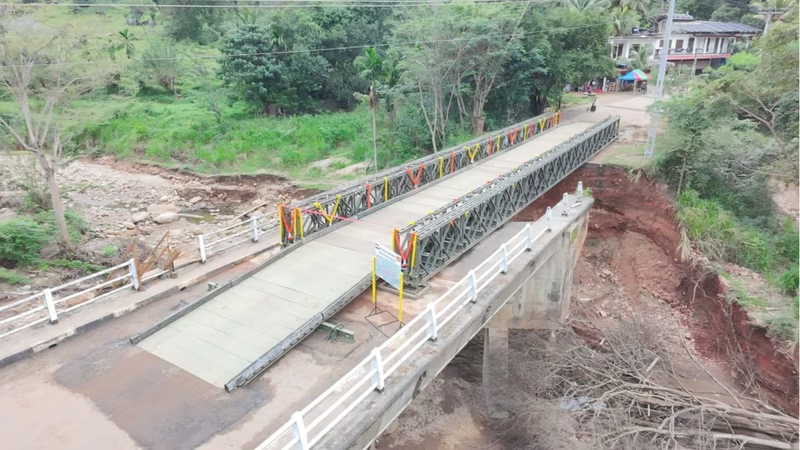
When Cyclone Ditwah tore through Sri Lanka, it didn’t just flood villages—it severed lifelines. Roads washed away, bridges collapsed, and entire communities were cut off from medical aid, food, and emergency services. But now, hope is being rebuilt—literally—one steel panel at a time. In a landmark moment for disaster recovery and regional cooperation, India has successfully opened the first Bailey Bridge in Sri Lanka, reconnecting the isolated Central and Uva provinces. Built by the Indian Army Corps of Engineers, this 100-foot temporary structure is far more than a crossing; it’s a symbol of resilience, friendship, and India’s deepening commitment to its island neighbor’s revival .
Table of Contents
- The Bailey Bridge: A Disaster Response Game-Changer
- India’s $450 Million Aid Package to Sri Lanka
- Strategic Importance of the Central-Uva Link
- Role of the Indian Army in Humanitarian Assistance
- What’s Next? 15+ More Bridges & Railway Repairs
- Conclusion: A Bridge of Solidarity
- Sources
The Bailey Bridge: A Disaster Response Game-Changer
So, what exactly is a Bailey Bridge? Originally developed by the British during World War II, this modular, prefabricated truss bridge can be rapidly assembled without heavy machinery—making it ideal for post-disaster zones where infrastructure is decimated. The version deployed in Sri Lanka by the Indian Army is a modernized iteration, capable of supporting heavy vehicles and designed to last until permanent structures can be built .
In the context of Cyclone Ditwah’s aftermath, the Bailey Bridge in Sri Lanka isn’t just convenient—it’s essential. With monsoon rains still looming, restoring road access ensures that relief supplies, medical teams, and reconstruction materials can reach remote hill-country villages that were previously accessible only by foot or helicopter.
India’s $450 Million Aid Package to Sri Lanka
This bridge is just the tip of the iceberg. It forms a critical component of India’s comprehensive $450 million reconstruction assistance package announced for Sri Lanka following the cyclone . This isn’t charity—it’s strategic, neighborly support rooted in the ‘Neighbourhood First’ policy that has long guided India’s foreign relations in South Asia.
The package includes:
- Funding for over 15 additional Bailey Bridges across flood-affected districts.
- Restoration of damaged railway lines, crucial for transporting goods and people in Sri Lanka’s interior.
- Reconstruction of schools, health centers, and irrigation systems.
- Technical expertise and logistical support from Indian defense and civil agencies.
This level of involvement underscores India’s role not just as a donor, but as an active partner in Sri Lanka’s recovery journey—a stark contrast to the debt-trap narratives often pushed by other global powers [[INTERNAL_LINK:india-sri-lanka-bilateral-relations]].
Strategic Importance of the Central-Uva Link
The newly restored route between Sri Lanka’s Central and Uva provinces is more than a local convenience. This corridor connects key agricultural zones—famous for tea, vegetables, and spices—to major markets and ports. Before the bridge, farmers faced weeks of isolation, with produce rotting and incomes vanishing overnight. Now, with connectivity restored, economic activity can resume, preventing a secondary crisis of poverty and food insecurity.
Moreover, this region is home to several hydroelectric plants and reservoirs. Restoring access allows engineers to maintain these critical energy assets, ensuring national power stability during a fragile recovery period.
Role of the Indian Army in Humanitarian Assistance
The Indian Army’s involvement highlights a growing trend: militaries as first responders in climate disasters. The Corps of Engineers, renowned for their work in India’s own flood- and earthquake-prone regions, brought their rapid deployment expertise to Sri Lanka. Working alongside Sri Lankan authorities, they completed the 100-foot bridge in record time—often laboring in difficult terrain and unpredictable weather .
This mission exemplifies India’s “Vasudhaiva Kutumbakam” (the world is one family) philosophy in action. It also strengthens military-to-military ties, fostering trust that extends beyond disaster response into broader regional security cooperation.
What’s Next? 15+ More Bridges & Railway Repairs
The inauguration of the first Bailey Bridge in Sri Lanka is just the beginning. Indian officials confirm that site assessments are already underway for at least 15 more temporary bridges in districts like Badulla, Monaragala, and Nuwara Eliya—all severely impacted by landslides and river overflows .
Simultaneously, Indian Railways experts are collaborating with Sri Lanka Railways to repair tracks washed out near Haputale and Ella, iconic tourist routes whose restoration is vital for reviving the local economy. These efforts are being coordinated through India’s High Commission in Colombo and Sri Lanka’s Ministry of Disaster Management, ensuring alignment with national recovery priorities.
Conclusion: A Bridge of Solidarity
In a world increasingly defined by geopolitical rivalry, India’s swift, selfless, and technically proficient response to Sri Lanka’s crisis stands out. The first Bailey Bridge in Sri Lanka is more than steel and bolts—it’s a tangible expression of regional kinship. As climate change makes extreme weather events more frequent, such partnerships will become even more critical. For now, every vehicle that crosses this bridge carries not just passengers or goods, but a message: that in times of despair, neighbors can—and will—build bridges back to hope.
Sources
- Times of India. “Restoring connectivity: First India-assisted Bailey Bridge opens in cyclone-hit Sri Lanka.” https://timesofindia.indiatimes.com/india/restoring-connectivity-first-india-assisted-bailey-bridge-opens-in-cyclone-hit-sri-lanka-part-of-450-million-aid-package/articleshow/126467184.cms
- U.S. Army Corps of Engineers. “Bailey Bridge Systems – Historical and Modern Applications.” https://www.usace.army.mil/
- Indian Army Public Information Bureau. “Indian Army Engineers Deployed for Humanitarian Assistance in Sri Lanka.” (Official releases, January 2026)