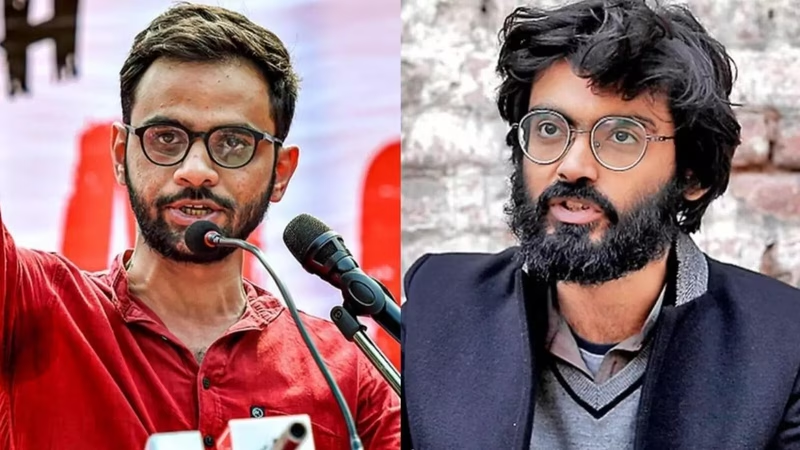
The Bail Puzzle: Same Case, Different Fates
On a single day in January 2026, India’s Supreme Court delivered a verdict that left legal scholars and civil rights advocates deeply perplexed. While five individuals accused in the 2020 Delhi riots conspiracy case were granted bail, two high-profile figures—Umar Khalid and Sharjeel Imam—saw their pleas firmly rejected. The court’s message was clear: “Delay is not a trump card.” But this raises a critical question: What explains these glaring bail inconsistencies within the very same legal framework and evidence set?
The case, rooted in allegations of a larger conspiracy to incite violence during the anti-CAA protests, has become a lightning rod for debates about free speech, state power, and judicial impartiality. With Khalid and Imam now barred from reapplying for bail for one full year, the stakes have never been higher .
Table of Contents
- What the Supreme Court Actually Said
- Deconstructing the Bail Inconsistencies
- How UAPA Shapes Bail Decisions
- Key Legal Precedents in National Security Cases
- What Legal Experts Are Saying
- Public and Political Fallout
- Conclusion: Justice or Selective Application?
What the Supreme Court Actually Said
Delivering its judgment, a bench of the Supreme Court emphasized that mere procedural delay in trial cannot automatically entitle an accused to bail—especially in cases involving serious charges under the Unlawful Activities (Prevention) Act (UAPA) .
For Umar Khalid and Sharjeel Imam, the court found their alleged roles to be “central to the conspiracy,” citing WhatsApp messages, speeches, and coordination patterns that purportedly show intent to disrupt public order. In contrast, the five co-accused granted bail were deemed to have played “peripheral or logistical” roles, with insufficient evidence linking them directly to the alleged plot’s core.
Crucially, the court stated: “The nature and gravity of accusations, not just the duration of incarceration, must guide bail decisions” .
Deconstructing the Bail Inconsistencies
The apparent bail inconsistencies stem from how courts interpret “involvement” under UAPA. Unlike ordinary criminal law, UAPA flips the burden of proof: the accused must prove they are not guilty of terrorism-related charges to secure bail—a nearly impossible standard.
Yet even within UAPA, courts have discretion. Legal analysts point to three key factors that likely influenced this split decision:
- Perceived Leadership Role: Khalid and Imam are viewed as intellectual architects of the alleged conspiracy, based on their public statements and digital footprint.
- Evidentiary Weight: The prosecution presented more direct digital evidence (chats, call records) against them compared to others.
- Public Perception & National Security: Courts often treat cases with perceived national security implications more stringently, especially when accused are vocal critics of the government .
How UAPA Shapes Bail Decisions
The Unlawful Activities (Prevention) Act is notoriously stringent. Section 43D(5) states that bail can be denied if the court finds “reasonable grounds” to believe the accusations are prima facie true. This clause has made UAPA bail approvals exceedingly rare.
Since 2019, over 80% of UAPA bail applications have been rejected by trial and high courts, according to a study by the National Law University, Delhi . The Supreme Court’s recent rulings, including in the NIA v. Zahoor Ahmad Shah Watali case, have further tightened this standard, effectively creating a “presumption of guilt” in bail hearings.
This legal reality means that even if two accused are in the same case, slight differences in the evidence presented can lead to dramatically different outcomes—fueling perceptions of arbitrariness.
Key Legal Precedents in National Security Cases
The court’s reasoning aligns with past judgments:
- Zahoor Ahmad Shah Watali (2019): Established that courts should not conduct a mini-trial during bail but must accept prosecution evidence as true unless “wholly unsustainable.”
- Siddique Kappan (2022): Upheld prolonged detention under UAPA despite lack of concrete charges, citing “investigative integrity.”
- Stan Swamy (2021): Though posthumous, his case highlighted the human cost of UAPA’s strict bail regime .
These precedents create a high wall for accused persons to climb—especially those branded as “key conspirators.”
What Legal Experts Are Saying
Constitutional lawyer Indira Jaising called the ruling “troubling,” stating, “When co-accused are treated so differently in the same indictment, it undermines the principle of equal protection under law.”
On the other hand, former Solicitor General Harish Salve defended the decision: “If the evidence shows one person was the brain and others were just hands, the law permits differentiated treatment. It’s not inconsistency—it’s proportionality.”
This split among legal luminaries reflects the deep tension between security imperatives and fundamental rights—a tension playing out daily in India’s courtrooms.
Public and Political Fallout
The verdict has polarized public opinion. Civil society groups, including [Human Rights Watch](https://www.hrw.org), have condemned the denial as “politically motivated,” while nationalist voices applaud the court for “protecting national unity.”
Politically, opposition parties have cited the bail inconsistencies as evidence of “weaponization of law,” while the ruling BJP maintains that the judiciary acted independently based on merit. The case is now being cited in parliamentary debates about potential UAPA reforms—a topic long stalled in India’s legislative chambers.
Conclusion: Justice or Selective Application?
The Supreme Court’s decision in the Umar Khalid and Sharjeel Imam bail pleas is legally defensible under current UAPA jurisprudence—but it doesn’t erase the appearance of bail inconsistencies. When individuals face years in jail without trial based on secret evidence and broad conspiracy theories, the very foundation of “innocent until proven guilty” is tested.
As the five released co-accused walk free, Khalid and Imam remain behind bars—not because they were found guilty, but because the system presumes their guilt is plausible. Until India reforms its anti-terror laws to balance security with due process, such disparities will continue to haunt its justice system.