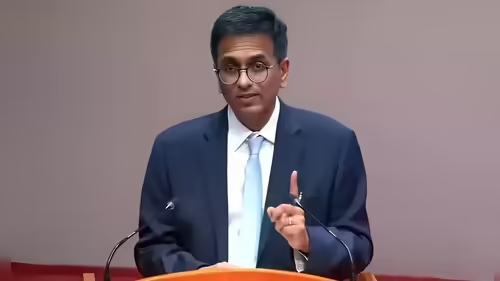
When former Chief Justice of India (CJI) D.Y. Chandrachud recently declared, “Bail is a right, not a favour,” he wasn’t just stating a legal opinion—he was reigniting a decades-old debate about fairness, liberty, and power in India’s criminal justice system. But instead of sparking scholarly discussion, his words triggered a political firestorm: the Congress party dismissed it as mere “fancy words,” while the BJP rushed to defend the ex-CJI’s stance .
This clash isn’t just about semantics. It cuts to the heart of how India treats its citizens before conviction—especially in an era where high-profile arrests, prolonged undertrial detentions, and weaponized investigations have become routine. Understanding the bail as right Chandrachud remark is essential to grasping the deeper crisis of justice delayed and denied.
Table of Contents
- What Did Ex-CJI Chandrachud Actually Say?
- Congress Dismisses It as ‘Fancy Words’—What’s Their Argument?
- BJP Defends: Judicial Independence and Legal Principle
- The Legal Truth: Is Bail Really a Right in India?
- Why This Matters: The Human Cost of Denied Bail
- Global Perspective: How Other Democracies Handle Bail
- Conclusion: Beyond Politics—a Call for Justice Reform
- Sources
What Did Ex-CJI Chandrachud Actually Say?
Speaking at a public lecture on judicial ethics and liberty, Justice Chandrachud emphasized a foundational principle of criminal jurisprudence: “Liberty is the rule; incarceration is the exception.” He stressed that under Indian law, accused persons are presumed innocent until proven guilty—and therefore, granting bail should be the norm, not the exception .
He cited landmark judgments, including the Supreme Court’s own rulings in State of Rajasthan v. Balchand (1977) and Siddharam Satlingappa Mhetre v. State of Maharashtra (2011), which affirm that “bail, not jail” must guide judicial discretion—especially when trial delays stretch for years.
Congress Dismisses It as ‘Fancy Words’—What’s Their Argument?
Congress spokesperson Jairam Ramesh quickly retorted that such statements are “fancy words” disconnected from ground realities . The party implied that the remark could be interpreted as soft on crime—particularly white-collar offenses like corruption or money laundering, where powerful individuals often secure bail while ordinary citizens languish in jails.
Their underlying concern? That in practice, bail has become a privilege for the rich and connected. By calling it a “right,” critics fear it might further entrench inequality—allowing influential accused to evade accountability while the system remains inaccessible to the poor.
BJP Defends: Judicial Independence and Legal Principle
In contrast, BJP leaders hailed Chandrachud’s statement as a reaffirmation of constitutional values. Union Minister Arjun Ram Meghwal stated, “This is not politics—it’s the bedrock of our justice system” .
The BJP’s defense aligns with its long-standing narrative of supporting judicial autonomy—especially under a CJI appointed during its tenure. But it also serves a strategic purpose: distancing itself from accusations of using investigative agencies like the ED and CBI to target opposition figures through prolonged custody without bail.
The Legal Truth: Is Bail Really a Right in India?
Technically, yes—but with major caveats. Under Sections 436–439 of the Code of Criminal Procedure (CrPC):
- Bailable offenses: Bail is a statutory right—police must release the accused if they fulfill conditions.
- Non-bailable offenses: Bail is discretionary—granted by courts based on factors like flight risk, evidence strength, and public interest.
However, special laws like the Prevention of Money Laundering Act (PMLA) and UAPA impose stringent bail conditions, effectively making bail nearly impossible for certain charges. This creates a two-tier system: one for ordinary crimes, another for politically sensitive or financial cases.
Why This Matters: The Human Cost of Denied Bail
The stakes are life-altering. Consider these facts:
- Over 70% of India’s 554,000 prison inmates are undertrials—not convicts .
- Many spend years behind bars waiting for trials that may never conclude.
- Families lose breadwinners, children drop out of school, and mental health deteriorates.
As Justice Chandrachud has repeatedly warned, denying bail without justification turns presumption of innocence into a hollow promise. [INTERNAL_LINK:india-undertrial-crisis] This isn’t theoretical—it’s a daily tragedy in district courts across the country.
Global Perspective: How Other Democracies Handle Bail
India isn’t alone—but its approach lags behind peers:
- United States: Bail is a constitutional right (8th Amendment), though cash bail systems create their own inequities.
- United Kingdom: “Presumption in favor of bail” is enshrined in law, with exceptions only for serious risks.
- Canada: Courts must release accused unless detention is necessary for public safety or court integrity.
International human rights bodies, including the UN, consistently urge India to align its bail practices with global standards on pretrial liberty .
Conclusion: Beyond Politics—a Call for Justice Reform
The controversy over the bail as right Chandrachud remark reveals more about India’s political polarization than its legal reality. Yet beneath the noise lies a urgent truth: a justice system that routinely denies liberty before conviction betrays its own ideals. Whether you call it a “right” or a “principle,” the outcome must be the same—fair, timely, and equal access to freedom for all, regardless of status. Until then, “fancy words” may be all we have left.
Sources
- Times of India: “’Fancy words’: Cong on ex-CJI Chandrachud’s ‘bail as right’ remark; BJP reacts”
- National Crime Records Bureau (NCRB) – Prison Statistics India 2024: Official Data
- United Nations Office on Drugs and Crime (UNODC) – Pretrial Justice Guidelines: Global Standards