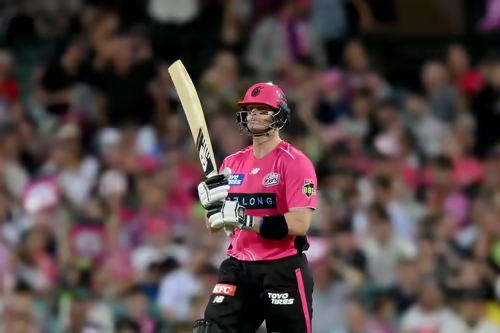
Cricket fans love a good drama—especially when it involves two of the game’s biggest stars. So when whispers spread across social media about a supposed ‘Babar Azam tantrum’ during a recent Big Bash League (BBL) match alongside Steve Smith, the internet lit up with speculation. Was there a rift? A leadership clash? A cultural misunderstanding?
Turns out, none of the above.
In a candid post-match clarification, Steve Smith not only debunked the rumors but offered a masterclass in modern T20 tactics—revealing that what looked like frustration was actually a calculated, high-stakes strategic call that paved the way for his explosive century. And far from being at odds, Smith confirmed he and Babar share a strong, respectful working relationship.
Table of Contents
- What Actually Happened During the BBL Match?
- The ‘Babar Azam Tantrum’ Myth: How It Started
- Smith’s Tactical Genius: Why the Power Surge Call Mattered
- Inside the Smith-Babar Relationship: No Rift, Just Respect
- Why On-Field Moments Get Misread (Especially in T20)
- What This Means for the Sydney Sixers’ BBL Campaign
- Conclusion: Context Over Clickbait
- Sources
What Actually Happened During the BBL Match?
During a high-pressure Sydney Sixers innings, Steve Smith was batting with Babar Azam at the crease. At a crucial juncture—around the 10-over mark—Smith signaled to delay taking the Power Surge, a BBL-specific rule allowing teams to take a two-over powerplay with only two fielders outside the circle, anytime between overs 11–20 .
Babar, possibly expecting the surge to be taken immediately for quick runs, appeared animated—gesturing toward the dugout and exchanging a few words with Smith. Cameras zoomed in. Social media erupted. Headlines wrote themselves: “Babar furious!” “Smith ignores captain?” “Sixers dressing room tension!”
But as Smith later explained, the decision was purely tactical—and ultimately brilliant.
The ‘Babar Azam Tantrum’ Myth: How It Started
The term “Babar Azam tantrum” originated from a single viral clip showing Babar’s expressive body language. In cricket, especially in high-intensity leagues like the BBL, players often communicate passionately—pointing, gesturing, even shouting mid-pitch. It’s part of the game’s emotional fabric.
However, without context, such moments are easily weaponized. Fan pages, meme accounts, and even some media outlets amplified the clip as evidence of discord. The narrative gained traction because it fit a familiar trope: the star foreign player clashing with the local legend.
But as Smith put it bluntly: “There was no issue at all.”
Smith’s Tactical Genius: Why the Power Surge Call Mattered
Smith’s reasoning was simple yet sophisticated. He noticed the opposition’s death bowlers were being held back. By delaying the Power Surge until overs 16–17, he could catch those bowlers off guard during their most vulnerable phase—when they’re typically managing yorkers and slower balls under pressure.
“I wanted to maximize our scoring in the last five overs,” Smith said. “Taking the surge early would’ve just given them time to adjust. Waiting let us hit them when they weren’t ready.”
The result? Smith smashed 108 off just 59 balls, with over 70% of his runs coming after the delayed Power Surge—a textbook example of strategic patience paying off .
Inside the Smith-Babar Relationship: No Rift, Just Respect
Far from being adversaries, Smith and Babar have developed a strong rapport since becoming teammates at the Sydney Sixers. Both are former captains, elite batsmen, and students of the game. Their on-field dialogue is frequent, intense, and collaborative.
After the match, the pair was seen laughing and chatting near the boundary rope—hardly the body language of feuding teammates. Smith emphasized: “Babar’s one of the best in the world. We talk tactics all the time. What you saw was just two players trying to win a game.”
This aligns with broader trends in modern cricket, where international stars form deep professional bonds across national lines—think Kohli-Warner or Root-Stokes. [INTERNAL_LINK:cricket-team-dynamics]
Why On-Field Moments Get Misread (Especially in T20)
T20 cricket moves fast—both physically and emotionally. In that environment:
- Micro-expressions are magnified by broadcast cameras.
- Players use shorthand communication that outsiders can’t decode.
- Narratives often override facts in the race for engagement.
- Cultural differences in expressiveness (e.g., South Asian vs. Australian styles) can be misread as conflict.
As the International Cricket Council (ICC) has noted, “Context is everything in interpreting player behavior” . Without post-match explanations, fans are left to fill in the blanks—often incorrectly.
What This Means for the Sydney Sixers’ BBL Campaign
Rather than exposing division, this incident highlights the Sixers’ strength: intelligent, adaptable batting leadership. With Smith and Babar firing in sync, the team becomes a serious title contender.
Coach Greg Shipperd praised the duo’s “game awareness” and called the Power Surge call “one of the smartest decisions I’ve seen in BBL history.” If the Sixers go on to win BBL|15, this moment might be remembered not as drama—but as the turning point.
Conclusion: Context Over Clickbait
The so-called “Babar Azam tantrum” is a classic case of optics overriding reality. What looked like conflict was, in fact, collaboration at its most strategic. Steve Smith didn’t just clear the air—he reminded us that elite sport is won not through ego, but through precise, sometimes counterintuitive decisions.
Next time you see a heated exchange on the pitch, pause before sharing. Because more often than not, it’s not a meltdown—it’s a masterstroke in disguise.
Sources
- Times of India: Steve Smith reveals truth behind Babar Azam ‘tantrum’ claims as BBL drama erupts
- Big Bash League Official Rules: Power Surge Explained – BBL Regulations
- ESPNcricinfo Match Report: Sydney Sixers vs. [Opponent], BBL|15 (January 2026).
- International Cricket Council (ICC): Guidelines on Interpreting Player Conduct