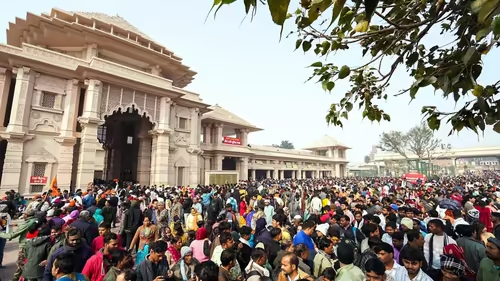
The serene atmosphere of Ayodhya was shattered on Saturday night by a single, terrifying phone call: a Ayodhya Ram Temple bomb threat. The announcement of a potential explosive device at one of India’s most sacred and heavily guarded sites instantly triggered a massive security response, putting the entire city on high alert. While authorities have since detained a suspect from Gonda district and are leaning towards the incident being the act of a mentally unstable individual, the event has raised critical questions about security protocols, the psychology behind such threats, and the vulnerability of national symbols in the digital age.
Table of Contents
- The Night of Fear: What Happened at the Ram Temple?
- Swift Response: Ayodhya Ram Temple Bomb Threat Security Protocol in Action
- The Suspect: Who is the Gonda Man and What Does It Mean?
- Beyond the Headlines: Analyzing the Motive and Credibility
- How India Protects Its Most Sensitive Sites
- Conclusion: A Test of Resilience for Ayodhya and India
- Sources
The Night of Fear: What Happened at the Ram Temple?
On the evening of January 24, 2026, a call was received by local authorities claiming that a bomb had been planted inside the premises of the grand Ram Temple in Ayodhya . Given the temple’s immense religious, cultural, and political significance, this was not a threat to be taken lightly. The timing was particularly sensitive, coming just over a year after its historic inauguration and during a period of heightened national attention on the site.
Details from the initial investigation suggest the caller was a man from the Gonda district of Uttar Pradesh. Preliminary inquiries by the police indicate he may have been under the influence of alcohol and could be suffering from mental health issues [[1], [2]]. However, in the immediate aftermath, no one knew this. All that mattered was the potential for catastrophic loss of life at a site that draws millions of pilgrims every year.
Swift Response: Ayodhya Ram Temple Bomb Threat Security Protocol in Action
The security apparatus around the Ram Temple, known to be one of the most fortified in the country, swung into immediate action. A multi-layered response was initiated:
- Immediate Lockdown: The temple complex and surrounding areas were swiftly evacuated and sealed off to prevent any potential panic or secondary threats.
- Bomb Disposal Squad (BDS) Deployment: Highly trained bomb disposal experts were rushed to the scene to conduct a thorough and meticulous search of the entire premises using advanced detection equipment.
- Massive Police Mobilization: Local police, state armed police, and central paramilitary forces were deployed in large numbers to secure the perimeter and manage the situation.
- Technical Surveillance: The call was traced using technical means, leading investigators directly to the suspect in Gonda within hours .
Thankfully, after an exhaustive search, the Bomb Disposal Squad gave the all-clear, confirming that the threat was a hoax. The temple was reopened to the public shortly after, but the psychological impact of the event lingered.
The Suspect: Who is the Gonda Man and What Does It Mean?
The rapid identification and arrest of the 28-year-old suspect from Gonda is a testament to the efficiency of modern investigative techniques. However, the emerging narrative—that he was intoxicated and possibly mentally unwell—shifts the conversation from terrorism to a different kind of public safety concern .
This raises a complex question: how should the justice system and society handle individuals who make credible-seeming threats due to a mental health crisis? While his actions caused widespread panic and diverted critical security resources, his intent appears to have been non-malicious, if deeply irresponsible. This case highlights the need for better mental health support systems and clear legal frameworks for dealing with such incidents, which are becoming more common globally.
Beyond the Headlines: Analyzing the Motive and Credibility
Even if the primary motive was a personal crisis, the choice of target is significant. The Ram Temple is more than just a building; it is a potent symbol. Making a threat against it guarantees maximum media attention and public reaction, which might have been the unconscious or conscious goal of the caller. This underscores a dangerous trend where individuals seeking notoriety or a sense of power can exploit the security anxieties of an entire nation with a single phone call.
Security experts, like those at the Observer Research Foundation, often point out that the credibility of a threat is less important than the response it necessitates. In today’s world, every threat must be treated as real until proven otherwise, a reality that places a constant strain on security forces and public resources .
How India Protects Its Most Sensitive Sites
The incident serves as a live-fire test of India’s security infrastructure for its most sensitive locations. The Ram Temple is protected by a multi-tiered security grid involving the Central Industrial Security Force (CISF), state police, and intelligence agencies. This includes perimeter walls, CCTV surveillance, metal detectors, drone-jamming technology, and a dedicated command center .
The swift and coordinated response to this Ayodhya Ram Temple bomb threat demonstrates that these systems are robust and effective. However, it also reveals their vulnerability to low-tech, non-ideological threats that stem from individual instability rather than organized terror networks. Adapting to this new challenge will be a key focus for security planners in the future.
Conclusion: A Test of Resilience for Ayodhya and India
While the immediate danger from the Ayodhya Ram Temple bomb threat has passed, the event has left a lasting impression. It was a stark reminder of the delicate balance between maintaining an open, welcoming place of worship and ensuring its absolute security. The quick work of law enforcement prevented a tragedy, but the underlying issues—mental health, the quest for attention, and the symbolic weight of national monuments—remain. Ayodhya, a city of faith and peace, was tested, and its security apparatus proved its mettle. Now, the focus must shift to preventing such incidents from happening again.
Sources
- The Times of India: “Bomb threat to Ram Temple triggers security alert, 1 held”
- Hindustan Times: “Man held for ‘bomb threat’ to Ayodhya’s Ram temple was drunk, mentally unstable”
- The Indian Express: “Ayodhya Ram temple bomb threat: Call traced to Gonda, accused held”
- Ministry of Home Affairs, Government of India: “Security Arrangements for Shri Ram Janmabhoomi Temple, Ayodhya”
- Observer Research Foundation: “Securing India’s Critical Infrastructure in the Age of Hybrid Threats”