Table of Contents
- A Resignation That Rippled Through UP Politics
- The Ayodhya GST Officer Resigns Drama Unfolds
- Who Is Swami Avimukteshwaranand? And What’s the Shankaracharya Row?
- The Magh Mela Protest and the Government Response
- Two Officers, Two Sides of a Political Divide
- Public Reaction and Bureaucratic Ethics
- Conclusion: A Deepening Cultural and Political Chasm
- Sources
A Resignation That Rippled Through UP Politics
In a move that has stunned both political and bureaucratic circles, a senior tax official in Ayodhya has stepped down from his post—not in protest against the government, but in staunch defense of it. The Ayodhya GST officer resigns story is more than just a personnel change; it’s a flashpoint in a larger cultural and political battle unfolding around the sacred city of Ayodhya.
This resignation comes on the heels of escalating tensions between the Uttar Pradesh government and a prominent Hindu seer, Swami Avimukteshwaranand Saraswati. The incident highlights the intense polarization and deep emotional currents that can run through India’s administrative machinery when faith, politics, and governance collide.
The Ayodhya GST Officer Resigns Drama Unfolds
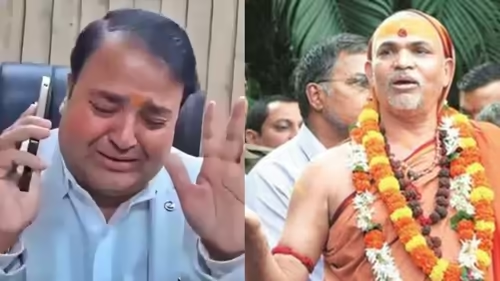
The officer in question, a Deputy Commissioner of GST in Ayodhya, submitted his resignation on Tuesday, January 27, 2026. In a now-viral video, he was seen breaking down in tears as he explained his decision [[1]]. He stated he was “deeply hurt” by the “derogatory remarks” made by Swami Avimukteshwaranand against Prime Minister Narendra Modi, Home Minister Amit Shah, and Chief Minister Yogi Adityanath [[3]].
His resignation letter, while not explicitly detailing every grievance, made it clear that his conscience would not allow him to continue serving while such criticisms of the nation’s leadership went unchallenged from his perspective. This act of public solidarity with the ruling dispensation has been hailed by BJP supporters as an act of patriotism, while critics question its implications for bureaucratic neutrality.
A Counter-Narrative Emerges
What makes this situation even more complex is that this resignation appears to be a direct counter to another high-profile exit. Just days earlier, another senior IAS officer had resigned in protest, allegedly over the state government’s handling of the same Shankaracharya issue [[5]]. This creates a stark dichotomy: one officer leaving to oppose the government’s actions, and another leaving to defend its leaders. It’s a rare and revealing glimpse into the internal fractures within the civil service during times of heightened political sensitivity.
Who Is Swami Avimukteshwaranand? And What’s the Shankaracharya Row?
Swami Avimukteshwaranand Saraswati is a well-known figure in the Hindu monastic order, claiming the title of Shankaracharya of the Jyotir Math—one of the four principal seats established by Adi Shankaracharya. However, his claim to this title has been a subject of long-standing legal and ecclesiastical dispute [[7]].
The current controversy stems from his participation in the Magh Mela in Prayagraj (Allahabad). Reports suggest that the seer faced difficulties in setting up his camp, which he alleges was due to deliberate obstruction by local authorities acting on behalf of the state government [[9]]. The government, however, maintains that the issue was purely procedural, related to a notice questioning the validity of his Shankaracharya title and the need for proper permissions for his large entourage.
The Magh Mela Protest and the Government Response
The Magh Mela, a major Hindu pilgrimage, is a significant event in Uttar Pradesh’s religious and cultural calendar. The alleged obstruction of a prominent seer’s arrangements at such a venue is politically explosive. Swami Avimukteshwaranand responded by launching a protest, which included sharp criticism of the state’s top leadership.
The Yogi Adityanath government has firmly denied any political motivation behind its actions. Officials have stated that all religious groups are treated equally and that the notice served to the seer was a routine administrative measure to verify credentials and ensure compliance with event regulations [[11]]. Despite these assurances, the perception of a targeted action has fueled the fire, leading to the chain of events that culminated in the GST officer’s resignation.
Public Reaction and Bureaucratic Ethics
The public reaction has been sharply divided along political lines. On social media, supporters of the BJP have lauded the GST officer as a hero who put his principles above his career. Hashtags like #RespectForGSTOfficer have trended, framing his act as one of loyalty to the nation’s elected leaders.
However, constitutional experts and former bureaucrats have raised serious concerns. They argue that the Indian Administrative Service and its allied services are built on the principle of political neutrality. An officer publicly aligning with a specific political ideology, especially in such an emotional and demonstrative manner, sets a dangerous precedent that could undermine the impartiality of the entire system [[13]].
Conclusion: A Deepening Cultural and Political Chasm
The story of the Ayodhya GST officer resigns is a microcosm of a much larger national narrative. It reflects the intense interplay between faith, identity, and governance in contemporary India. While the officer’s personal convictions are his own, his very public act has turned a bureaucratic resignation into a potent political symbol. As the Shankaracharya row continues to simmer, it serves as a reminder of how deeply personal and political lines can blur in the world’s largest democracy.
Sources
- Times of India: ‘Shankarcharya’ row: Ayodhya GST deputy commissioner quits in support of PM, CM [[1]]
- The Hindu: UP GST officer resigns, cites ‘hurt’ over remarks against PM Modi [[3]]
- India Today: Ayodhya GST officer resigns in support of PM Modi, CM Yogi Adityanath [[5]]
- Live Law: Jyotir Math Shankaracharya Dispute Explained [[7]]
- NDTV: Swami Avimukteshwaranand’s Magh Mela Protest: What’s The Controversy? [[9]]
- [INTERNAL_LINK:up-politics]
- [INTERNAL_LINK:magh-mela-history]