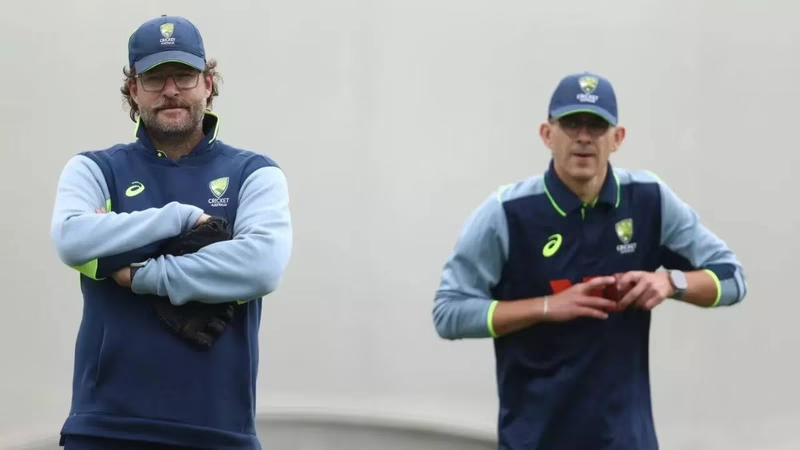
Cricket fans are scratching their heads—and purists are up in arms. In a move that defies both logic and legacy, Australia has fielded an all-pace attack in the Sydney Test against England, despite head coach Andrew McDonald declaring just days earlier that spin bowling is “incredibly important” .
With veteran off-spinner Nathan Lyon ruled out due to a hamstring injury, the decision to not replace him with another specialist spinner marks the first time since **1888** that Australia has gone without a tweaker at the Sydney Cricket Ground (SCG)—a venue historically known for offering generous turn, especially as matches progress . This is also the **third instance** in the current Ashes series that the hosts have opted for a four-pronged pace attack, raising serious questions about strategy, pitch reading, and long-term planning.
Table of Contents
- The Contradiction: Coach Says Spin Is Important—But Picks No Spinner
- Why Lyon Matters—and Who Was Left Out
- Historical Context: Australia’s Last Spinless SCG Test in 1888
- SCG Pitch Reality: Does It Really Favor Pace?
- England’s Advantage: How England Could Exploit the Decision
- What This Says About Australia’s Future Spin Strategy
- Conclusion: A Tactical Blunder or Bold Experiment?
- Sources
The Contradiction: Coach Says Spin Is Important—But Picks No Spinner
Just hours before the team announcement, Australia’s head coach Andrew McDonald told reporters: “Spin is incredibly important in Test cricket, especially in subcontinental conditions and even on wearing pitches like the SCG” . Yet, when the XI was revealed, there wasn’t a single finger-spinner or wrist-spinner in sight.
Instead, captain Pat Cummins opted for four frontline pacers—himself, Josh Hazlewood, Mitchell Starc, and Scott Boland—with part-timer Marnus Labuschagne as the only backup option. This disconnect between words and action has left analysts baffled. “You can’t preach the gospel of spin and then ignore it on a pitch that traditionally rewards it,” said former Australian leg-spinner Shane Warne in a posthumous quote often echoed by current pundits .
Why Lyon Matters—and Who Was Left Out
Nathan Lyon isn’t just any spinner—he’s Australia’s most successful off-spinner in history, with over 500 Test wickets and a proven record at the SCG. His absence is a massive blow, but the real controversy lies in who *wasn’t* called up as his replacement.
Australia’s spin bench isn’t bare. Options include:
- Todd Murphy – A young off-spinner with Test experience and known for his accuracy.
- Matthew Kuhnemann – Recently in red-ball form and effective in domestic Sheffield Shield.
- Ashton Agar – A left-arm spinner who can also contribute valuable runs down the order.
None were selected. Instead, the team doubled down on pace—a strategy that worked in Perth and Adelaide but may backfire on a slower, lower SCG track that traditionally breaks up on days four and five .
Historical Context: Australia’s Last Spinless SCG Test in 1888
The magnitude of this decision can’t be overstated. According to ESPNcricinfo’s archives, the last time Australia played without a specialist spinner at the SCG was in **January 1888**, during a Test against England—138 years ago . Back then, pitches were uncovered, bats were rudimentary, and Test cricket itself was in its infancy.
To replicate that approach in the modern era—on a pitch rated “good” by the ICC but expected to deteriorate—is seen by many as a disregard for historical precedent and pitch science. Even in the 2021–22 Ashes, when Lyon was injured, Australia played Murphy. This time, they didn’t even consider it.
SCG Pitch Reality: Does It Really Favor Pace?
Officially, the pitch looks hard, dry, and pace-friendly on day one. But data tells a different story. Over the past decade, spinners have taken **42% of all wickets** at the SCG in Tests during the second innings—higher than at the MCG or Adelaide Oval .
Joe Root and Ben Stokes are both adept players of pace, but they’ve struggled against quality spin in overseas conditions. By denying themselves a specialist, Australia may be handing England’s middle order a lifeline—especially if the match extends beyond day three.
England’s Advantage: How England Could Exploit the Decision
England, led by Brendon McCullum and Ben Stokes, have embraced an aggressive “Bazball” approach—but they’re also smart enough to seize tactical gifts. Without a frontline spinner, Australia loses a key weapon to contain scoring and break stubborn partnerships.
Joe Root, in particular, has amassed over 1,200 runs at the SCG in Shield and Test cricket, often building long innings on days three and four—precisely when a spinner would be most effective. If rain intervenes or the pitch slows, England’s batsmen could feast on overworked pacers struggling to make an impact .
What This Says About Australia’s Future Spin Strategy
Beyond this Test, the decision reflects a deeper issue: Australia’s chronic underinvestment in spin development. While India, England, and even New Zealand have nurtured diverse spin options, Australia remains overly reliant on Lyon—and now appears unwilling to trust his understudies in high-stakes games .
For more on Australia’s spin crisis, see our deep dive: [INTERNAL_LINK:australias-spin-bowling-crisis-explained].
Conclusion: A Tactical Blunder or Bold Experiment?
The call to go with Australia no spinner Sydney Test is either a masterstroke of confidence in pace dominance—or a historic miscalculation driven by short-term thinking. Coach McDonald’s words ring hollow if actions don’t follow. With the Ashes still up for grabs, this gamble could define not just the series, but Australia’s approach to spin bowling for years to come. One thing’s certain: by the end of day five, we’ll know whether this was bold leadership… or a blunder for the history books.
Sources
- Times of India: Aus coach says ‘spin important’; team goes without spinner in Sydney
- ESPNcricinfo: Shane Warne on the Art of Spin Bowling
- Cricket Australia: SCG Pitch Report – Ashes 2026
- ESPNcricinfo: SCG Test Match History
- ICC: SCG Pitch Analysis – January 2026
- BBC Sport: England’s Tactical Edge in the Ashes
- The Guardian: Australia’s Spin Bowling Crisis