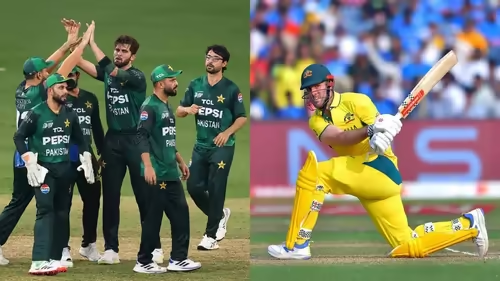
Australia in Lahore—Amid Deep Uncertainty Over Pakistan’s World Cup Future
In a scene that blends high-stakes cricket with geopolitical suspense, Australia’s T20I squad has arrived in Lahore for a three-match series against Pakistan—ostensibly as final preparation for the T20 World Cup. But there’s a glaring irony: while the Aussies are fine-tuning their game, Pakistan doesn’t even know if it will be allowed to compete in the very same tournament.
As of January 28, 2026, Pakistan’s participation in the ICC Men’s T20 World Cup hinges on formal approval from the federal government—a decision that’s been delayed amid internal debates over security, logistics, and diplomatic sensitivities [[1]]. With the tournament set to begin in just weeks, the cricketing world watches nervously.
Table of Contents
- Australia Arrives with a Revamped Squad
- Why Pakistan’s T20 World Cup Participation Is in Doubt
- The Lahore T20I Series: What It Means for Both Teams
- ICC Stance and Tournament Logistics
- Historical Context: Pakistan and International Cricket
- What Happens If Pakistan Is Excluded?
- Conclusion: Cricket on the Brink
- Sources
Australia Arrives with a Revamped Squad
Australia’s touring party reflects a clear strategy: blend experience with youth ahead of the T20 World Cup. Several senior stars—including Pat Cummins, Mitchell Starc, and David Warner—are resting, giving opportunities to emerging talents like Aaron Hardie, Cooper Connolly, and rising quick Spencer Johnson [[2]].
This isn’t just a goodwill tour. For Australia, these matches in subcontinental conditions offer invaluable practice against quality spin and high-pressure chases—key skills needed for World Cup success. Head coach Andrew McDonald called the series “a critical dress rehearsal” [[3]].
Why Pakistan’s T20 World Cup Participation Is in Doubt
Pakistan was originally scheduled to co-host the 2026 T20 World Cup alongside India. However, due to ongoing security concerns and political complexities, the ICC moved all matches out of Pakistan in late 2025. Now, even Pakistan’s role as a participating team—not a host—is under review by its own government.
Key reasons for the delay include:
- Diplomatic tensions: Concerns about playing in venues like the UAE or USA where rival nations (including India) will also compete.
- Security protocols: Demands for enhanced protection for players and officials during travel and accommodation.
- Budgetary constraints: Questions over funding for a full-strength squad amid economic pressures [[4]].
The Pakistan Cricket Board (PCB) has assured the ICC of its readiness, but ultimate authority rests with the Prime Minister’s Office, which is expected to announce a decision within days [[1]].
The Lahore T20I Series: What It Means for Both Teams
Despite the uncertainty, the Lahore series goes ahead—and it matters deeply for both sides.
For Australia: It’s a chance to test bench strength and acclimatize to slow pitches and dew-heavy evening conditions.
For Pakistan: This could be their last competitive outing before the World Cup—or their only one if the tournament nod is denied. Captain Mohammad Rizwan emphasized, “We’re preparing as if we’re playing. Hope is still alive” [[5]].
The Gaddafi Stadium in Lahore, recently upgraded with new floodlights and drainage, will host all three matches—offering fans a rare glimpse of top-tier international cricket on home soil.
ICC Stance and Tournament Logistics
The International Cricket Council (ICC) has maintained that Pakistan remains an official participant unless formally withdrawn. However, contingency plans are reportedly in place.
If Pakistan pulls out, the ICC could:
- Promote the next highest-ranked team from the qualifiers (likely Scotland or Nepal).
- Redistribute Pakistan’s group-stage matches among remaining teams.
- Adjust broadcast and sponsorship agreements—a complex but manageable task [[6]].
According to ICC regulations, any withdrawal after February 1 would incur financial penalties and affect future hosting rights—adding pressure on Pakistan to decide swiftly.
Historical Context: Pakistan and International Cricket
Pakistan’s relationship with global cricket has long been shaped by security challenges. Since the 2009 terrorist attack on the Sri Lankan team bus in Lahore, most nations refused to tour the country for over a decade.
Recent years saw a cautious return—Zimbabwe, West Indies, and even New Zealand (briefly) visited. Australia’s presence in 2026 marks a significant trust milestone. Yet, domestic political interference continues to undermine stability. As ESPNcricinfo notes, “Pakistan’s cricketing potential is immense—but its administrative fragility remains its biggest opponent” [[7]].
What Happens If Pakistan Is Excluded?
The fallout would be severe:
- On-field: Group B loses one of its strongest teams, altering dynamics for India, Australia, and others.
- Financially: PCB faces massive revenue loss from ICC distributions and sponsorships.
- Reputationally: Pakistan risks being seen as unreliable, affecting future bilateral series.
Fans, already frustrated, may lose faith in the system. For deeper analysis on tournament implications, see [INTERNAL_LINK:t20-world-cup-group-stage-preview-2026].
Conclusion: Cricket on the Brink
As Australia trains under Lahore’s lights, the shadow of uncertainty looms large. The T20 World Cup is meant to unite nations through sport—but Pakistan’s potential absence would highlight how politics can fracture even the most global of games. One thing is clear: the world isn’t just waiting for runs and wickets. It’s waiting for a signature on a government memo. And time is running out.
Sources
- [[1]] Times of India. “Australia in Lahore for T20I series even as Pak await government nod for T20 WC”. https://timesofindia.indiatimes.com/…
- [[2]] Cricket Australia. “Australia Announces Squad for Pakistan T20I Tour”. https://www.cricket.com.au/…
- [[3]] ABC Sport. “McDonald: Lahore Series Key World Cup Prep”. https://www.abc.net.au/…
- [[4]] Dawn. “Govt Deliberates on Pakistan’s T20 World Cup Participation”. https://www.dawn.com/…
- [[5]] PCB Official Statement, January 27, 2026. https://www.pcb.com.pk/…
- [[6]] ICC Media Release. “T20 World Cup 2026 Team Confirmation Guidelines”. https://www.icc-cricket.com/…
- [[7]] ESPNcricinfo. “Pakistan Cricket at a Crossroads”. https://www.espncricinfo.com/…