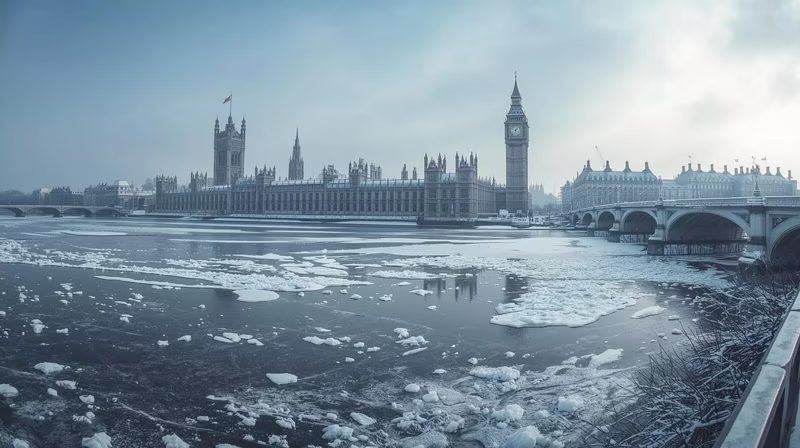
Imagine a Europe where ski resorts in the Alps are buried under snow for nine months of the year, where the Thames regularly freezes over in winter, and where summer crops fail due to unseasonal frosts. This isn’t the plot of a dystopian novel—it’s a scientifically plausible scenario if the Atlantic current system collapses.
Recent, alarming research has confirmed that this vital ocean conveyor belt is showing clear signs of instability. Scientists are no longer speaking in hypotheticals; they’re issuing urgent warnings that a shift in this current could fundamentally alter Europe’s climate, potentially triggering a ‘mini ice age’ in the worst-hit regions .
Table of Contents
- The Atlantic Current: What It Is and Why It Matters
- Signs of Collapse: From Ancient Shells to Modern Data
- What Happens if the Atlantic Current Collapses?
- The Role of Climate Change and the Path Forward
- Conclusion: An Urgent Call for Climate Action
- Sources
The Atlantic Current: What It Is and Why It Matters
The Atlantic current in question is part of the larger Atlantic Meridional Overturning Circulation (AMOC). Think of it as a massive, underwater river that transports warm, tropical water from the Gulf of Mexico northward across the Atlantic. This system, of which the Gulf Stream is the most famous surface component, acts like a central heating system for Europe.
Without this constant influx of warmth, the climate of countries like the UK, France, and Germany would be far more akin to that of Canada, at a similar latitude. The AMOC is the invisible guardian of Europe’s famously mild winters.
Signs of Collapse: From Ancient Shells to Modern Data
The evidence for the AMOC’s growing weakness is both modern and ancient. A groundbreaking study has analyzed the growth rings of ancient clam shells—a powerful climate proxy that provides an unbroken, annual record of ocean conditions over centuries .
These natural archives have revealed two major episodes of instability in the North Atlantic circulation since the year 1800, with the most recent one happening in the early 20th century . This historical context, combined with 21st-century satellite and sensor data, paints a deeply concerning picture of a system under severe stress.
Further compounding the evidence, a deep current carrying cold water south from Greenland has already slowed by a staggering 26% since 2014 . This slowdown is a classic early-warning sign of a potential AMOC collapse, a tipping point that a group of 42 leading climate scientists recently warned is closer than previously estimated .
What Happens if the Atlantic Current Collapses?
The consequences of a full or partial AMOC collapse for Europe would be profound and far-reaching:
- Drastic Temperature Drops: Northwestern Europe could see winter temperatures plummet by 5 to 15°C within a few decades . This isn’t just a colder winter; it’s a fundamental shift in the region’s climate zone.
- Unpredictable Weather & Drought: Precipitation rates across Europe are expected to decrease, leading to more intense droughts and a significant impact on the continent’s hydroclimate .
- Global Economic Chaos: The ripple effects wouldn’t be confined to weather. An AMOC collapse could disrupt global supply chains and compromise food systems by altering agricultural productivity worldwide .
While it’s important to note that a full-scale ice age is highly improbable, a regional “mini ice age”—characterized by significantly colder and more volatile conditions—is a serious risk that climate models are taking very seriously .
The Role of Climate Change and the Path Forward
The primary driver behind this looming crisis is human-induced climate change. The massive influx of freshwater from melting Greenland ice sheets is diluting the salty, dense water in the North Atlantic that is essential for the AMOC’s sinking motion—a process that powers the entire circulation.
The path forward is clear, though challenging. Reducing greenhouse gas emissions is the single most crucial step to mitigate these risks and prevent irreversible changes to the global climate system. The window to act is narrowing, but it is not yet closed.
For a deeper understanding of how our planet’s climate systems are interconnected, explore our comprehensive guide on [INTERNAL_LINK:global-climate-systems]. Additionally, the National Oceanic and Atmospheric Administration (NOAA) provides authoritative, up-to-date information on ocean circulation and its role in climate at NOAA’s Ocean Currents page.
Conclusion: An Urgent Call for Climate Action
The warning signs from the Atlantic current are no longer a whisper from the scientific fringe; they are a loud, data-driven alarm. The evidence from ancient clam shells to modern ocean sensors tells a consistent and urgent story. Europe’s climate stability, and indeed global climatic patterns, hang in the balance.
While the image of a new ice age is a powerful, perhaps even sensational, concept, the real message is one of profound systemic risk. The solution lies not in fear, but in immediate, decisive action to curb our carbon emissions and protect the delicate balance of our planet’s natural systems.
Sources
- Times of India: Could a North Atlantic current really change Europe’s climate into an ice age?
- Science Advances Study on AMOC Instability: Long-term decline in the stability of the North Atlantic subpolar gyre
- Clam Shell Proxy Research: Clam shells sound alarm over unstable North Atlantic currents [[11], [20]]
- Expert Analysis on AMOC Collapse: Analysis: The potential impacts of an AMOC collapse on Europe [[2], [3]]
- NOAA Ocean Currents: NOAA’s official resource on ocean circulation