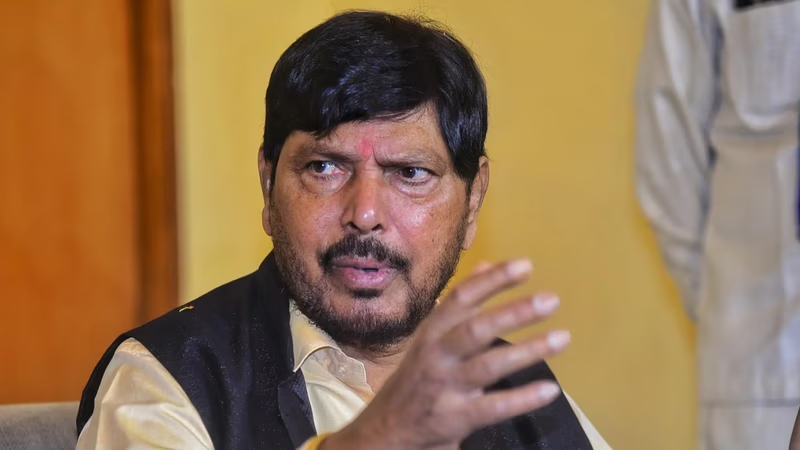
In a dramatic twist ahead of the high-stakes Brihanmumbai Municipal Corporation (BMC) elections, Union Minister and Republican Party of India (Athawale) chief Ramdas Athawale has fired a political salvo at his own allies. Calling the exclusion of RPI(A) from the Mahayuti seat-sharing pact a “betrayal of trust,” Athawale has signaled a rare but strategic revolt within Maharashtra’s ruling coalition.
The Mahayuti alliance—comprising the BJP, Eknath Shinde-led Shiv Sena, and smaller partners like RPI(A)—has long projected unity. But Athawale’s outburst reveals deep fissures beneath the surface, especially over representation of Ambedkarite and Dalit voices in Mumbai’s civic governance. While he stopped short of severing ties, his decision to run RPI(A) candidates on 38 BMC seats independently could fracture the anti-UBT vote and complicate the alliance’s path to a clear majority.
Table of Contents
- Athawale Betrayal Mahayuti: What Happened?
- Why the RPI(A) Wanted BMC Seats: Ambedkarite Representation
- The Mahayuti’s Dilemma: Balancing Allies and Ambitions
- What Contesting 38 Seats Means—Strategically
- Historical Context: RPI(A) and the Mahayuti Alliance
- Political Fallout: Can Mahayuti Still Win BMC?
- Conclusion: A Protest Within the System
- Sources
Athawale Betrayal Mahayuti: What Happened?
The immediate trigger for Athawale’s anger was the Mahayuti’s final seat-sharing formula for the upcoming BMC polls—India’s largest civic election, with 236 wards and a budget exceeding ₹50,000 crore.
Despite being a longstanding ally and a Union Minister in the Modi cabinet, Athawale’s RPI(A) was offered zero seats in the initial distribution between BJP and Shinde Sena. This, he argued, ignored the party’s grassroots presence in Mumbai’s eastern and central suburbs, where Ambedkarite communities form a significant voter bloc.
“This is not just a political setback—it’s a betrayal of trust,” Athawale declared. His statement carries weight: RPI(A) has traditionally delivered loyal votes to the Mahayuti, especially in Dalit-dominated constituencies.
Why the RPI(A) Wanted BMC Seats: Ambedkarite Representation
For Athawale, this isn’t merely about numbers—it’s about dignity and inclusion. The BMC, as Mumbai’s civic backbone, controls everything from housing and sanitation to education and healthcare. Yet, Ambedkarite voices have historically been underrepresented in its corridors of power.
By demanding seats, RPI(A) sought to ensure that policies affecting marginalized communities are shaped by leaders who understand their lived realities. As Athawale put it: “Our workers deserve respect. Our community deserves a say in how Mumbai is run.”
This aligns with Dr. B.R. Ambedkar’s vision of political participation as a tool for social justice—a core tenet of [INTERNAL_LINK:ambedkarite-politics-in-maharashtra].
The Mahayuti’s Dilemma: Balancing Allies and Ambitions
The BJP and Shinde Sena, meanwhile, face their own pressures. With Shiv Sena (UBT) and Congress mounting a fierce challenge, both parties are reluctant to cede winnable seats to smaller partners—even loyal ones.
Internal sources suggest the Mahayuti leadership believed RPI(A) lacked the organizational strength to win independently, making seat allocation a “waste” of a potential BJP or Sena victory. But this calculus underestimated Athawale’s symbolic capital and grassroots loyalty.
What Contesting 38 Seats Means—Strategically
Athawale’s decision to field RPI(A) candidates on 38 wards is a calibrated move—not a full-blown rebellion. Notably, he emphasized that RPI(A) will still support the Mahayuti on all other seats, signaling that this is a protest, not a breakup.
Strategically, this serves multiple purposes:
- Asserts Relevance: Proves RPI(A) has independent vote-pulling power.
- Forces Negotiation: Sets the stage for better terms in future elections (e.g., 2029 state polls).
- Mobilizes Base: Energizes Ambedkarite voters who feel politically invisible.
However, the risk is vote-splitting. If RPI(A) draws even 5–10% from Mahayuti candidates in tight wards, it could hand victories to UBT or Congress—a scenario BJP strategists are scrambling to contain.
Historical Context: RPI(A) and the Mahayuti Alliance
RPI(A) has been part of the BJP-led NDA since the early 2000s, with Athawale serving as a bridge between the saffron party and Dalit voters. In Maharashtra, RPI(A) joined the Mahayuti in 2019 and played a role in its 2022 state election win.
Yet, smaller allies often complain of being treated as “vote banks, not partners.” Athawale’s current stance reflects a growing trend among regional Dalit parties demanding substantive—not symbolic—inclusion.
Political Fallout: Can Mahayuti Still Win BMC?
The BMC is critical not just for governance but as a **barometer of political momentum** heading into 2029. A fractured Mahayuti could embolden opposition forces.
According to election analysts at the Center for South Asian Studies, intra-alliance conflicts in municipal elections often foreshadow larger state-level realignments. “When trust breaks at the local level, it rarely stays contained,” one expert noted.
Conclusion: A Protest Within the System
Ramdas Athawale’s cry of “Athawale betrayal Mahayuti” is more than political theater. It’s a demand for recognition in a system that often marginalizes smaller voices—even loyal ones. By contesting 38 seats, he’s not burning bridges; he’s drawing a line in the sand: “We are partners, not pawns.”
Whether this gamble pays off—or backfires—will be decided by Mumbai’s voters. But one thing is certain: the Mahayuti’s unity is no longer as solid as it once seemed.