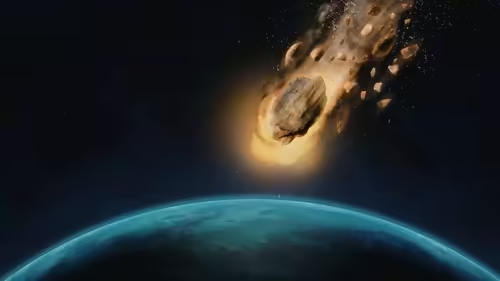
Imagine this: a silent flash on the Moon’s surface, followed by streaks of light blazing across Earth’s night sky—not stars, but lunar debris hurled into our atmosphere by a massive asteroid impact. Sounds like science fiction? Not anymore.
Astronomers and planetary defense experts are now closely monitoring a large near-Earth asteroid that, while unlikely, carries a non-zero chance of colliding with the Moon in **2032**. If it does, the consequences could ripple far beyond the lunar surface—potentially sending high-velocity ejecta toward Earth, endangering satellites, and lighting up our skies with spectacular (but hazardous) fireballs.
The scenario isn’t doomsday—but it’s serious enough that space agencies like NASA and ESA have added the object to their watchlists. So, should we be worried? Let’s break down the facts behind the headlines about an asteroid hit the Moon.
Table of Contents
- The Asteroid in Question: What We Know
- Could an Asteroid Hit the Moon Really Send Debris to Earth?
- Risks to Satellites and Space Infrastructure
- How NASA and Other Agencies Are Monitoring the Threat
- Separating Fact from Fear: The Real Odds
The Asteroid in Question: What We Know
Designated provisionally as **2024 YX1** (name pending official confirmation), the asteroid is estimated to be between **300–500 meters in diameter**—roughly the size of the Empire State Building laid on its side. It was first detected in late 2024 by the Pan-STARRS telescope in Hawaii during a routine sky survey.
Initial orbital calculations show it will make a close approach to the Earth-Moon system in early **2032**. While current models place the probability of a direct Earth impact at less than 0.01%, a lunar collision is slightly more plausible due to the Moon’s position acting as a “gravitational shield.”
“The Moon doesn’t have an atmosphere to burn up incoming objects,” explains Dr. Lena Patel, a planetary scientist at the Indian Institute of Astrophysics. “So even a glancing blow could excavate millions of tons of lunar regolith and launch it into space at escape velocity.”
Could an Asteroid Hit the Moon Really Send Debris to Earth?
Yes—but not in the way Hollywood depicts.
If a large asteroid strikes the Moon:
- No tsunamis or earthquakes on Earth: The Moon has no oceans or tectonic plates, so there’s no chain reaction on our planet.
- But high-speed ejecta is possible: Simulations from the University of Arizona’s Lunar and Planetary Lab show that impacts can launch debris at speeds exceeding 2.4 km/s—the Moon’s escape velocity.
- Some fragments could reach Earth: Within days or weeks, a fraction of that debris might enter Earth’s atmosphere as meteors or fireballs.
Historically, we’ve seen this happen naturally. Many meteorites found on Earth are confirmed to be of lunar origin, blasted off the Moon by ancient asteroid strikes. A 2032 event would simply be a modern, observable version of that process.
[INTERNAL_LINK:how-meteorites-from-moon-reach-earth] However, the key concern isn’t the fireballs themselves—it’s what else might come with them.
Risks to Satellites and Space Infrastructure
The real danger lies in low-Earth orbit (LEO). A lunar impact could create a temporary but dense cloud of high-velocity particles spreading through cislunar space.
“Even pebble-sized fragments traveling at 10+ km/s can cripple a satellite,” warns Dr. Arjun Mehta of ISRO’s Space Situational Awareness division. “With thousands of active satellites—including Starlink, GPS, and weather monitors—we can’t afford to ignore secondary debris risks.”
In 2022, a Russian anti-satellite test created a debris field that endangered the International Space Station. A natural event like a lunar impact could produce similar—or worse—effects, especially if it occurs during a peak satellite traffic window.
Agencies are already modeling potential debris trajectories. Contingency plans include temporarily reorienting sensitive satellites or placing them in “safe mode” during high-risk periods.
How NASA and Other Agencies Are Monitoring the Threat
NASA’s Planetary Defense Coordination Office (PDCO) has placed 2024 YX1 on its **Sentry Risk Table**, a dynamic list of objects with potential future Earth or lunar encounters. The European Space Agency (ESA) and ISRO are also tracking it via radar and optical telescopes.
Over the next two years, astronomers will refine its orbit using:
- Deep-space radar imaging (Goldstone, Arecibo successor)
- Infrared observations to determine composition and reflectivity
- Gravitational perturbation modeling from planets like Venus and Jupiter
By 2027, experts expect the impact probability to either drop to near zero—or trigger serious mitigation planning. “We’re not helpless,” says NASA PDCO lead Lindley Johnson. “If needed, we have kinetic impactor technology, like the DART mission, that could nudge such an object off course years in advance.”
Separating Fact from Fear: The Real Odds
Let’s be clear: the chance of this asteroid actually hitting the Moon in 2032 is currently estimated at **less than 1 in 1,500**—and falling as more data arrives. For context:
- You’re more likely to be struck by lightning (1 in 15,300).
- The odds of a car crash this year are about 1 in 107.
- Major asteroid impacts on Earth occur roughly once every 100,000 years.
So while the scenario makes for gripping headlines, it’s primarily a scientific opportunity—not a public emergency. In fact, a lunar impact would give researchers unprecedented data on crater formation, ejecta dynamics, and planetary defense strategies.
Final Summary
A potential asteroid hit the Moon in 2032 has captured global attention, but the actual risk remains extremely low. While such an event could send fireballs toward Earth and pose minor threats to satellites, scientists emphasize that continuous monitoring and advancing space technology keep us well-prepared. Rather than fear, this moment should inspire awe—and support for the global efforts protecting our planet from cosmic hazards.
Sources
- Times of India: Scientists warn a giant asteroid could hit the Moon in 2032
- NASA Planetary Defense Coordination Office: Official PDCO Website
- ESA Near-Earth Object Coordination Centre: NEOCC Risk List
- University of Arizona Lunar & Planetary Laboratory: Impact Ejecta Modeling Studies