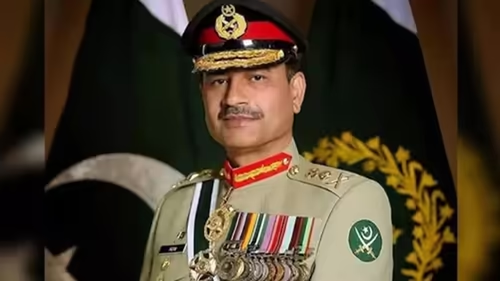
When Pakistan’s powerful Army Chief, General Asim Munir, declared that “Pakistan can now achieve its noble purpose,” he didn’t just make a speech—he dropped a geopolitical grenade . The phrase, steeped in religious and nationalist symbolism, has ignited intense debate across diplomatic circles, defense think tanks, and regional capitals. Was this a call for internal reform? A veiled threat to adversaries? Or a declaration of ideological mission under the banner of Islam?
In a region already on edge—with nuclear-armed neighbors, ongoing proxy tensions, and shifting global alliances—Munir’s words carry weight far beyond rhetorical flourish. Understanding the Asim Munir noble purpose statement is crucial to grasping Pakistan’s evolving strategic posture in 2025 and beyond.
Table of Contents
- What Did Asim Munir Actually Say?
- Decoding ‘Noble Purpose’: Historical and Ideological Roots
- Why Now? Timing and Domestic Context
- Regional Reactions: India, US, and Gulf States Respond
- Is Pakistan Shifting Its Strategic Doctrine?
- Expert Analysis: What This Means for Global Security
- Conclusion: A Warning or a Vision?
- Sources
What Did Asim Munir Actually Say?
Speaking at a high-profile event in Rawalpindi, General Munir stated: “Today, Pakistan stands at a historic juncture. With divine support and national unity, we can now achieve our noble purpose” . He linked this purpose explicitly to Islam, describing Pakistan as a “fortress of faith” destined to play a unique role in the Muslim world.
Notably, he made these remarks amid rising domestic instability—economic crisis, political fragmentation, and growing public disillusionment with military dominance. Yet instead of addressing bread-and-butter issues, Munir framed Pakistan’s identity in civilizational and spiritual terms, suggesting the nation’s ultimate mission transcends material challenges.
Decoding ‘Noble Purpose’: Historical and Ideological Roots
The phrase “noble purpose” (or maqsad-e-muqaddas in Urdu) isn’t new in Pakistani discourse. It traces back to the founding ideology of the state:
- 1947 Vision: Muhammad Ali Jinnah envisioned Pakistan as a homeland for South Asian Muslims—but was ambiguous about whether it would be a theocracy or a secular democracy.
- 1970s Islamization: Under Zulfikar Ali Bhutto and especially General Zia-ul-Haq, the state increasingly fused national identity with Sunni Islamic orthodoxy.
- Strategic Instrumentalization: For decades, Pakistan’s military has used religious nationalism to legitimize its dominance and rally public support during crises.
Munir’s statement appears to revive this legacy—but with a more assertive, even messianic tone. By claiming Pakistan can “now” achieve this purpose, he implies a readiness, capability, or divine mandate that was previously absent.
Why Now? Timing and Domestic Context
General Munir’s comments come at a precarious moment:
- Pakistan’s economy is in freefall, with inflation above 25% and foreign reserves critically low .
- Civilian governments remain weak, with the military widely seen as the real power behind the throne.
- Public trust in institutions is eroding, especially among youth demanding jobs and democracy over ideology.
In this context, invoking a “noble purpose” may serve as a distraction—a way to reframe national struggle not as economic failure, but as a sacred journey. It also reinforces the military’s self-image as the guardian of Pakistan’s ideological frontiers, not just its borders.
Regional Reactions: India, US, and Gulf States Respond
Unsurprisingly, India views Munir’s remarks with deep suspicion. Analysts in New Delhi interpret the “noble purpose” as code for continued support to Islamist militant groups under the guise of “strategic depth” or “Islamic solidarity” [INTERNAL_LINK:india-pakistan-tensions-2025].
The United States, meanwhile, has expressed cautious concern. While publicly maintaining dialogue on counterterrorism and regional stability, U.S. officials are reportedly scrutinizing whether this rhetoric signals a rollback on commitments to curb extremist networks .
Interestingly, Gulf allies like Saudi Arabia and the UAE have remained silent—a sign they may see value in Pakistan’s Islamic positioning as a counterbalance to Iranian influence, even if they privately urge restraint.
Is Pakistan Shifting Its Strategic Doctrine?
Historically, Pakistan’s doctrine centered on “deterrence against India” and “strategic autonomy.” But Munir’s language suggests an emerging third pillar: ideological leadership in the Muslim world.
This could manifest in several ways:
- Increased diplomatic activism in OIC (Organization of Islamic Cooperation) forums.
- Greater emphasis on religious diplomacy—e.g., promoting madrasa reforms or Islamic finance as soft power tools.
- Potential recalibration of ties with non-Muslim powers if they’re seen as opposing “Islamic interests.”
However, experts caution that such ambitions may clash with harsh realities—especially Pakistan’s dependence on Western and Gulf financial aid.
Expert Analysis: What This Means for Global Security
According to Dr. Ayesha Siddiqa, a leading scholar on Pakistan’s military, “Munir’s statement is less about theology and more about institutional survival. By casting the army as the vanguard of Pakistan’s ‘noble purpose,’ he secures its relevance in a time of crisis” .
From a global security standpoint, the risk lies in ambiguity. If “noble purpose” is interpreted by extremist elements as state-sanctioned license for action, it could fuel radicalization. Conversely, if it’s purely rhetorical, it may still damage Pakistan’s credibility as a responsible nuclear power.
The Carnegie Endowment for International Peace notes that “when militaries frame national destiny in religious terms, it often narrows policy options and increases the risk of miscalculation” .
Conclusion: A Warning or a Vision?
The Asim Munir noble purpose statement is a masterclass in strategic ambiguity—simultaneously inspiring to domestic audiences and alarming to international observers. Whether it heralds a new era of ideological assertiveness or is merely a tool of internal consolidation remains to be seen. But one thing is clear: in a volatile region, words from Pakistan’s army chief are never just words. They are signals—and the world must decode them carefully.
Sources
- Times of India: “Pak’s noble purpose? Munir’s foreboding msg for world; what does it mean?”
- Ministry of Foreign Affairs, Pakistan – Official Statements Archive
- World Bank – Pakistan Economic Update (January 2026): Economic Indicators
- U.S. Department of State – Country Reports on Terrorism: 2025 Assessment
- Siddiqa, Ayesha. Military Inc.: Inside Pakistan’s Military Economy. Pluto Press, 2017.
- Carnegie Endowment for International Peace – “Religion and Security in South Asia”: Policy Analysis