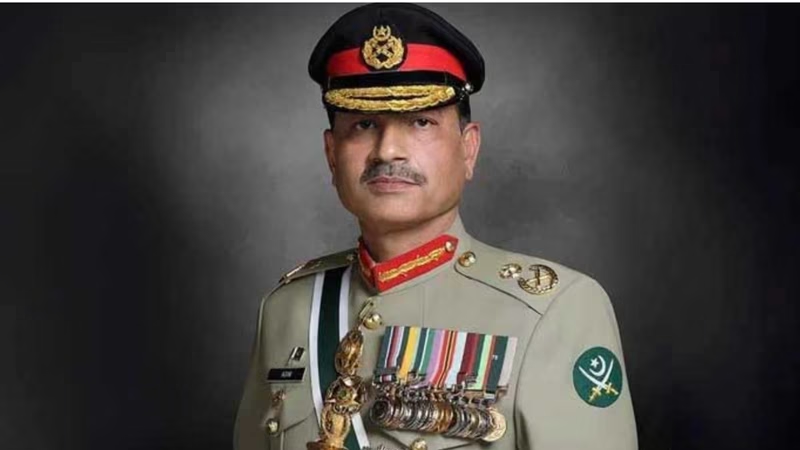
In a quiet corner of Rawalpindi, away from the public eye but deep within the corridors of power, a significant family event unfolded. Pakistan’s Army Chief, General Asim Munir, recently presided over the marriage of his daughter, Mahnoor, to her first cousin, Abdul Rehman—the son of Munir’s brother, Syed Qasim Munir . While the ceremony was officially described as “discreet” and “subdued,” its guest list told a far more revealing story .
The Asim Munir daughter wedding wasn’t just a private family affair; it was a gathering of the Pakistani state’s most influential figures, a snapshot of who holds real power in the country today. This isn’t merely gossip—it’s a window into the intertwined nature of military, political, and familial networks that shape Pakistan’s destiny.
Table of Contents
- The Wedding Event: A Subdued Affair with an Elite Guest List
- Asim Munir and His Nephew: The Family Ties That Bind
- The Guest List: Who Was There and What It Signals
- Pakistan’s Military Leadership in 2025: A New Power Structure
- Traditions and Implications: Military Weddings and Power Dynasties
- Conclusion: A Wedding as a Political Barometer
- Sources
The Wedding Event: A Subdued Affair with an Elite Guest List
Held on December 26, 2025, at the General’s residence near the Pakistan Army’s General Headquarters (GHQ) in Rawalpindi, the Asim Munir daughter wedding was a private ceremony . Reports confirm the bride, Mahnoor Munir, married her first cousin, Abdul Rehman, who is reportedly an army officer himself . The ceremony followed Islamic traditions, likely centered around the Nikah, the formal marriage contract, which is the cornerstone of a Pakistani wedding .
Despite the insistence on its private nature, the event’s exclusivity was defined by its attendees, not its scale. The presence of the President and the Prime Minister, as reported, instantly elevates this from a simple family gathering to a significant political and social event .
Asim Munir and His Nephew: The Family Ties That Bind
General Asim Munir hails from a traditional Punjabi family, with roots tracing back to Jalandhar before the 1947 partition . His family life is typically kept private, but this marriage has shed some light on his immediate relatives. His wife, Iram Naqvi, belongs to the Sadat family of Okara, and the couple has built a life centered around the military establishment .
The groom, Abdul Rehman, is the son of Munir’s brother, Syed Qasim Munir. This practice of marrying within the extended family, while common in many parts of Pakistan, takes on a different hue when the family in question sits at the apex of the nation’s power structure. It reinforces internal bonds and consolidates familial loyalty at the highest levels.
The Guest List: Who Was There and What It Signals
The attendance of Pakistan’s President and Prime Minister is the most telling detail. In any other country, this might be a simple courtesy, but in Pakistan’s context—where the military has historically been the ultimate power broker—it speaks volumes . Their presence is a public demonstration of deference and alignment with the Army Chief.
This is not an isolated incident of familial influence. Investigative reports have previously noted that relatives of General Munir have been appointed to key federal and provincial positions, suggesting a network of patronage that extends from the GHQ into the civilian government . The wedding, therefore, can be seen as a social reaffirmation of these powerful alliances.
Pakistan’s Military Leadership in 2025: A New Power Structure
To fully grasp the significance of this event, one must understand the unprecedented power General Munir wields. In the wake of a short but intense conflict with India in May 2025, Pakistan’s political and military leadership pushed through a major constitutional amendment—the 27th . This amendment effectively abolished the post of Chairman of the Joint Chiefs of Staff Committee (CJCSC) and elevated the Chief of Army Staff (COAS) to the new, supreme position of Chief of Defence Forces (CDF) .
This move, finalized in December 2025, has concentrated an extraordinary amount of national security and strategic decision-making power in General Asim Munir’s office . He is no longer just the head of the army; he is the undisputed commander of all of Pakistan’s armed forces. In this light, a wedding in his family becomes a nexus point for the entire national power elite.
Traditions and Implications: Military Weddings and Power Dynasties
Pakistani military weddings, often referred to with pride as “Bhai Ki Shaadi,” are known for their unique blend of traditional rituals and strict military protocol . While the public sees vibrant colors and ceremonial processions, the private ceremonies of the top brass are often more austere but deeply symbolic.
Key traditions include the father or a senior male relative (the Wali) acting as a witness to the Nikah, and the ceremonial holding of the Holy Quran over the bride’s head as she joins her husband’s family [[31], [29]]. In the Munir family’s case, with the groom being the Army Chief’s nephew, the line between the bride’s and groom’s family is beautifully, and powerfully, blurred.
Such intra-familial unions among the elite can serve to keep wealth, influence, and strategic alliances tightly held within a trusted circle. While a personal choice, in the context of a figure as powerful as General Munir, it feeds into a narrative of an increasingly insular and dynastic power structure in Pakistan.
Conclusion: A Wedding as a Political Barometer
The marriage of Mahnoor Munir to her cousin, Abdul Rehman, is far more than a personal milestone for the Army Chief’s family. It is a potent symbol of the current state of play in Pakistan. The presence of the country’s top civilian leadership at a private military family event underscores the military’s dominant role in national affairs. The recent consolidation of power under the new CDF role makes General Asim Munir the single most powerful individual in the country. This wedding, therefore, was not just a celebration of love, but a quiet, yet unmistakable, affirmation of a power structure where family, military rank, and political authority are deeply and inextricably linked. For those watching Pakistan, the guest list was the real story.
Sources
- Times of India: Pakistan: Asim Munir marries daughter to brother’s son
- Dawn: [INTERNAL_LINK:pakistan-military-power-structure-2025]
- BBC News: Who is Pakistan’s powerful army chief Gen Asim Munir?
- Pakistani Wedding Traditions, Customs & Rituals. WeddingDetails.com.