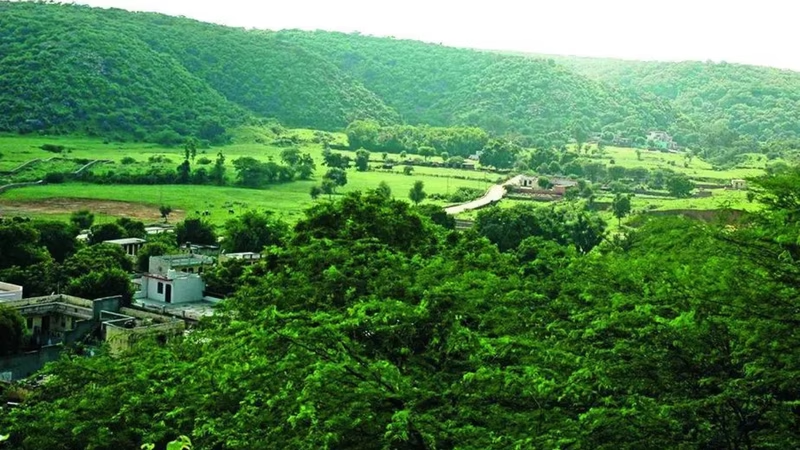
The ancient Aravali hills—older than the Himalayas and once a green shield against desertification—are being systematically stripped bare. In Rajasthan alone, a staggering 1,230 mining leases span across this ecologically vital range, covering over 17,393 hectares of land. And while the central government imposed a ban on new leases after massive public outcry, existing operations continue unabated, leaving behind a trail of denuded slopes, polluted air, and broken watersheds.
The situation is most acute in three districts: Rajsamand (with over 540 leases), Udaipur, and Jaipur. Here, what were once forested ridges are now lunar-like landscapes of red dust and blasted rock—quarried for marble, granite, and construction-grade stone to feed India’s urban boom.
This isn’t just an environmental tragedy. It’s a slow-motion water crisis in a state already battling drought. The Aravalis act as a natural catchment, recharging aquifers that supply groundwater to millions. When hills are flattened, so is the region’s capacity to retain rainwater.
Table of Contents
- The Scale of Aravalis Mining in Rajasthan
- Why the Aravalis Matter Ecologically
- The Central Ban—and Why It Hasn’t Stopped Existing Leases
- Environmental Impact: Denuded Hills and Drying Wells
- Rajsamand: The Epicenter of Mining Activity
- Legal Loopholes and Enforcement Gaps
- What Activists and Experts Are Demanding
- Conclusion: Saving the Aravalis Before It’s Too Late
- Sources
The Scale of Aravalis Mining in Rajasthan
According to data from the Rajasthan Department of Mines and Geology, there are:
- Over 1,230 mining leases currently active or under legal dispute in the Aravali belt.
- Rajsamand district alone accounts for 542 leases—nearly half the state’s total.
- Udaipur and Jaipur follow with 280 and 190+ leases respectively.
- Combined, these leases cover an area larger than Chandigarh.
Most of these are for minor minerals like quartzite, mica, and construction stone—commodities in high demand due to India’s infrastructure push. But the cumulative impact is anything but minor.
Why the Aravalis Matter Ecologically
The Aravali Range, stretching 692 km from Gujarat to Delhi, is not just a geological marvel—it’s a lifeline.
- Water Recharge Zone: The hills capture monsoon runoff and feed underground aquifers that supply 30–40% of Rajasthan’s groundwater.
- Biodiversity Hotspot: Home to leopards, hyenas, and over 300 bird species, including the endangered Indian vulture.
- Climate Buffer: Acts as a barrier against the westward expansion of the Thar Desert into fertile regions.
“Destroy the Aravalis, and you destroy Rajasthan’s water future,” warns Dr. Meena Gupta, former member of the National Green Tribunal (NGT). “This isn’t just about trees—it’s about survival.”
The Central Ban—and Why It Hasn’t Stopped Existing Leases
In 2023, following sustained protests by environmental groups and residents, the Ministry of Environment, Forest and Climate Change (MoEFCC) banned the granting of new mining leases in the Aravali regions of Rajasthan, Haryana, and Gujarat.
However, the order explicitly allowed existing leases to continue—even those whose environmental clearances had expired or were under legal challenge. This loophole has enabled mining to persist, often under the guise of “renewal” or “extension.”
“The ban was symbolic, not substantive,” says environmental lawyer Ritwick Dutta. “Without canceling the old leases, the destruction never stops.”
Environmental Impact: Denuded Hills and Drying Wells
Field visits by researchers from the Wildlife Institute of India (WII) reveal alarming trends:
- Hillsides stripped of vegetation, leading to severe soil erosion.
- Disrupted natural drainage channels, causing flash floods in downstream villages.
- Rising dust pollution—Rajsamand now records PM10 levels 3x above safe limits.
- Farmers report wells drying up within 2–3 years of mining commencement nearby.
[INTERNAL_LINK:aravali-water-crisis-rajasthan-farmers] documents how villagers are walking 5 km daily for water due to falling water tables near quarries.
Rajsamand: The Epicenter of Mining Activity
Rajsamand district, known for its marble and stone, has become ground zero for the mining crisis. Local activists estimate that over 60% of the district’s Aravali tracts are under lease.
Villages like Kumbhalgarh and Railmagra report constant blasting vibrations damaging homes and temples. “Our children can’t study—the dust gets into everything,” says Lakshmi Devi, a schoolteacher in Kumbhalgarh.
Despite repeated complaints to the Rajasthan State Pollution Control Board (RSPCB), enforcement remains weak due to staffing shortages and alleged industry influence.
Legal Loopholes and Enforcement Gaps
Several systemic issues enable continued mining:
- Legacy Leases: Many leases predate the Forest (Conservation) Act, 1980, making them “grandfathered in.”
- Fragmented Oversight: Mining, forest, and pollution authorities often operate in silos.
- Delayed Litigation: Environmental cases take 5–10 years to resolve—by then, hills are already gone.
- Lack of Satellite Monitoring: Real-time tracking of illegal excavation is rare outside protected zones.
What Activists and Experts Are Demanding
Civil society groups like the Aravali Bachao Andolan are calling for:
- Immediate cancellation of all mining leases in ecologically sensitive Aravali zones.
- Deployment of drone-based surveillance to detect illegal mining.
- Restoration of mined areas under the Compensatory Afforestation Fund (CAMPA).
- Declaration of the entire Aravali range as an Ecologically Sensitive Area (ESA).
The Supreme Court, which has previously intervened to halt mining in Haryana’s Aravalis, may soon take up Rajasthan’s case as well.
Conclusion: Saving the Aravalis Before It’s Too Late
The Aravalis mining crisis in Rajasthan is a stark reminder that policy bans mean little without enforcement and political will. With over 1,230 leases still operational, the clock is ticking for one of India’s oldest mountain ranges. If the hills continue to vanish, so too will the water, wildlife, and livelihoods they sustain. Protecting the Aravalis isn’t just an environmental cause—it’s an investment in Rajasthan’s—and India’s—future resilience.