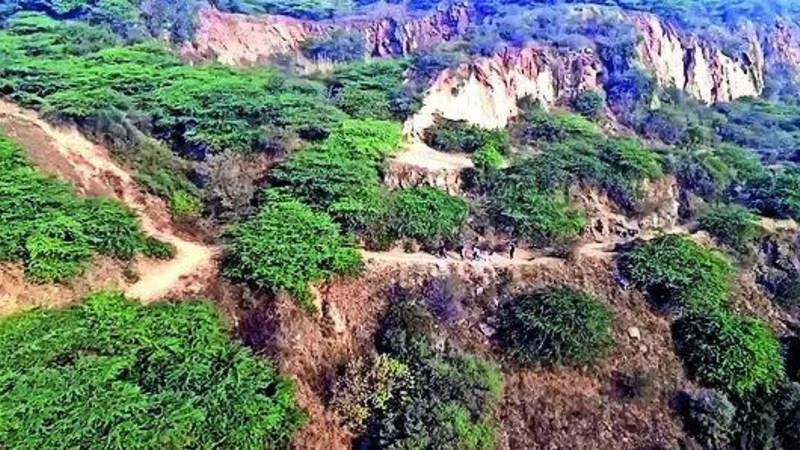
Imagine a 20-year-long legal battle to save one of India’s oldest mountain ranges—only to see it quietly unraveled by a bureaucratic report. That’s the alarming reality facing the Aravali protection framework today.
Since the early 2000s, the Supreme Court of India has acted as the guardian of the Aravalis, issuing landmark orders banning mining, halting groundwater extraction, and protecting ecologically fragile zones from reckless construction. On two critical occasions, even the Prime Minister’s Office (PMO) stepped in to block attempts to dilute these environmental safeguards. Yet, despite this robust judicial and executive backing, a new government report appears to be tilting the scales back toward mining interests—sparking outrage among environmentalists and legal experts alike .
Table of Contents
- Why the Aravalis Matter
- Supreme Court and PMO: The 20-Year Shield for Aravali Protection
- The New Report Raising Red Flags
- Haryana’s “Recreational” Facade for Non-Forest Activities
- Expert Reactions: Ecological Backsliding or Policy Shift?
- What Happens Next? The Fight for the Aravalis
- Conclusion: The Future of Aravali Protection Hangs in the Balance
- Sources
Why the Aravalis Matter
Stretching over 670 kilometers across Rajasthan, Haryana, Delhi, and Gujarat, the Aravalis are not just scenic hills—they are a vital ecological barrier. They act as a natural air filter for the National Capital Region (NCR), recharge groundwater aquifers, and prevent the Thar Desert from advancing eastward .
Once rich in biodiversity, the range now faces severe degradation due to decades of unregulated mining and urban sprawl. Protecting what’s left isn’t just about saving trees—it’s about safeguarding the very air, water, and climate stability of northern India.
Supreme Court and PMO: The 20-Year Shield for Aravali Protection
The foundation of modern Aravali protection was laid in 1994 when the Supreme Court first banned mining in the Haryana segment. This was reinforced in 2002 and again in 2009, when the Court explicitly prohibited construction in the ecologically sensitive Aravali Notification Area (ANA) .
Crucially, the PMO intervened in 2018 and again in 2022 to reject proposals from the Haryana government that sought to relax these norms under the guise of “eco-tourism” or “recreational facilities” . These interventions were seen as a strong signal that the Centre stood with the judiciary in preserving this fragile ecosystem.
The New Report Raising Red Flags
Experts are now warning that a recently circulated government report—reportedly drafted by a committee with industry representation—appears to favor reopening mining and relaxing construction rules in the Aravalis. While the report hasn’t been officially published, its alleged recommendations have triggered alarms among conservation groups .
“This report directly contradicts two decades of judicial precedent and executive caution,” says environmental lawyer Ritwick Dutta. “It seems to be paving the way for commercial exploitation under a thin veneer of sustainability.”
Haryana’s “Recreational” Facade for Non-Forest Activities
Haryana has long pushed to permit non-forest activities in the Aravalis. The state argues that “recreational infrastructure”—like golf courses, resorts, and adventure parks—can coexist with conservation. But activists call this a euphemism for real estate development.
Recent proposals have included:
- Building luxury resorts in the Aravali foothills near Gurgaon
- Approving private “eco-parks” that function as gated communities
- Redefining “forest land” to exclude degraded or mined areas from protection
These moves, experts say, are in direct violation of the Supreme Court’s interpretation of the Forest (Conservation) Act and the Aravali Notification .
Expert Reactions: Ecological Backsliding or Policy Shift?
Renowned ecologist Dr. Sunita Narain of the Centre for Science and Environment (CSE) has condemned the report, stating, “The Aravalis are the lungs of the NCR. To compromise their integrity for short-term economic gain is reckless environmental policy.”
Legal scholars point out that any dilution of the current protection regime would not only violate court orders but could also invite contempt proceedings. The Supreme Court has previously held that its orders on environmental matters are binding and non-negotiable .
For more on forest conservation law in India, see our deep dive on [INTERNAL_LINK:forest-conservation-act-explained].
What Happens Next? The Fight for the Aravalis
Environmental groups are preparing legal challenges and public awareness campaigns. They’re urging citizens to demand transparency about the report’s contents and to hold authorities accountable to the existing legal framework.
Meanwhile, the Supreme Court remains the ultimate arbiter. If the government moves to implement any recommendations that contravene its past orders, it is almost certain to face immediate judicial review—and likely rejection.
Conclusion: The Future of Aravali Protection Hangs in the Balance
The Aravali protection story is a classic clash between ecological wisdom and short-term development pressures. For 20 years, India’s highest court and its central government stood firm. Now, with ambiguous reports and persistent lobbying from state actors, that legacy is under serious threat.
The coming months will be decisive. Will India honor its judicial and environmental commitments, or will the Aravalis become another casualty of unchecked urbanization? The answer will shape not just a mountain range, but the ecological future of northern India.
Sources
- The Times of India: SC saved Aravalis for 20 years, and PMO on two occasions
- Supreme Court of India Judgments: Mining in Aravalis (Writ Petition (Civil) No. 89 of 1994, etc.)
- Ministry of Environment, Forest and Climate Change: Aravali Notification, 1992
- WWF India: Ecological Significance of the Aravalis
- Centre for Science and Environment (CSE): Public Statements on Aravali Conservation