Table of Contents
- When a Muslim Maestro Meets a Hindu Epic
- AR Rahman Ramayana Movie: The Vision Behind the Soundtrack
- Hans Zimmer and the Global Resonance of Ramayana
- Why Rahman Believes Ramayana Is for Everyone
- The Cast and Creative Team Redefining an Ancient Tale
- Beyond Religion: Art as a Bridge of Unity
- Conclusion
- Sources
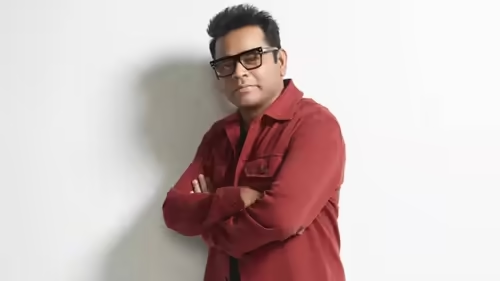
In a world increasingly divided along religious lines, a single sentence from AR Rahman has sparked a wave of hope: “Ramayana is Hindu, I’m Muslim—and that’s beautiful.” The Oscar-winning composer recently opened up about his involvement in Nitesh Tiwari’s highly anticipated cinematic adaptation of the Ramayana, a project that unites him with Hollywood legend Hans Zimmer and stars Ranbir Kapoor and Sai Pallavi. His words aren’t just a soundbite—they’re a profound declaration about the power of art to transcend identity and speak to our shared humanity.
When a Muslim Maestro Meets a Hindu Epic
For many, the idea of a Muslim artist composing music for one of Hinduism’s most sacred epics might raise eyebrows. But for Rahman, it’s not just natural—it’s essential. In a candid interview, he addressed the question head-on: “Ramayana is Hindu. I’m Muslim. Hans Zimmer is Jewish. And together, we’re making something that belongs to the world.”
This isn’t performative inclusivity. Rahman has long drawn from India’s pluralistic spiritual heritage—from Sufi qawwalis to Carnatic ragas—in his work. His approach reflects a deep understanding that India’s cultural fabric is woven from countless threads, none of which cancel out the others.
AR Rahman Ramayana Movie: The Vision Behind the Soundtrack
The AR Rahman Ramayana movie project marks a historic moment in Indian cinema—not just for its scale, but for its philosophical ambition. Director Nitesh Tiwari (Dangal, Chhichhore) aims to present the Ramayana not as a sectarian text, but as a timeless moral compass relevant to all people, regardless of faith .
Rahman’s role is pivotal. His music must evoke the grandeur of Ayodhya, the sorrow of exile, the fury of Lanka, and the ultimate triumph of dharma—all while avoiding cliché. “I don’t see this as a ‘religious’ score,” he explains. “I see it as a human story. Rama’s journey is about integrity, sacrifice, and love. Those values are universal.”
Hans Zimmer and the Global Resonance of Ramayana
The collaboration with Hans Zimmer adds another layer of significance. Zimmer, known for scores like Inception and The Lion King, brings a global sonic palette to the project. Rahman sees this partnership as symbolic: “When a Jewish composer from Germany, a Muslim from Chennai, and a Hindu director from India come together on the Ramayana, it sends a message the world desperately needs.”
This isn’t just about box office appeal—it’s about repositioning an ancient Indian narrative as part of humanity’s shared heritage, much like the Greek epics or Shakespearean tragedies. As noted by UNESCO, oral traditions like the Ramayana are recognized as Intangible Cultural Heritage of Humanity—a testament to their cross-cultural relevance .
Why Rahman Believes Ramayana Is for Everyone
Rahman’s reverence for the epic goes beyond aesthetics. He emphasizes its ethical core: “The Ramayana teaches us how to live—with compassion, with duty, with humility. You don’t have to worship Rama to learn from him.”
He draws a parallel to his own upbringing: “My mother used to tell me stories from the Mahabharata and Ramayana alongside Quranic parables. In our home, wisdom had no religion.” This lived experience informs his artistic philosophy—one that seeks truth wherever it may be found.
The Cast and Creative Team Redefining an Ancient Tale
Starring Ranbir Kapoor as Lord Rama and Sai Pallavi as Sita, the film promises a fresh yet respectful interpretation. Both actors are known for their nuanced performances and deep research into roles. Kapoor, who has previously explored spiritual themes in films like Sanju, calls this “the most important role of my life.” Pallavi, celebrated for her grace and authenticity, says she approached Sita “not as a goddess, but as a woman of extraordinary strength.”
Key creative elements include:
- Director: Nitesh Tiwari – known for blending emotional depth with mass appeal.
- Music: AR Rahman & Hans Zimmer – a fusion of Indian classical and global orchestral traditions.
- Visual Design: Reportedly inspired by Ajanta-Ellora frescoes and Southeast Asian Ramayana traditions.
For more on mythological adaptations in modern cinema, see our analysis on [INTERNAL_LINK:indian-epics-in-contemporary-film].
Beyond Religion: Art as a Bridge of Unity
In today’s polarized climate, Rahman’s stance is both brave and necessary. By refusing to let faith become a barrier to artistic expression, he models a path forward for creators everywhere. His work reminds us that culture isn’t owned—it’s shared, interpreted, and renewed across generations and geographies.
As he puts it: “If we only create within our own boxes, we’ll never grow. The Ramayana isn’t just India’s story. It’s a gift to the world—and I’m honored to help deliver it.”
Conclusion
The AR Rahman Ramayana movie is shaping up to be more than a film—it’s a cultural event with the potential to heal and inspire. Through his music, Rahman isn’t just scoring a myth; he’s composing a manifesto for unity in diversity. In declaring that a Muslim can honor a Hindu epic with sincerity and love, he challenges us all to look beyond labels and embrace the wisdom that binds us together. And in a time of division, that might be the most revolutionary act of all.
Sources
- Times of India. “‘Ramayana is Hindu, I’m…’: AR Rahman on doing music for Ranbir Kapoor, Sai Pallavi starrer.” https://timesofindia.indiatimes.com/…
- UNESCO. “Intangible Cultural Heritage: The Ramayana Tradition.” https://ich.unesco.org/…