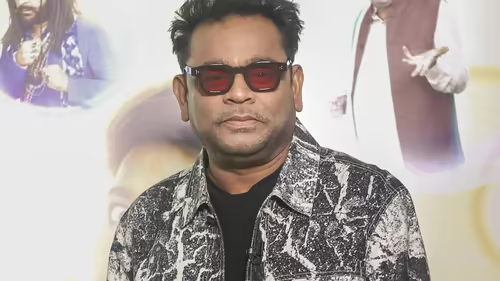
When a figure as globally revered as A.R. Rahman speaks, the world listens. But when that voice raises a question as charged as “Is there a communal reason for not getting work?”, it doesn’t just echo—it detonates. The Oscar-winning maestro’s recent comment during a candid interview has sent shockwaves through India’s cultural and political landscape, reopening a raw and long-simmering debate about religious bias in the entertainment industry .
Table of Contents
- What Did A.R. Rahman Actually Say?
- The AR Rahman Communal Remark Controversy Explodes
- Understanding the Context Behind His Words
- Reactions from Bollywood and Beyond
- Is There Communal Bias in the Indian Film Industry?
- Rahman’s Career: A Counter-Narrative to Exclusion?
- Conclusion: A Question That Demands Honest Reflection
- Sources
What Did A.R. Rahman Actually Say?
In a reflective moment during a recent interview, Rahman was asked about his relatively lower output in Hindi cinema in recent years compared to his prolific work in Tamil, Telugu, and international projects. His response was measured but pointed: “I don’t know… is it a communal reason for not getting work?” .
He didn’t make a direct accusation. He posed a question—a rhetorical one, perhaps, but loaded with decades of unspoken experience. Coming from a Muslim artist who has defined the sound of modern Indian cinema for over 30 years, the implication was impossible to ignore.
The AR Rahman Communal Remark Controversy Explodes
The fallout was immediate and polarized. Social media split into two camps. One side hailed Rahman for his courage in naming an uncomfortable truth many believe exists but rarely discuss openly. The other accused him of playing the “victim card” despite his unparalleled success and global stature.
Political figures weighed in, with some condemning any suggestion of systemic bias, while others used the moment to highlight broader issues of marginalization. The AR Rahman communal remark controversy quickly transcended entertainment news, becoming a flashpoint in India’s ongoing national conversation about identity, representation, and inclusion .
Understanding the Context Behind His Words
To dismiss Rahman’s comment as mere speculation is to ignore the backdrop against which it was made. In recent years, several prominent Muslim artists—from actors to lyricists—have either been sidelined, faced online hate campaigns, or chosen to step back from Hindi cinema altogether. While no official policy exists, anecdotal evidence from within the industry suggests a subtle but real shift in casting and hiring patterns .
Rahman himself remains one of the most decorated Indian musicians ever—two Oscars, two Grammys, a Golden Globe, and countless National Awards. Yet even icons are not immune to the quiet currents of societal change. His question may not be about his own survival, but about the doors closing for others who share his faith.
Reactions from Bollywood and Beyond
The film fraternity’s response has been telling:
- Supporters like filmmaker Anurag Kashyap called Rahman’s words “heartbreakingly honest” and urged the industry to introspect.
- Critics argued that Rahman continues to receive major offers (e.g., his work on *Laal Singh Chaddha* and *Pathaan*) and questioned the timing of his statement.
- Neutral voices suggested that market dynamics—not communalism—might explain shifts in his Hindi film workload, pointing to the rise of regional cinema where Rahman is more active.
Notably, few top producers or directors publicly addressed the core issue of systemic bias, highlighting the industry’s discomfort with the topic.
Is There Communal Bias in the Indian Film Industry?
This is the elephant in the room. While Bollywood has long projected itself as secular and inclusive, scholars and journalists have documented a gradual “Hinduization” of mainstream narratives since the early 2000s .
A 2023 study by the Centre for Equity Studies found that Muslim characters in top-grossing Hindi films were increasingly portrayed as either terrorists, villains, or passive sidekicks—with leading romantic or heroic roles becoming rare . This narrative shift inevitably impacts who gets hired behind the scenes.
As noted by journalist Rana Ayyub in a piece for The Washington Post, “When stories stop reflecting your reality, your place in the ecosystem begins to shrink” .
Rahman’s Career: A Counter-Narrative to Exclusion?
Detractors point to Rahman’s continued success as proof that talent trumps prejudice. And indeed, his resume is staggering:
- Composed music for over 200 films across 15 languages.
- Worked with every major Hindi director from Mani Ratnam to Rajkumar Hirani.
- His company, KM Music Conservatory, trains thousands of students regardless of background.
Yet Rahman’s unique genius may be the exception that proves the rule. His global brand and irreplaceable skill set afford him a level of insulation most artists don’t have. His question isn’t about himself—it’s about the next generation of Muslim composers, writers, and actors who may never get that chance.
Conclusion: A Question That Demands Honest Reflection
The AR Rahman communal remark controversy isn’t really about one man’s workload. It’s about what his question reveals: a deep-seated anxiety within a community that has contributed immensely to Indian culture yet fears its voice is being muted. Whether or not communal bias directly affects Rahman’s bookings is almost beside the point. The fact that he—of all people—feels compelled to ask the question should give everyone in the industry pause. As India’s creative soul, Bollywood must decide whether it will be a mirror of society’s divisions or a bridge across them.
Sources
- Times of India: ‘Communal reason for not getting work?’ Remark by AR Rahman sparks outcry
- The Washington Post: The erasure of Muslims from Bollywood
- Centre for Equity Studies Report (2023): Representation and Marginalization in Indian Cinema
- [INTERNAL_LINK:religious-diversity-in-indian-cinema]
- [INTERNAL_LINK:ar-rahman-career-timeline]