Table of Contents
- The Firestorm: What Sparked the AR Rahman Communal Bias Controversy?
- The Full Story: AR Rahman’s Actual Statement on Communal Bias
- “India is My Inspiration”: Rahman’s Deep Connection to His Homeland
- Beyond the Controversy: AR Rahman’s Current Projects in 2025
- Key Takeaways: Separating Fact from Online Noise
- Sources
The internet can be a fickle place, especially when it comes to celebrities. One moment, you’re an Oscar-winning national treasure; the next, you’re trending for all the wrong reasons. That’s exactly what happened to music maestro AR Rahman recently, following remarks that were widely interpreted as an accusation of communal bias in Bollywood.
But was that his true intent? Or was a nuanced conversation lost in the noise of social media outrage? Let’s dive deep into the heart of this controversy, unpack Rahman’s actual words, and understand why he’s so quick to call India his greatest muse.
The Firestorm: What Sparked the AR Rahman Communal Bias Controversy?
The controversy began after comments made by AR Rahman during a recent interview surfaced online . In the clip, he appeared to suggest there was a form of prejudice or a “power shift” within the Hindi film industry landscape . These snippets, taken out of their full context, ignited a firestorm on social media, with many accusing the composer of making divisive statements against the very industry that helped make him a global icon.
The backlash was swift and intense. Critics argued that such remarks from a figure of his stature could fuel unnecessary division. This online maelstrom created a significant amount of pressure, prompting Rahman to issue a formal clarification to set the record straight.
The Full Story: AR Rahman’s Actual Statement on Communal Bias
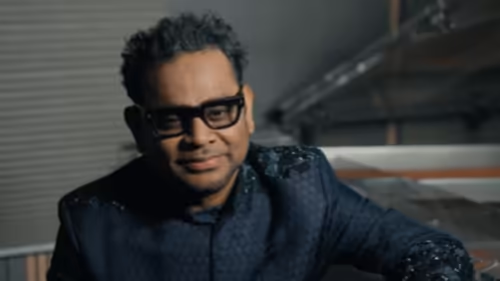
In response to the growing criticism, AR Rahman released a heartfelt video statement to clarify his position. He was unequivocal in his message: he never intended to hurt anyone.
“I understand that intentions can sometimes be misunderstood,” Rahman stated, acknowledging how his words might have been received . He went on to emphasize his core message: “I never wished to cause pain… I hope my sincerity is felt” .
His primary goal, he explained, wasn’t to point fingers but to express a complex reality he has observed over his decades-long career. However, the edited nature of the initial viral clips stripped away this crucial nuance, leaving only a provocative soundbite that fueled the controversy.
“India is My Inspiration”: Rahman’s Deep Connection to His Homeland
Perhaps the most powerful part of Rahman’s response was his reaffirmation of his profound love for his country. In his statement, he declared, “India is my inspiration, my teacher, and my home” . This wasn’t just a PR line; it’s a sentiment that has echoed through his work since his debut with Roja.
Rahman’s music is a beautiful tapestry woven from India’s diverse cultural, linguistic, and spiritual threads. From Sufi qawwalis to Carnatic ragas, his compositions celebrate the nation’s pluralism. His insistence on calling India his “teacher” speaks volumes about his humility and his belief that his art is a direct product of the country’s rich heritage. This deep-seated connection makes the accusation of him wanting to harm the nation’s social fabric seem particularly misplaced.
Beyond the Controversy: AR Rahman’s Current Projects in 2025
While the online world was focused on the controversy, AR Rahman has been hard at work on a slate of exciting new ventures that showcase his boundless creativity. Far from being embroiled in negativity, his professional life is thriving:
- The Wonderment Tour 2025: He is currently headlining a massive international tour across the US, Canada, and other global cities, featuring state-of-the-art visuals and a star-studded lineup of vocalists [[17], [22]].
- Upcoming Film Scores: His musical genius will soon be heard in major releases like Tere Ishk Mein (Nov 2025), Ufff Yeh Siyapaa (Sep 2025), and the highly anticipated Thug Life (Jun 2025) .
- Innovative Ventures: Rahman is also pioneering new entertainment formats, such as his project “Secret Mountain,” which blends AI-powered avatars with immersive storytelling and genre-bending music .
These projects are a testament to his forward-looking vision and his status as a global artist who continues to push boundaries. For more on his legendary career, check out our deep dive on [INTERNAL_LINK:ar-rahman-oscar-winning-journey].
Key Takeaways: Separating Fact from Online Noise
So, what’s the real story behind the AR Rahman communal bias controversy? Here’s a quick summary:
- Misinterpretation, Not Malice: Rahman’s core message was one of observation, not accusation. His intent was misunderstood due to decontextualized clips.
- A Heartfelt Apology: He was quick to clarify that he never meant to cause pain to anyone and hopes his sincerity is recognized [[1], [6]].
- Unwavering Patriotism: His declaration that “India is my inspiration” is central to his identity as an artist and a person [[10], [11]].
- Focus on Art: Despite the online noise, Rahman remains deeply committed to his craft, with a busy schedule of innovative and high-profile projects in 2025.
In an era where online discourse often favors outrage over understanding, Rahman’s request for his sincerity to be felt is a poignant reminder to look beyond the headline. His legacy is built on uniting people through music, not dividing them—a fact his vast body of work stands as a powerful testament to. For more on the state of the Indian film industry, you can refer to this comprehensive analysis from BBC Culture.
Sources
- Times of India: AR Rahman responds to criticisms, calls India his inspiration, ‘Never meant to hurt anyone’
- Web Search Results on AR Rahman’s statement [[1], [4], [6], [7], [10], [11], [12], [13]]
- Web Search Results on AR Rahman’s 2025 projects [[15], [16], [17], [19], [22]]