Table of Contents
- The Controversy That Sparked a Firestorm
- How AR Rahman’s Children Leapt to His Defense
- Rahman’s Own Clarification: Intent vs. Interpretation
- The Bigger Picture: A Communal Shift in Bollywood?
- Conclusion: A Family United Against Misrepresentation
- Sources
The Controversy That Sparked a Firestorm
Oscar-winning composer AR Rahman recently found himself at the center of a massive online controversy. In a candid interview, he suggested that a significant “power shift” in Bollywood since 2018 might have a “communal thing” at its core, which he believes has led to a noticeable reduction in his work within the Hindi film industry .
He further ignited the debate by labeling Vicky Kaushal’s historical drama ‘Chhaava‘—a film for which he composed the music—as “divisive.” Rahman expressed discomfort with the film’s narrative choices, specifically citing the “use of words like Subhanallah in negative scenes was cringe” . While he maintained that scoring the film was an “honour,” his frank assessment of its content quickly went viral and drew sharp criticism from various quarters .
How AR Rahman children Leapt to His Defense
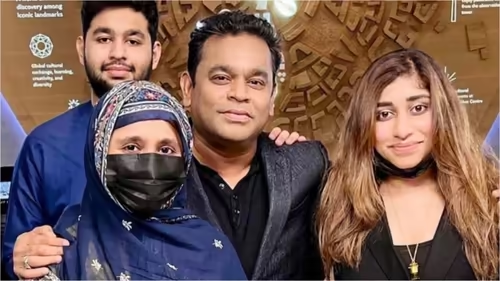
In the face of mounting online abuse and misrepresentation, Rahman’s family didn’t stay silent. His children—son Ameen and daughters Khatija and Raheema—rallied together to defend their father’s integrity and immense contribution to global music.
They took to social media to express their support. Ameen shared a series of videos and photographs highlighting his father’s journey and achievements . Meanwhile, both Khatija and Raheema shared a supportive note penned by fellow composer Kailas Menon on their Instagram Stories, standing firmly by their father .
Their core message was one of frustration with the online mob. They pointed out the hypocrisy of critics who attack their father without understanding his work or his deeply held values of unity and peace. Their defense wasn’t just emotional; it was a call for a more informed and respectful discourse .
Key Points from the Family’s Defense
- Legacy Over Noise: They emphasized Rahman’s four-decade career built on creating music that transcends religion and borders, calling him “more Indian than any other identity” .
- Rejecting Hypocrisy: The children highlighted the irony of people who don’t engage with religious texts like the Bhagwad Gita or Quran but are quick to argue, mock, and abuse online.
- Protecting Their Father: Their primary goal was to shield their father from what they perceived as a coordinated campaign of misinformation and personal attacks.
Rahman’s Own Clarification: Intent vs. Interpretation
Seeing the situation spiral, AR Rahman himself issued a clarification. He stated unequivocally, “I never wished to cause pain” and expressed his deep love for his country, calling it his “home, inspiration and teacher” [[2], [19]].
He explained that his comments on the ‘power shift’ were an observation about his own professional experience, not an accusation against the entire industry. He lamented that “people who are not creative have the power to decide” on projects, which he feels has impacted the quality and diversity of music in films .
Rahman concluded his statement by reaffirming his commitment to his art and his nation: “I remain grateful to this nation and committed to music that honours the past” .
The Bigger Picture: A Communal Shift in Bollywood?
Rahman’s initial remarks have opened a much larger can of worms, sparking a crucial debate within the Indian film and music fraternity. His suggestion of a “communal shift” has resonated with some veteran artists who feel sidelined by new power structures focused more on corporate interests and political alignment than on pure creativity .
This controversy touches on sensitive issues of representation, artistic freedom, and the evolving socio-political landscape of India. While some see Rahman’s comments as a brave truth-telling, others view them as an oversimplification of a complex industry dynamic. Regardless, the conversation he has started is now impossible to ignore. For more on the changing dynamics of the Indian music scene, see our analysis on [INTERNAL_LINK:bollywood-music-evolution].
Conclusion: A Family United Against Misrepresentation
The backlash against AR Rahman’s comments may have been swift and harsh, but it also revealed the strength of his family bond. The public defense mounted by his AR Rahman children was a powerful reminder that behind every public figure is a private individual with a family who cares deeply for them. Their intervention shifted the narrative from a simple controversy to a story about protecting a legacy built on universal harmony through music. As the dust settles, Rahman’s own clarifications and his children’s unwavering support stand as a testament to their shared values and resilience in the face of online vitriol.